
Apple Patents Technology That Uses Your Eye Size to Control Devices
Your pupils widen slightly when something grabs your attention, and Apple wants to turn that tiny, involuntary reaction into a device command. A newly published patent describes a system that watches your pupil size in real time and uses it to figure out what you want, before you even tap a button.
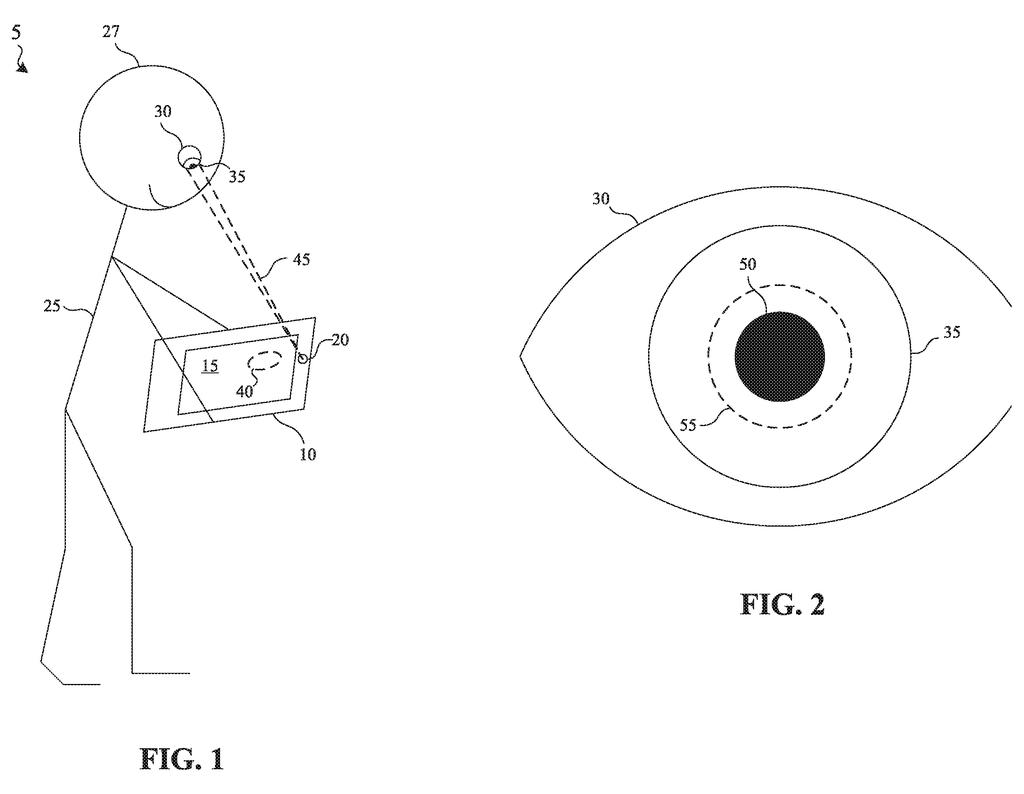
How Apple wants your eyes to replace your fingertips
Ever noticed how your eyes naturally lock onto something the moment it interests you? Apple has, and a new patent filing suggests the company wants to put that reflex to work.
The idea: while you are watching content on a screen, a sensor tracks both where you are looking and how much your pupil expands or contracts. When the system spots a particular pattern in your pupil size, timed to the moment your gaze lands on a specific item, it reads that as a signal that you are genuinely interested in or intending to interact with that thing. The device then responds automatically, no tap or voice command needed.
The tricky part is that pupils also react to light. A bright scene on screen can make your pupils shrink for reasons that have nothing to do with interest. Apple's approach accounts for this by checking whether the pupil change lines up with a shift in ambient light before deciding it means anything. The goal is to catch real intent, not just your eyes adjusting to a flashy video.
obtaining pupil dilation data and gaze direction data of a user while content is displayed on the display, the pupil dilation data and gaze direction data obtained using the one or more sensors and varying over time during the display of the content …
Translation: The device tracks your eye movements and changes in pupil size while you look at the screen.
How the system separates intent from ambient light changes
The patent describes a method running on a device equipped with a display, a processor, and one or more sensors capable of tracking gaze and pupil size simultaneously.
At its core, the system does two things in parallel:
- Gaze tracking confirms which item on screen the user is looking at.
- Pupil dilation tracking watches for a "peak pattern" (a measurable rise or dip in pupil diameter) that correlates with the moment the user fixates on that item.
The key engineering problem the claim addresses is exogenous noise (pupil changes caused by outside factors, mainly light). The patent calls this an "exogenous signal" and requires the system to check how much ambient light variability was happening during the peak pattern. If the pupil change can be explained by the screen getting brighter or darker, the system discards it. Only pupil changes that survive this filter are treated as intentional signals.
Once a genuine interaction is identified, the device "initiates a response," which the patent leaves deliberately open: it could mean opening a link, expanding a menu, adding an item to a cart, or any other action the application developer maps to that event. The hardware context is not specified in the claim, meaning it could apply to a headset, a phone, a tablet, or future form factors.
… physiological data (e.g., pupil diameter) of a user during a user experience in which content is displayed on a display. The physiological data varies over time during the user experience and a pattern is detected.
Translation: Sensors monitor how your eyes react over time to figure out what you are looking at.
What pupil-based control means for Vision Pro and beyond
For a device like Apple Vision Pro, where touching a physical screen is not always an option, finding natural and low-effort input methods is a real design challenge. A system that can detect your interest from your eyes alone, without requiring a hand gesture or voice command, could make mixed-reality interfaces feel much more fluid. You look at a product in an ad, your pupils respond, and the device offers to buy it or learn more, all without you doing anything deliberate.
The broader implication is for any eyes-on interface. Apple's track record in eye-tracking patents suggests this is part of a longer effort to move beyond touch. If this approach reaches shipping hardware, it would also raise real questions about how much a device should act on signals the user did not consciously send.
Apple's 37th filing we've tracked on our eye and hand controls watch since May adds to a set of ideas that includes tilt and hand position controls and finger controls on VR glass.
Claim 1 is doing a lot of work, and its scope is genuinely wide. It covers any device, any content, and any response, so long as the pupil-peak detection is filtered against ambient light variability. That filter is the only real technical specificity in the claim, which means Apple is staking out broad territory: essentially, "using pupil dilation as an input signal, with a light-correction step."
That breadth cuts both ways. A granted claim this wide could create headaches for any competitor building gaze-plus-physiological-signal interfaces, from VR headsets to driver-monitoring systems in cars. But broad independent claims are also the ones patent offices push back on hardest, and Apple will likely need to narrow this during examination to distinguish prior art in eye-tracking and psychophysiology research.
The underlying idea is genuinely interesting from a user-experience standpoint. Detecting intent before a user acts is the kind of problem interface designers care about. Whether a pupil-dilation signal is reliable enough in practice, across different users, lighting conditions, and emotional states, is a harder question that the patent does not answer.
There are more where this came from
We read every patent application Big Tech publishes and send you the ones worth knowing. Plain English, free, every week.
The drawings
5 drawing sheets from US 2026/0299689 A1 · click any drawing to enlarge


Want this weekly breakdown for a company we don't cover? Patentlyze Pro →
Be the first to weigh in