
Apple Patents Eye-Tracking That Scrolls Text When You Finish Reading
Apple has filed a patent for a display system that watches where your eyes are moving and automatically scrolls to the next section of text the moment it detects you've finished reading the current one.
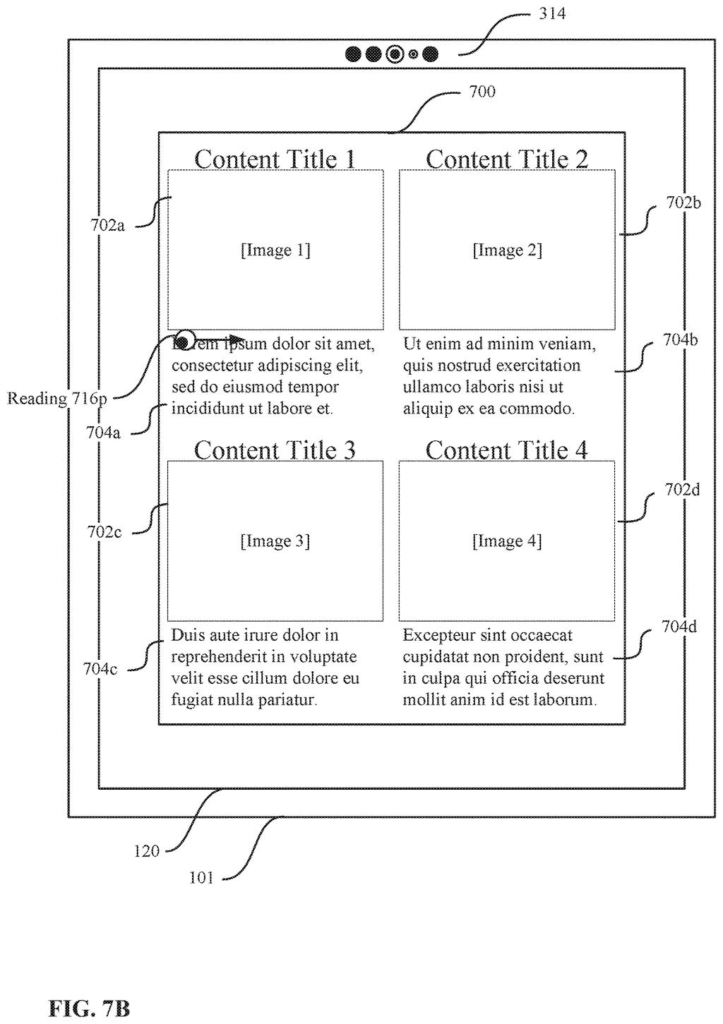
What Apple's gaze-based auto-scroll actually does
A reader sits down with a long article on a headset. They work through one paragraph, and without touching anything, the next paragraph slides into view right where their eyes land next. That hands-free experience is exactly what this Apple patent describes.
The system uses eye-tracking hardware to follow how your gaze moves across lines of text. When your eyes reach the end of a paragraph and flick back toward the start of the next section, the device interprets that motion as a sign you've finished reading. It then scrolls the screen so the next paragraph appears right where you're already looking.
Critically, if you're still reading and your eyes are scanning mid-paragraph, the text stays put. The device only acts when it's confident you've moved on. The patent also covers related features: expanding items you stare at, showing extra information when you tilt your head, and switching between screens based on where you're looking.
in accordance with a determination that the motion of the gaze of the user indicates that the user has finished reading the first portion of text: scrolling the text so that the second portion of text moves in a first direction …
Translation: The screen scrolls down automatically once your eyes reach the end of the current paragraph.
How the device reads your reading pattern
The core method in this patent involves a device with a display and a gaze-tracking sensor working together to decide when to scroll, and when to leave the screen alone.
Here's the sequence the patent describes:
- The device shows a first chunk of text at one position on screen and a second chunk below it.
- It continuously monitors how the user's gaze moves (tracking the characteristic left-to-right, line-by-line sweep of reading).
- When the gaze pattern signals the user has finished the first chunk, the screen scrolls so the second chunk appears exactly where the user's eyes are already heading as they move toward the start of a new paragraph.
- If gaze patterns suggest reading is still in progress, nothing moves.
The patent also describes three additional capabilities. First, an item on screen can expand automatically when you stare at it long enough. Second, the device can detect head movement combined with gaze direction to navigate between different screens entirely. Third, pointing your head and gaze at a piece of content can trigger a panel of augmented information (think annotations or related facts) layered over what you're looking at.
All of these behaviors are gated on combinations of eye motion and head motion, meaning the system tries to distinguish deliberate reading or viewing from casual glancing.
… an electronic device scrolls text of a content item in accordance with a determination that the user is reading the content item.
Translation: Your device tracks your eye movements to figure out when you are actively reading.
What this means for Vision Pro and future Apple displays
For a device like Apple Vision Pro, where your hands are free and interaction happens through eyes and gestures, auto-scrolling based on reading pace could make consuming long-form text far more natural. Right now, reading in a headset still requires a deliberate scroll action. If this system works as described, you'd never need to pause your reading to move the page.
The broader set of features, including gaze-driven navigation and head-tilt overlays, points toward a more expressive eye-control vocabulary for spatial computers. If Apple can make gaze feel as reliable as a tap, a growing pile of Apple spatial-computing filings starts to look less like speculation and more like a connected design system taking shape.
Apple's 33rd filing we've tracked since May in our eye and hand controls watch adds to a picture that includes logging in by gaze and pausing an AI mid-conversation.
Claim 1 covers something quite specific: the device watches for the back-and-forth eye movement pattern of active reading, waits for the gaze to reverse toward the beginning of the next block of text, and only then scrolls the page to meet the eye. That chain of three conditions working together is what the claim actually protects, not eye-tracking in general and not auto-scrolling in general.
In practice, that narrowness has real consequences. A rival could build a reading-aware scroll feature that waits for a long pause instead of a direction reversal and stay outside this claim entirely. The claim would block that exact trigger sequence, but it leaves the broader territory open.
For Vision Pro, owning this particular mechanism still matters. A headset without a keyboard or trackpad lives or dies on whether reading feels natural, and a patented method that gets the scroll timing right gives Apple something concrete to build around.
There are more where this came from
We read every patent application Big Tech publishes and send you the ones worth knowing. Plain English, free, every week.
The drawings
53 drawing sheets from US 2026/0288293 A1 · click any drawing to enlarge


Want this weekly breakdown for a company we don't cover? Patentlyze Pro →
Be the first to weigh in