
A weekly read of what the world’s biggest technology companies just told the U.S. patent office.
A full week by the numbers: we wrote up 339 filings, with Microsoft out front at 57, then Google at 45, Sony at 40, Samsung at 35, and Qualcomm at 29. OpenAI published exactly one. The full run lives under this week’s Big Tech patents; these thirteen stood out.
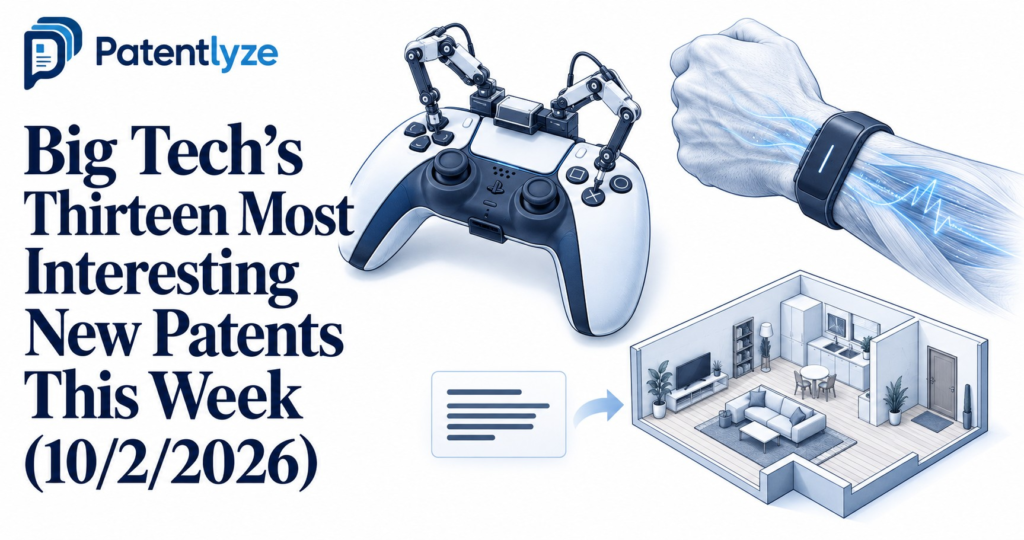
1. Sony Patents a Motorized Clip-On That Physically Presses Your Controller Buttons
Every accessibility controller on the market asks you to buy a new controller. Sony has filed for a clip-on with motorized arms that presses the buttons on the controller you already own.
Claim 1 is an attachment device: a clamp that fastens to a controller, an arm that rests on a button or trigger, a drive unit that moves the arm, and a control unit that tells the drive when to fire. Nothing in the controller changes, and no console software has to know.
The arm presses with physical force, the way a thumb would, so the claim covers any controller with a physical input. What sends the command is left open, which means software, a second input device, or a recorded sequence could all drive it.
The obvious use is accessibility: players with limited grip or reach get help without a special controller. The other use is automation, since a device that presses buttons on a schedule can grind, farm, or replay a timed sequence with no software exploit for a game to detect.
Three inventors, Yumi Ueda, Naoki Kudo and Airi Takeuchi. Filed in October 2025 as the U.S. entry of a Japanese international application from April 2023, eighteen claims. The open question is speed: a mechanical press will always lag a direct signal, which matters in anything fast.
2. Google Patents a Browser That Remembers Every Page You Visit and Lets You Search Them with Plain English
Your browser history is a list of titles and timestamps that cannot tell you what you read. Google has filed for a browser that stores the meaning of every page in a vector database and answers questions about your own browsing.
Claim 1 is a method on the user’s device. The browser takes an input, pulls session data from a vector database that represents browsing history and the current state of the tabs, builds a prompt for a machine-learned sequence model, and parses the reply to show an answer or change the browser itself.
The vector part is the point. Each page is stored as a numerical fingerprint of its meaning, so a question like “what did I read about interest rates on Tuesday” matches the right page even when none of those words appear on it. The reply can also reopen a tab or fill a form.
If this ships in Chrome, history stops being a log and becomes something you talk to. The filing does not say whether the database lives on your machine or on a server, and that one decision will decide whether most people turn it on.
Two inventors, Zebedee Pedersen and Yasmine Rubinovitz. Filed in June 2026 as a continuation of a December 2024 application, twenty claims.
3. Tesla Patents a Way to Open Car Doors the Moment You Lean In
Keyless entry already knows your phone is near the car. Tesla has filed for a system that reads where your phone is to the centimeter, decides you are leaning in, and opens the door before you touch it.
Claim 1 is a vehicle system. It locates the phone with ultra-wideband radio, runs a neural network trained on movement data and on readings from a sensor under a seat to predict whether the user is leaning into the vehicle, and on a yes it acts on a door, trunk or frunk.
Ultra-wideband is the same positioning radio Apple uses for AirTag, so the car knows which door you are at and how you are moving, not just that you are close. The under-seat sensor in the training data is there to tell leaning in from standing beside the car.
For a driver with full hands this is the whole pitch: no handle, no phone, no button. The failure mode is the reason for the neural network. A door that opens for a neighbor walking past is worse than a door that waits.
Four inventors, Brahmesh Saligrama Dharanendra Jain, Bernard Bekker, Austin Shaski and Gary Chen. Filed in March 2026 as a continuation of a July 2024 application, twenty claims. Tesla’s thirty-eighth filing in our coverage since May.
4. Sony Patents a System That Reads Your Voice to Find Better Multiplayer Matches
Bad lobbies are usually a mismatch in how people talk, not how they play. Sony has filed for a PlayStation system that listens to your voice chat, profiles your social style, and uses it to pick teammates and police the ones who shout.
The first live claim is a method that keeps a profile for every player of a multiplayer game, captures a player’s speech during play, runs it through a voice analysis model that is a trained machine learning model, and updates the profile with what it finds.
The description is more specific than the claim. Intensity is scored from word choice and volume. The profile tracks chattiness, friendliness, patience and irritability. Matching can pair quiet players together, honor an age setting, and the console can mute a player, cap outbursts at a set volume, or replace words before they reach you.
Sony says why in plain terms: some players are stressed by yelling, some swear constantly and should not be matched with younger players, and sometimes there is a baby in the room. The bleeping and volume control is the half players would notice first.
Five inventors, Sergey Bashkirov, Celeste Bean, Sudha Krishnamurthy, Masanori Omote and Sagar Sudhakara. Filed in March 2026 as a continuation of a June 2023 application. The original twenty claims were canceled and twenty new ones filed.
5. Verily Life Sciences Patents a Cancer-Detection Method That Reads Your Breath
Cancer screening today means a biopsy, a scan, or both. Verily, Google’s life sciences company, has filed for a tracer molecule that sticks to tumor cells and releases a synthetic gas you exhale, so a breath test says whether it found anything.
Claim 1 is a method. A tissue is exposed to a two-part compound: one half binds to tumor cells, the other half is a volatile organic compound that does not occur in nature. The amount of that compound in exhaled breath indicates how many tumor cells are at the tissue.
The synthetic gas is the trick. Breath already carries hundreds of natural compounds, so a man-made one has no background noise, and any trace of it means the tracer found a target. The claim covers quantity too, so more gas means more tumor.
A breath test is cheaper than a PET scan and gentler than a biopsy, which is why this reads like front-page science. It is also years from a clinic: the compound needs toxicology work, trials and approval, and the claim is broad enough that examiners will push back.
Four inventors, Benjamin Krasnow, Kristopher Lavery, Sarah Sanowar and Eric Paoli. Filed in November 2025 as the U.S. entry of an international application from May 2024, twenty-four claims.
6. Meta Patents a System That Coaches You to Flex the Right Muscle for Its Wrist Controls
A muscle-reading wristband only works if you fire the muscle it is listening for. Meta has filed for a setup routine that tells you which movement to make, watches the electrical signal, and locks the gesture in once your body gets it right.
The live claim is a method for a wearable. The device shows instructions for a movement tied to a specific motor unit, reads the biopotential sensors while you do it, and when the signal clears a threshold it maps that signal to a gesture.
Then comes the part that matters for daily use. When the band is moved to a different spot on the arm, the system reads the movement again, ties the new signal to the same gesture, and keeps recognizing it. The calibration survives taking the band off.
This is the lineage of CTRL-labs, the neural wristband startup Meta bought in 2019. The hardest part of that product has always been the first five minutes with a new user, and this is the filing about those five minutes.
Four inventors, Diego Adrian Gutnisky, Najja Marshall, Emanuele Formento and Mario Bräcklein. Filed in March 2026 as a continuation of an October 2024 application. The original claim 1 was canceled, leaving twenty live claims.
7. Sony Patents a System That Reads Your Emotions to Change What’s Playing
A TV knows what you clicked. It does not know you stopped caring ten minutes ago. Sony has filed for a camera that catches the smallest flickers in your face, reads your emotional state, and changes the service you are using.
Claim 1 is a method: capture optical event data of a person with an event-based sensor, look for predefined emotional patterns in it, determine the person’s emotional state, and adjust the service based on that state. No specific emotion, sensor model or service is named.
An event-based sensor does not take frames. Each pixel reports only when its brightness changes, so the camera sees fast, tiny facial movements a normal camera averages away, at very low power. That is what makes micro-expressions readable in a living room.
The filing names TVs, music, lighting, cars and robots as the services that could respond. For Bravia and PlayStation owners, the pitch is a device that notices boredom before you reach for the remote. The question is whether anyone wants to be watched that closely.
Three inventors, Shan Lin, Piergiorgio Sartor and Diederik Paul Moeys. Filed in September 2025 as the U.S. entry of a European international application from March 2024, eighteen claims. The examiner sent a first rejection in August, so the claim will be narrowed.
8. Google Patents a Video Camera System That Lets You Switch Off Face Recognition Entirely
Most camera privacy settings hide the result and keep doing the work. Google has filed for a camera setting that stops the recognition step itself and erases what the camera already gathered about a person.
Claim 1 is a method. The camera streams video, the app offers a setting that controls a recognition feature, the user turns it off, the camera still detects that a person is present, and it then forgoes deciding whether that person is someone known.
The description adds the cleanup: data collected during earlier recognition attempts is deleted, including a label that marked someone as an unfamiliar stranger. Off means the file on that visitor goes away, which is a stronger promise than most settings make.
For a Nest doorbell this is the difference between a toggle you trust and one you suspect. Biometric privacy laws in Illinois, Texas and the EU reward exactly this design: a control on the device that provably stops the processing.
Eleven inventors, including Akshay Bapat, George Heitz III and Navneet Dalal. Filed in June 2026 as a continuation of a September 2023 application, twenty claims. It covers the setting and the cleanup, not a new way to recognize faces.
9. Microsoft Patents a Way for Doctors to Highlight Your Body During 3D Video Calls
“Somewhere around here” is where a video appointment falls apart. Microsoft has filed for a 3D call that hears the doctor name a body part and lights that exact region up on a live scan of the patient.
Claim 1 is a mesh-matching method. A 3D scan of the patient becomes a posed, standardized body model. The system maps each point on the standard model to the matching point on the real scan, receives a region name, finds that region on the model, and highlights the corresponding points on the scan.
The mapping step is the invention. “Left shoulder” has a fixed meaning on a template body, and the lookup carries it onto a scan of your shoulder, with your proportions and posture, in real time. Both sides of the call see the same highlighted patch.
The limit is hardware. The claim starts from a 3D mesh, which means depth cameras, so this lands in telehealth clinics and physical therapy before it reaches a laptop webcam. For patients in those settings, it removes a daily source of confusion.
Four inventors, Andréa Britto Mattos Lima, Spencer Fowers, Thiago Vallin Spina and Deepti Balachandra Hegde. Filed in March 2025 with no parent application, twenty claims. One of two Microsoft 3D-call filings this week.
10. Sony Patents a Device That Calms You Down Before Making You Feel Connected to Someone
Most wellness gadgets pick one job: relax you, or remind you of someone. Sony has filed for a device that settles you into a mindful state first, then plays a cue built from a specific person you miss, in that order.
Claim 1 is a device with two control sections. The first runs a mindfulness mode and delivers a stimulus that brings the user into a mindful state. The second runs a connection mode and delivers a stimulus built from information acquired from a recalled person. The first must start before the second.
The sequence is the patent. Sony argues a cue from a loved one lands harder on a calm, present mind than on a distracted one. What the cue is stays open: sound, light, touch or scent, and the drawing shows a handheld unit with an odor cartridge.
Loneliness is a real market, especially for older adults and long-distance families, and this is an unusually soft idea for a company known for cameras and consoles. Whether a device can deliver that feeling is the question the document leaves open.
Two inventors, Shinichi Teraguchi and Karen Murata. Filed in October 2025 as the U.S. entry of a Japanese international application from April 2024, twelve claims. The examiner issued a first rejection in August.
11. Adobe Patents a Way to Turn a Text Description Into a Walkable 3D World
Building a 3D environment takes a team and days. Adobe has filed for a pipeline that reads a sentence, renders a full 360-degree view of the place, and expands it into a scene you can walk through.
Claim 1 is a method. A text query names what the scene should contain. Machine learning models generate a spherical representation of that scene, a complete picture in every direction from one point, and then process that sphere into a traversable three-dimensional environment.
The sphere is the blueprint. Making one consistent 360-degree image first, then building geometry from it, is how the system keeps the walls and floors agreeing with each other as you move, the failure that makes most text-to-3D output look melted.
For game studios, filmmakers and anyone blocking out a VR space, this collapses concepting from days to minutes. Adobe already ships generative images and video in Firefly, so the distribution exists. The output quality is the part the filing cannot show.
Five inventors, Yiwei Hu, Zhaoyang Zhang, Yannick Hold-Geoffroy, Miloš Hašan and Fujun Luan. Filed in March 2025 with no parent, twenty claims. The examiner’s first rejection arrived the day before publication, so the claims are already being argued.
12. Google Patents a Way to Train Search AI on Full User Sessions, Not Just Clicks
A click tells a model what you chose. A session tells it what you were trying to do. Google has filed for a method that packages whole search sessions, query by query, result by result, action by action, into training sequences for a neural network.
Claim 1 is a method. Session data for many users becomes one training sequence per session, built from blocks in time order. Each block holds the query, the results returned, and what the user did next. A neural network is then trained on those sequences with a pre-training objective.
That is the recipe used to train large language models, applied to search behavior. The model learns that a click means something different after a refined query than after a first one, and that abandoning a result is a signal too.
For anyone who works in search, this is a strategy reveal: Google is building training data from a behavioral record no outside lab can reproduce. For users, the promise is results that anticipate the follow-up question. Whether it reaches the results page is not stated.
Nine inventors, led by Inderjit Singh Dhillon. Filed in December 2025 as the U.S. entry of an international application from October 2024, twenty-five claims.
13. Meta Patents a Headset System That Mutes Audio When Others Are Listening
A private voice message in a crowded train car is private only until the sound leaks. Meta has filed for a system that notices when more than one person is receiving an audio stream and mutes the part that was meant for one.
This is a two-claim filing. Claim 2 is the muting method: detect that several users are listening to an audio stream across several audio sources, mute at least a portion of it on that basis, and transmit the stream with the muted portion in place. The second listener hears a gap.
Claim 1 is unrelated: an array of sensors fires a sound pulse, records it, reverses it in time, re-emits it, and combines the echo with the reversed pulse to get a cleaner reading. It is a sensing technique that could sharpen how a headset maps the room.
Meta files like this often: a fifty-one-page document that bundles two ideas from the same lab under two short claims. The muting half could be a software update to Ray-Ban glasses. The ultrasonic half needs hardware that does not exist in Meta’s lineup today.
Four inventors, Gengxi Lu, Francesco Marsili, Danielle Gelb and Ryan Alexander Chavez. Filed in March 2026, claiming priority to a provisional from April 2025. Two claims in fifty-one pages.
What ties them together
Five of the thirteen read your body and act on what they find. Sony listens to your voice and watches your face. Meta reads the electricity in your forearm. Tesla reads how you move toward the car. Verily reads your breath. None of them waits for a button.
The device decides what you meant, and the decision is the product.
The other column hands control back. Google’s camera stops recognizing faces when told, and erases what it kept. Meta’s headset mutes what was meant for one person. Sony’s calm device will not play the cue until you are ready to hear it. The order of operations is written into the claims.
Two filings do the work for you instead of reading you. Adobe turns a sentence into a room. Google turns a search session into training data, which is the same idea pointed at itself. And one filing, Sony’s clip-on, is a robot with no opinion at all: it presses the button you tell it to.
The tension is the same as last week’s. Every reading in the first column costs attention: a microphone in the lobby, a camera on the couch, a sensor under the seat. The second column is where the companies start to admit it. Expect more of those filings, because the first column is not slowing down.
Patentlyze reads every new patent application that Apple, Google, Microsoft, Meta, Nvidia, Samsung, OpenAI, Qualcomm, Sony, Intel, AMD, IBM, Adobe, Salesforce, Tesla, Amazon, and Disney file at the USPTO, and writes a plain-English breakdown of the ones that say something about where products are heading. New filings drop every Thursday. The full archive lives in our patent library.
Get lists like this in your inbox
We read every patent application Big Tech publishes and send you the ones worth knowing. Plain English, free, every week.