
New Apple Patent Lets Viewers Turn Down Sports Commentators While Keeping the Crowd
Apple's patent describes a rulebook that rides along with a movie or game broadcast and tells your player which sounds you may turn down, swap or move, and which stay locked.
What Apple's listener-adjustable audio does
Every time you stream a game and wish the announcers would pipe down, you're stuck with the mix someone else chose. This Apple patent describes a way to hand you some of that control, while still letting the people who made the content decide how much.
The idea: the producer ships the sound as separate pieces (commentary, crowd noise, music, dialogue) along with a rulebook. The rulebook says which pieces you may change and which are locked. It can also include presets, one-tap setups such as a chosen language or quieter commentary, which you can then fine-tune.
The same system covers a movie with English and French dialogue, or a virtual tour where the soundtrack shifts as you walk from room to room.
… the scene description defines which of the scene components are modifiable by a user and which of the scene components cannot be modified …
Translation: The producer decides which specific sounds viewers are allowed to change.
How a producer's rulebook sorts every sound
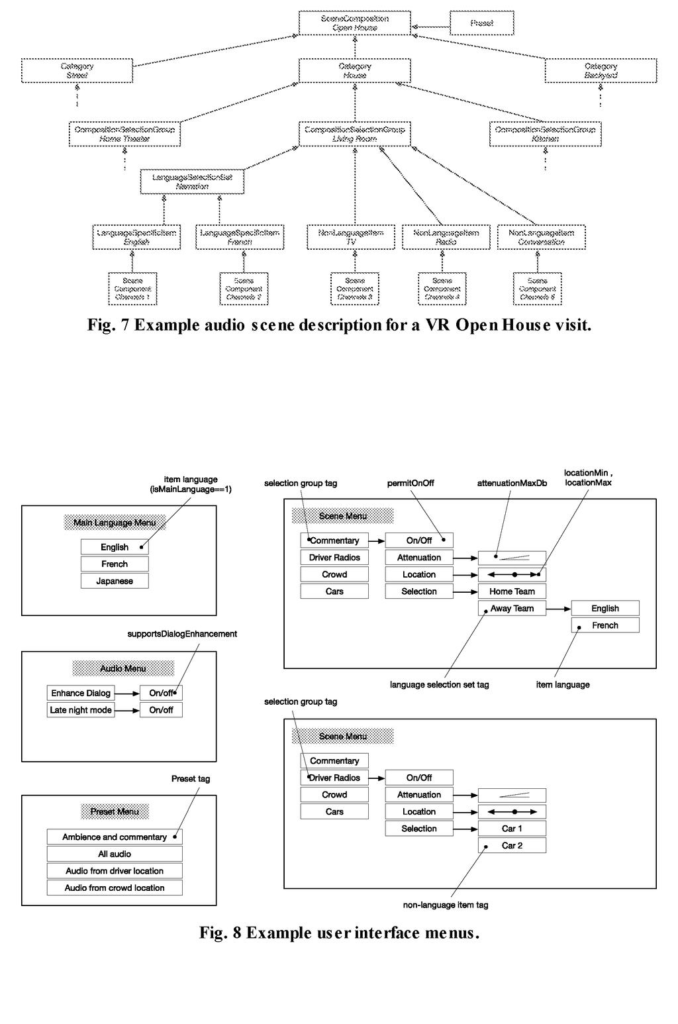
The filing describes extra data, called a scene description, that travels with audio content. The audio arrives as scene components: individual pieces such as a multi-channel recording, a single sound source (an audio object), or Ambisonics (a recording of a full 360-degree sound field). The scene description states which components a user can modify and which cannot be changed.
The description is organized as a hierarchy:
- Items: components are grouped as language-specific (an English narrator) or non-language (crowd noise).
- Language selection sets: different languages of the same content, with one active at a time.
- Composition selection groups: choices where only one member can play, such as Home Team or Away Team commentary.
- Scene composition: everything needed to play one complete presentation as the producer intended.
The description can also hold presets. Each preset picks between alternative versions of a sound and sets its volume reduction (attenuation) or position. A controller pulls out the parts meant for the menu and passes them to the player app. When you pick a preset, the controller modifies the components and feeds them to a spatial audio renderer, the software that turns them into signals for speakers or headphones.
Menu labels are sent as index numbers that point into a shared string table, so the text itself doesn't use bandwidth. Different tables can supply different languages. The filing also describes switching audio with video feeds and with your location in a VR space.
… a scene composition is defined that contains all scene components needed to render the digital audio content in a single presentation …
Translation: It bundles every audio element together to play the broadcast the way it was originally made.
What this means for streams, films and VR tours
If this ever reaches a product, the practical change is a simple set of audio switches on things you already watch. A football broadcast could offer your team's commentary, a quieter announcer, or just the stadium. A film could let you swap dialogue languages without losing the music and effects.
It also shows how Apple describes the job of a media player: the content's creator writes the rules, and your device shows you only the controls the creator allows. For headphone and VR listeners, the filing describes sound that changes with where you are in a virtual tour, such as a narrator and music that carry across rooms while room sounds fade in and out.
Apple's 517th filing in our Apple coverage since May adds to its work on how movie and game sound is packaged, following applications on storing sound objects and their positions separately and delivering immersive surround sound more efficiently.
The price of this design is that the producer keeps the final say. You can silence the commentators only if the people who made the broadcast decided you may, and they can cap how far you turn anything down. If you hoped for a free-for-all mixer on your own headphones, the rulebook rules it out.
A second cost sits with the producers. Every track has to be labeled and sorted into groups before it ships, and a mistake in that labeling could leave you with a menu that offers the wrong choices or none at all. Both the sender and your player also have to agree on a shared list of labels, so it only works where both sides adopt the format.
Those costs look worth paying. Sports, films and tours gain the most from a few well-chosen switches, and one-tap presets keep the menu from turning into a mixing board. A rulebook the creator controls is a fair price for sound that still plays as intended.
Get our take in your Top Stories
Liked this breakdown? Add Patentlyze as a preferred source on Google, and our plain-English take shows up more often in your Top Stories the next time Apple patent news breaks.
There are more where this came from
We read every patent application Big Tech publishes and send you the ones worth knowing. Plain English, free, every week.
The drawings
7 drawing sheets from US 2026/0313310 A1 · click any drawing to enlarge


Want this weekly breakdown for a company we don't cover? Patentlyze Pro →
Be the first to weigh in