
Microsoft Files Patent for Headset Instructions That Adapt to the Equipment You Have
A recorded how-to from one lab or factory floor could be replayed in a completely different room, with a headset swapping in whatever equipment you actually have.
What Microsoft's headset guide actually does
You're standing in a lab you've never worked in, a headset on your face, and the instructions call for a water bath this room doesn't have. Normally that guide would be useless, because it was built around someone else's room.
Microsoft's filing describes a way around that. An expert performs a procedure once, filmed by a headset, a phone or a camera on the ceiling. The system watches, writes down each step and which tool it needed, and notes what each tool had to be able to do, like hold a certain temperature.
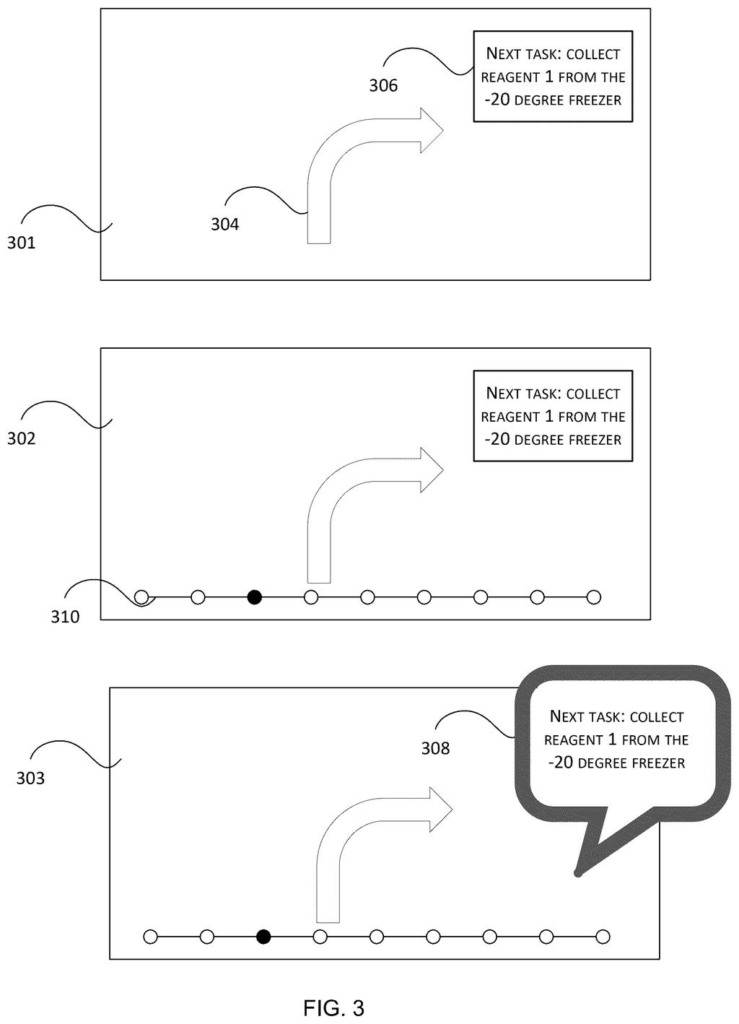
Later, your headset scans your room, finds equipment that can do those same jobs, and builds a route. Arrows lead you from station to station, and prompts tell you what to do next. The filing even describes an animated avatar of the expert showing the hand motions next to the gear in your room.
… generating an input task-to-object-mapping by analyzing data that defines a process performed by a first user interacting with objects in a first location, wherein the input task-to-object-mapping comprises, for each task in the series of tasks, a mapping of the task to an object used in the task …
Translation: It records how a person does a job by noting every tool they use for every step.
How the system swaps equipment by capability
The method has two halves. First, the system analyzes a recording of someone doing a job, such as headset video, and pulls out an ordered list of tasks and the object used in each. That list is the task-to-object mapping (a cheat sheet pairing every step with its tool). For each object it also records a non-spatial characteristic: what the object must be able to do for that step, such as heating to 56° C, or what conditions it needs, such as good lighting or a clear bench. Where the object sits in the room is left out on purpose.
Second, a headset in a new room scans it and identifies the objects there, their positions and their capabilities. Each object from the recording is matched to a candidate in the new room whose abilities cover the task. If several fit, pre-defined criteria pick one, such as the faster machine. Live status (switched off, in use, broken) can filter candidates, and so can whether you're trained to use them.
Finally the system builds a process path, a route of waypoints through the new room from the task order, the matched objects and their positions. It sends that route to a headset or other mobile device, which shows arrows to the next station plus a prompt.
The filing's worked example is extracting DNA from bacteria. The original lab uses a water bath and spin column; the second lab has a heat block and a vacuum column, and the steps are adapted to a vacuum version.
A task-specific non-spatial characteristic of each object in the input task-to-object-mapping is determined and used to map each object in the input task-to-object-mapping to a candidate object identified at a second location to generate an output task-to-object-mapping.
Translation: The system looks at the traits of the original tools to find matching equipment in a new room.
What this means for hands-on job training
The practical payoff is training and repair guidance that travels. The filing says building a headset guide today is manual: someone defines the steps and combines photos of the equipment in the room where it will be used, and the work repeats when a part or machine changes. Here, one recording could serve many rooms with different layouts, including a room the original expert was not allowed into for safety or security reasons.
For you as the person following along, that means fewer instructions that assume equipment you lack. The filing also describes checking your work: a second recording of what you did can be compared against the planned steps, with any differences reported. The filing does not name any product.
Microsoft's 14th filing we've tracked since May in the AR glasses race adds to a run that includes a thermal lens patent and one matching photos to maps.
Claim 1 is wide on hardware. It says only that the finished route goes to "a device in the second location," so a headset, phone or tablet all fit, and the recording can come from any source that shows a person working with objects. Video, avatars and headsets only show up in the later claims.
The wording leans on two moves together: matching each tool by what it can do for that step, and building a walking route from where the matched tools sit in the new room. Matching by exact model number would be a different approach from the one the claim describes.
If granted, the claim would cover one recording reused across many different rooms. That is a tidy, practical idea from a continuation of a 2022 application, and the capability matching does most of the work.
Get our take in your Top Stories
Liked this breakdown? Add Patentlyze as a preferred source on Google, and our plain-English take shows up more often in your Top Stories the next time Microsoft patent news breaks.
There are more where this came from
We read every patent application Big Tech publishes and send you the ones worth knowing. Plain English, free, every week.
The drawings
6 drawing sheets from US 2026/0311435 A1 · click any drawing to enlarge


Want this weekly breakdown for a company we don't cover? Patentlyze Pro →
Be the first to weigh in