
Apple Patents a Labeling System So Your iPhone and Cell Tower Use Matching AI
Your phone and the nearest cell tower have to use matching AI models, or the signal reports your phone sends turn into gibberish. Apple's patent application is a labeling system that keeps the two in step.
What Apple's phone-to-tower AI labels do
A phone in a coat pocket keeps sending a nearby cell tower little reports on how good its signal is. To keep those reports small, which saves battery and airtime, the phone squeezes them with an AI model, and the tower has to use a matching AI model to unsqueeze them.
That match is the whole problem. If the two models don't fit together, the tower can't read what your phone said. Apple's patent application gives every model a short ID, like a label on a key. Your phone tells the tower which models it can run, the tower sends back a list of IDs, and then tells your phone which one to switch on.
The filing also covers updates. When a model gets a new version, the IDs let the phone and the tower agree on the change first, so neither side switches alone.
transmitting a first capability indication to a base station, wherein the first capability indication relates to capabilities of one or more models for performing at least one task based on artificial intelligence (AI) or machine learning (ML); …
Translation: The phone tells the cell tower what kind of artificial intelligence tools it has available.
How the phone and tower agree on a model
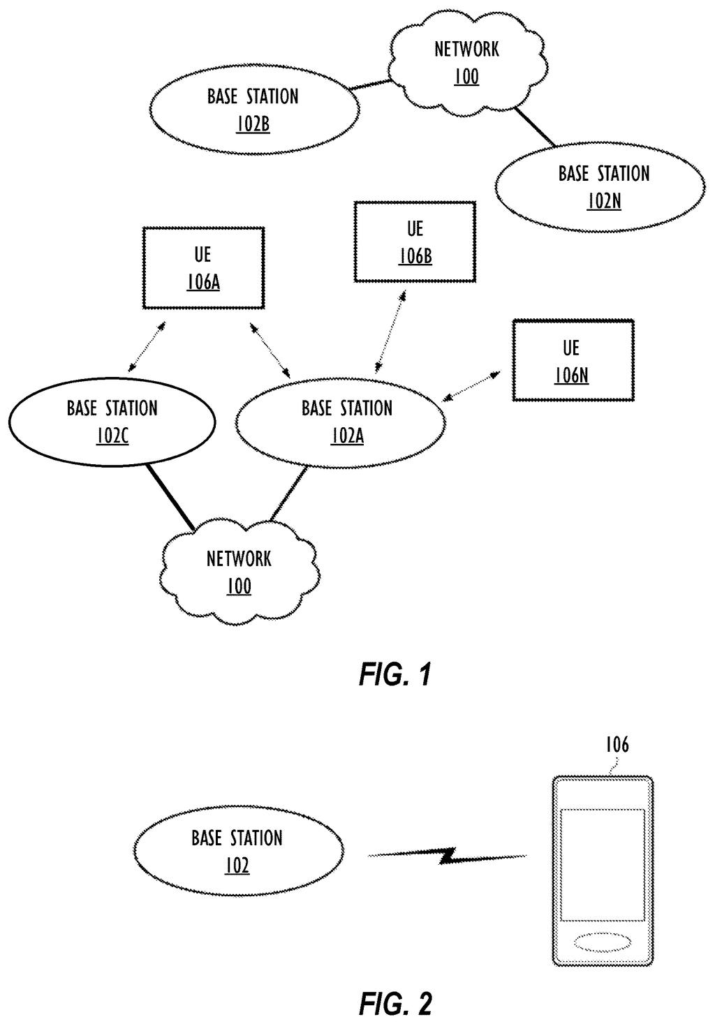
The patent describes a four-step handshake between a phone (the filing calls it user equipment) and a base station (the cell tower). The target task is channel state information (CSI) compression: the phone measures its radio conditions, shrinks the report with an AI encoder, and the tower runs a matching decoder to rebuild it. Together the two halves form a "two-sided" model.
- The phone sends a capability indication, a list of the AI models it can run.
- The tower replies with a set of model identifiers, usually through Radio Resource Control (RRC) messages, the standard setup channel between phone and network.
- The tower sends an activation command naming one ID, using short control messages (DCI or MAC CE, two existing 5G signaling types).
- The phone switches on the model that matches that ID.
One ID can set a model's structure, a group of models, the quantizer (the step that rounds numbers into bits), or the size of the report. The claims also cover a mapping between a globally unique ID and a cell-specific one, and using different models for different layers or ranks (how many parallel data streams the phone is using).
The description lays out five ways to build an ID: tie it to the decoder, the encoder, both, the link between them, or a shared training dataset. Updated models are either downloaded by the phone or uploaded to the tower, then switched on with a second activation command.
… receiving, at the UE, an activation command from the base station, wherein the activation command indicates at least a first model identifier from the set of model identifiers; and activating, by the UE, at least a first model corresponding to the first model identifier for performing a first task based on AI or ML.
Translation: The phone receives an order from the tower to turn on a specific intelligence model.
Why matching AI models matter for battery life
Most of us never think about our cell connection, but this is the plumbing behind how well it works. Smaller signal reports mean less transmit power, which the filing ties to longer battery life and less use of the airwaves. That only works if phone makers and network equipment makers can agree on which AI model is in play at any moment, and a shared ID scheme is one way to get that agreement.
The idea reaches past signal reports. The description says the same approach could apply to beam management and positioning, and to other two-sided AI models running between a phone and a network. For Apple, whose phones have to work on many carriers' networks, a common labeling scheme would matter.
Apple's 522nd filing in our Apple coverage since May follows work on angle-based avatar detail and hiding dropped video frames.
The shortest route to a product looks short on the phone side. No new hardware shows up in the claims. It is signaling rules and software in the phone's modem chip, plus matching software at the tower.
The tower side is the hard part. A carrier runs towers built with equipment from several vendors, and every one of them would have to adopt the same ID scheme. The filing itself says it builds on ongoing industry standards discussions, so a phone cannot use it alone.
The verdict: routine plumbing for the engineers, and a lot of coordination before it ships. You would likely never notice it, and that is its goal.
Get our take in your Top Stories
Liked this breakdown? Add Patentlyze as a preferred source on Google, and our plain-English take shows up more often in your Top Stories the next time Apple patent news breaks.
There are more where this came from
We read every patent application Big Tech publishes and send you the ones worth knowing. Plain English, free, every week.
The drawings
12 drawing sheets from US 2026/0312882 A1 · click any drawing to enlarge


Show the other 4 sheets


Want this weekly breakdown for a company we don't cover? Patentlyze Pro →
Be the first to weigh in