
Qualcomm Patents Battery-Free Tags That Map How Radio Signals Move Through a Store
Keeping a computer model of a building's wireless signals accurate normally takes a cumbersome survey of the whole space. Qualcomm's filing scatters cheap, battery-free tags around the building and lets them collect the readings instead.
What Qualcomm's battery-free tags actually do
You're pushing a cart through a big warehouse store, and your phone's blue location dot keeps hopping between aisles. One reason indoor tracking struggles is that shelves, metal racks and crowds bend and block radio signals in ways the store's network doesn't fully know.
Qualcomm's patent application describes a fix. It starts with a radio digital twin, a computer model of the building and how wireless signals travel through it. To keep that model accurate, you'd normally need a cumbersome survey of the whole building. Instead, the filing scatters cheap, battery-free tags around the space. A nearby transmitter sends them a burst of energy, they wake up and send a short beacon, and Wi-Fi access points and electronic shelf labels listen and report what they heard.
A server then uses those readings to correct the model, and it can run the check again whenever the shelves move.
receive, via the one or more transceivers, from a receiver device, one or more measurements of an environment, the one or more measurements based on a plurality of beacon signal transmissions associated with one or more energy harvesting tags (eTags) in the environment; and calibrate a radio digital twin (RDT) based on the one or more measurements.
Translation: The system collects data from battery-free tags to map how wireless signals move through a space.
How the energizer wakes tags one zone at a time
The claims cover a server (the patent calls it a network entity) that does two things. It collects measurements from a receiver device, based on beacon signals sent by energy-harvesting tags. Then it uses them to calibrate a radio digital twin, a simulated copy of a building and its wireless network that predicts how signals travel, bounce and fade.
The tags are the unusual part. Each is a thin flexible circuit, about 43 by 45 millimeters and 0.2 millimeters thick in the example, with no battery. It harvests energy from a radio signal around the 900 MHz range, stores it in a capacitor (a tiny charge reservoir), and uses it to send a Bluetooth-style beacon around 2.4 GHz. The filing says a tag can harvest from a transmitter as far as 20 meters away.
The server's job looks like this:
- Tells an energizer device when to wake each zone of tags, one zone at a time, so they don't drown each other out.
- Tells receivers (Wi-Fi or Bluetooth access points, or shelf label radios) when and where to listen, and how many measurements to collect.
- Asks for more readings in cluttered or crowded areas, and caps scan time to save power.
- Calibrates the twin, optionally using channel impulse responses (records of how a signal changed on its path).
Recalibration can be triggered by a user, a detected layout change, or a receiver being added, moved or removed. Where no tag sits, the system can estimate a virtual measurement from nearby tags.
… dense battery-less energy harvesting tag (eTag) deployments to build and calibrate radio digital twins of indoor environments.
Translation: Using many battery-free tags allows the system to create a virtual model of indoor radio waves.
What this means for mapping a store's Wi-Fi
If you shop in a large store or work in a warehouse, the practical payoff is better indoor positioning without repeat surveys. The filing says an accurate twin can help with resource allocation, handover (moving a device from one access point to another) and training machine learning models that figure out where people are indoors.
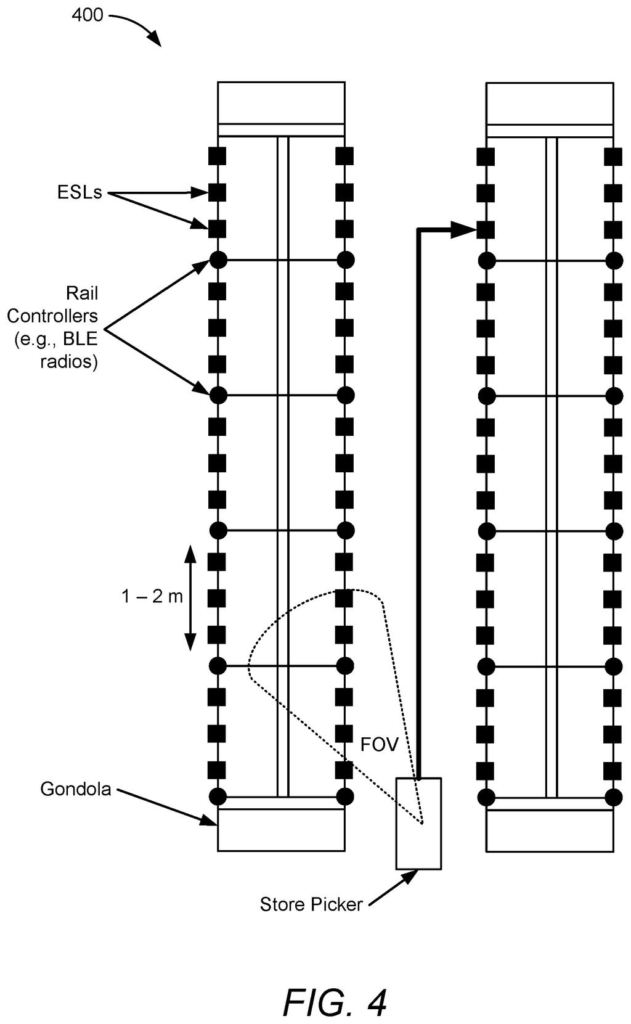
The setup also uses gear many stores already have. Electronic shelf labels, the digital price tags on shelves, are described as possible listening points. Stores rearrange shelves often, and the filing treats that as routine: moved shelves can trigger a fresh round of readings for just the affected area. This is a patent application, so it shows a direction on paper, and nothing in it says when or whether it ships.
Qualcomm's 500th filing in our Qualcomm coverage since May follows work like shelf label tags and signal-aware routing.
The price of skipping the survey is hardware: lots of tags, plus a transmitter that has to wake them one zone at a time so they don't talk over each other. A full check of a big store therefore runs in slow rounds. The filing admits a similar cost by letting receivers stop listening after a set time, even if they haven't collected enough readings.
Where no tag sits, the system fills the gap with an educated guess from nearby readings. A guess like that gets less reliable where the layout changes fast, which is why the filing checks its guesses against spots that do have tags.
Still, the trade looks worth it for a retailer who rearranges shelves often. Buying cheap stickers once beats paying for a repeat survey after every reset, as long as the tags are packed densely where shelves and crowds are heaviest.
Get our take in your Top Stories
Liked this breakdown? Add Patentlyze as a preferred source on Google, and our plain-English take shows up more often in your Top Stories the next time Qualcomm patent news breaks.
There are more where this came from
We read every patent application Big Tech publishes and send you the ones worth knowing. Plain English, free, every week.
The drawings
12 drawing sheets from US 2026/0312698 A1 · click any drawing to enlarge


Want this weekly breakdown for a company we don't cover? Patentlyze Pro →
Be the first to weigh in