
Google Files Patent for AI Language Models That Stop Answering in the Wrong Language
Ask an AI a question in Thai and get a perfectly sensible answer in English: Google has a patent application aimed at fixing that. The idea is to give each language its own small add-on, then lock those add-ons in place while the rest of the model is tuned.
What Google's per-language AI add-ons actually do
Imagine you ask an AI tool a question in Swahili or Thai, and it replies with a perfectly good answer, but in English. The meaning is right and the language is wrong. Researchers call this source language hallucination, and it is a known headache for models trained on dozens of languages at once.
Google's patent application describes a fix. Picture the model as one shared brain with a small, separate notebook for each language. During the big first round of training, the brain and every notebook learn together. Later, when the model is tuned for a specific job, only the shared brain gets adjusted while the notebooks stay locked. To switch languages, the system just switches notebooks.
There is one more wrinkle. The shared brain can slowly drift away from the locked notebooks, so Google also freezes part of the output side of the model. The filing says that step almost completely eliminates the wrong-language problem.
a shared set of parameters that are shared among the plurality of domain-specific variants of the machine learning model; and a domain-specific set of parameters that are specific to the domain-specific variant of the machine learning model; …
Translation: The system splits its brain into shared general knowledge and specialized language rules.
How the model freezes parts to keep languages straight
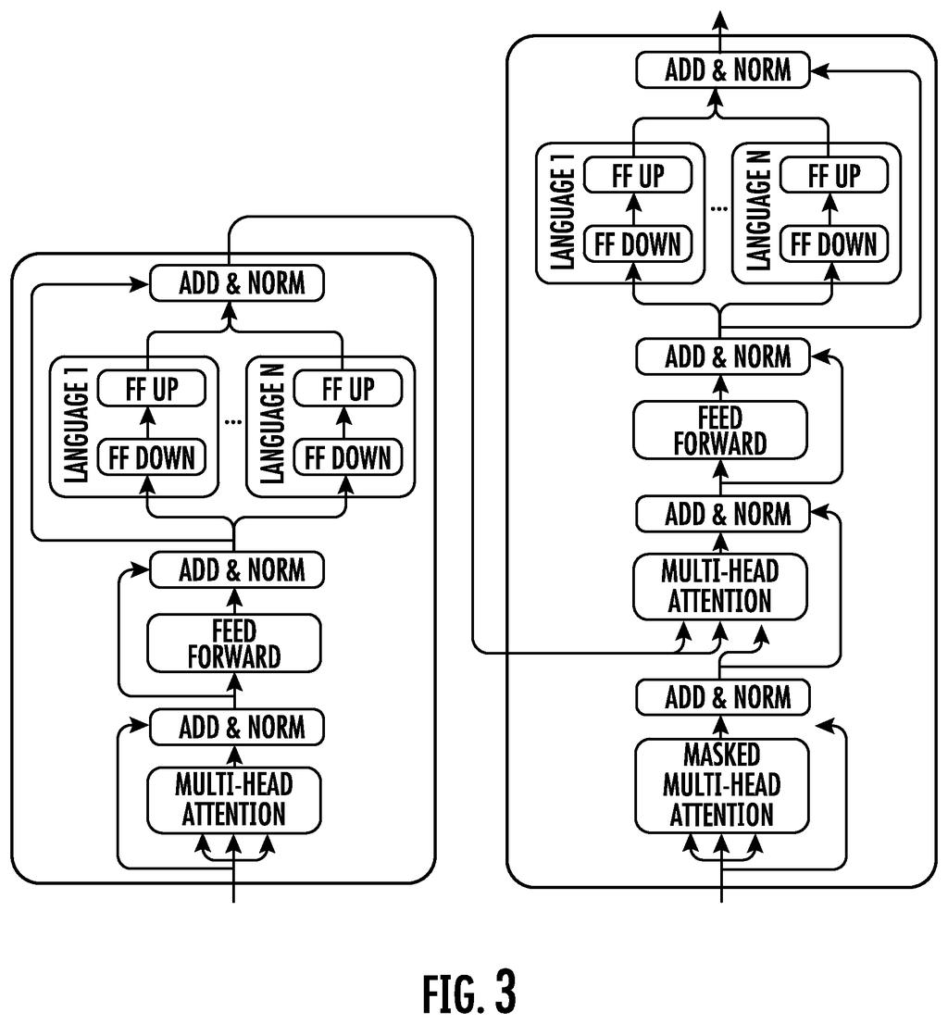
The filing describes a model built from two kinds of settings, called parameters (the adjustable numbers an AI learns during training). Shared parameters handle what all languages have in common. A separate set of language-specific parameters holds what is unique to each one. The filing says these can be stored in a table with one row per language and one column per layer of the model (an N×L table).
In the example design, a standard transformer (the architecture behind most modern chatbots) gets a small add-on module, called a bottleneck adapter, after the feed-forward step in each layer. Text first passes through the shared weights, then is routed through the add-on for its own language, layer after layer.
The training works in stages:
- Pre-training: the shared and language-specific parameters are updated together.
- Fine-tuning: only the shared parameters change, and the language modules stay frozen.
- Drift fix: some shared decoder parameters, such as the decoder feed-forward ones, are frozen too.
Without that last step, the shared parts can wander away from the frozen modules (the filing calls this representation drift), and the model slips back into the wrong language. The filing reports results across over forty languages. The claims also extend the same recipe to image types and to mixed data like text, images and audio.
… the proposed multi-domain model employs a plurality of domain-specific sets of parameters during pre-training to separate domain-specific information from domain-agnostic information.
Translation: Training keeps general rules separate from specific language topics to prevent mixing them up.
Why this matters for languages with less data
If you use AI in a language other than English, the practical win is simple: you get your answer in the language you asked in. The filing points to translation, search, content generation and understanding user commands, and says the approach is aimed especially at situations with limited training data, where multilingual models usually struggle.
There is a cost angle too. Sharing most of the model across languages means less duplicated storage, and locking the language modules during fine-tuning cuts the computing needed to adapt the model. For a company serving users in many languages, that adds up. The filing does not name a product, so treat it as a look at how Google approaches the problem rather than a preview of a launch.
Google's 101st filing in Language AI we've tracked since May follows work like swapping models into image readers and two-model search ranking.
Claim 1 is written broadly. It never mentions language, translation or even text. It asks for a model split into a shared part and a part for each 'domain,' trained together, then tuned with the shared part moving and the domain part locked.
The narrower trick, freezing part of the decoder to stop wrong-language answers, shows up only in dependent claims 3 through 5 and their language twins. Claim 1 on its own reaches any model built to that recipe, whether it sorts satellite photos or handles Thai.
If granted as written, that breadth would cover a lot of ground for one training pattern. It also has a specific order of steps, and a model that adjusted the domain-specific pieces during tuning would sit outside the wording of claim 1. My verdict: a broad claim on a sensible recipe, with the language-fix details carrying the real engineering.
Get our take in your Top Stories
Liked this breakdown? Add Patentlyze as a preferred source on Google, and our plain-English take shows up more often in your Top Stories the next time Google patent news breaks.
There are more where this came from
We read every patent application Big Tech publishes and send you the ones worth knowing. Plain English, free, every week.
The drawings
9 drawing sheets from US 2026/0310959 A1 · click any drawing to enlarge


Want this weekly breakdown for a company we don't cover? Patentlyze Pro →
Be the first to weigh in