
Alphabet Spinout Verily Patents a Blood-Sugar Sensor That Sits Under Your Eyelid
Verily's patent application tucks a sensor, as small as 3.5 millimeters long, under your lower eyelid to read blood sugar with invisible light instead of a needle.
What Verily's under-eyelid glucose sensor does
Every time someone with diabetes pricks a finger to check their blood sugar, they trade a little pain for a single number. This Verily patent application describes a way to skip that trade.
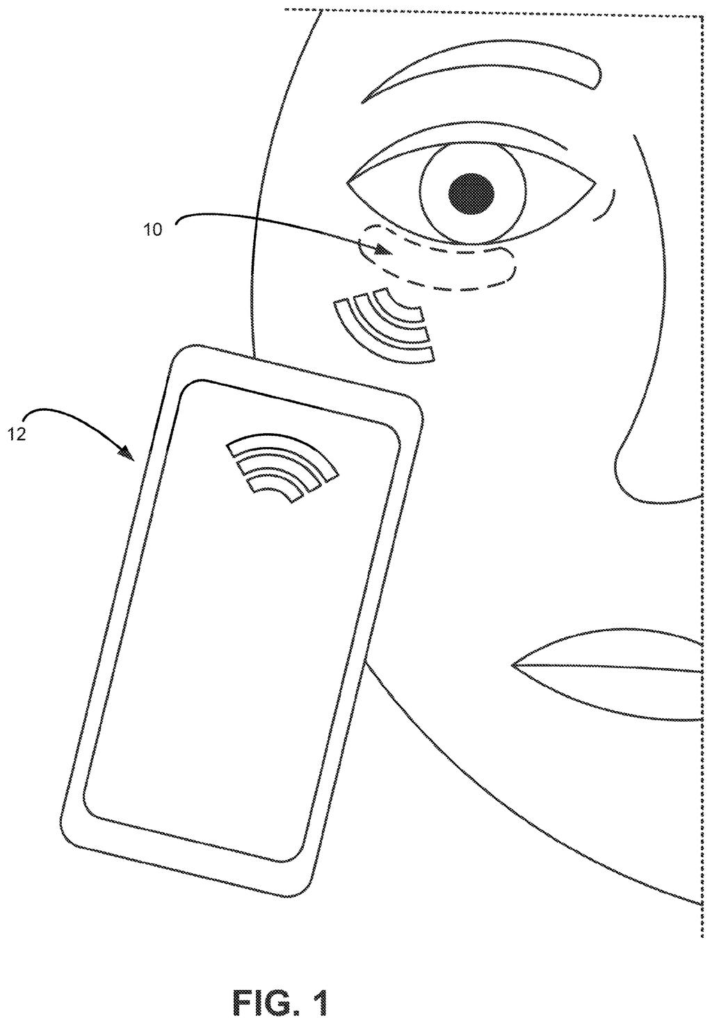
The idea is a tiny, soft, curved sensor that you slide into the pocket between your lower eyelid and your eyeball. It shines invisible infrared light at the lining of your eyelid, which is packed with very small blood vessels close to the surface, and measures what bounces back. Readings can happen on a schedule, and your phone can collect them and warn you when a number looks off.
The company's argument is that the eyelid beats the wrist or finger because those vessels are shallow and look much the same from person to person. Fewer things get in the way of the signal.
… a flexible casing configured to fit between the lower eyelid and an eyeball of the patient, wherein the casing encapsulates the mounting substrate and the optoelectronic components …
Translation: The sensor is built inside a flexible casing designed to slide right under the user's lower eyelid.
How the sensor cancels out the tears
The device is a small, flexible circuit board wrapped in a soft, curved, infrared-transparent casing so it can sit comfortably between the lower eyelid and the eye. On the board are a tiny chip with wireless communication, a wireless power source, one or more micro LEDs (very small light emitters) and a photodiode (a light sensor). The LEDs shine short wave infrared light, with wavelengths from 900 to 1700 nanometers, at the palpebral conjunctiva, the thin, blood-rich membrane lining the inside of the eyelid. The sensor catches the reflection.
Tears are the main problem. A film of water between the device and the eyelid muddies the signal. So the casing surface above the LEDs and sensor is hydrophobic (it repels water), and the filing says that area can also get a thick, medical-grade mineral oil or petrolatum coating.
To clean up what's left, the filing describes two kinds of LED:
- One tuned to glucose, with a center wavelength of 1525 to 1675 nm.
- One tuned to water in tears, at 1400 to 1500 nm.
The water signal is subtracted from the glucose signal, leaving a cleaner glucose reading.
The device can be powered and read through near field communication (the short-range wireless tech behind tap-to-pay) from a phone. The filing also describes a small magnet tool for sliding it back out.
… one or more micro light emitting diodes (LEDs) and a micro photodiode detector adjacent to the one or more LEDs, can be inserted beneath a lower eyelid of the patient and above an eye.
Translation: Tiny lights and a detector sit inside the eyelid to measure blood components without breaking the skin.
Why Verily bets on the eyelid over the wrist
If you live with diabetes, the practical question is how often you have to deal with needles. The filing points out that today's continuous glucose monitors still need a sensor inserted under the skin and last about 7 to 14 days. Wrist and finger gadgets that use light have not reached acceptable accuracy, according to the patent's own background. This design tries to offer a needle-free option that sits in a spot with shallow, consistent blood vessels.
The filing also says the same approach could be tuned for other blood substances, such as cholesterol, though glucose is the focus of the claims. Keep in mind that this is a patent application, and the text includes no accuracy data or test results. Nothing here says a product is on the way.
This filing joins our wearables that read your body watchlist, alongside earlier applications like one predicting irregular heartbeats and one linking sleep to fall risk.
Swapping a finger-prick for a sensor tucked under your eyelid sounds like a clear win, but the design still asks things of you: sliding the device into place, in some versions coating it with oil to keep tears from blurring the reading, and in others keeping a phone close enough to power it. Each step is another place the measurement can fail.
The underlying engineering does make real sense. The lower eyelid is a sheltered, snug space, and the device subtracts the water signal from your tears to isolate what the blood is actually doing. Those are genuine advantages that come without obvious cost.
What the document cannot offer is any evidence that the system works as promised. No measured results appear anywhere in the filing, so the accuracy claim is entirely theoretical. For someone who dreads needles badly enough, the tradeoff may still feel worth it, but right now the design asks several things to go right at once with nothing yet to show they do.
Get our take in your Top Stories
Liked this breakdown? Add Patentlyze as a preferred source on Google, and our plain-English take shows up more often in your Top Stories the next time Google patent news breaks.
There are more where this came from
We read every patent application Big Tech publishes and send you the ones worth knowing. Plain English, free, every week.
The drawings
15 drawing sheets from US 2026/0305985 A1 · click any drawing to enlarge


Want this weekly breakdown for a company we don't cover? Patentlyze Pro →
Be the first to weigh in