
Sony Files Patent for a Distance-Sensing Laser That Eases Off for Nearby Objects
Laser distance sensors face a catch: the power that lets them see far can be a safety problem up close. Sony's patent describes a single tiny laser that changes its own strength just by changing the electric current feeding it.
What Sony's two-speed laser actually does
Lasers that measure distance, like the ones in car sensors, work best when they pack a lot of punch, because stronger pulses travel farther. But that same punch becomes a laser safety concern when the thing being measured is close by. The compact pulsed lasers Sony describes are stuck with whatever strength their internal design sets, so they are hard to turn down once built.
Sony's filing describes a chip-sized laser with two modes. Feed it a smaller electric current and it gives off gentle light for nearby objects. Feed it a bigger current and the color of its light shifts slightly, which trips a built-in switch that produces short, powerful pulses for faraway objects.
The sensor can check how far away something is and pick the matching mode, using a change in current instead of bolted-on optics or moving parts.
a laminated semiconductor layer that includes an active layer that emits light of a first wavelength that is a wavelength that changes according to a driving condition …
Translation: The device uses a semiconductor layer that shifts its emitted light wavelength based on how hard it is driven.
How one chip switches between two laser modes
The device is a stack of layers that all share one straight line of light. At the bottom sits a semiconductor laser, which acts as the pump. Its light has a color, or wavelength, that depends on the driving condition: push in more electric current, or run it hotter, and the color shifts toward longer wavelengths.
Next in line is a laser crystal sandwiched between two mirror coatings. The rear coating is the clever part: it reflects some colors of pump light almost completely and lets other colors pass through. When the pump light is trapped, the crystal absorbs it and produces its own light at a different wavelength. When the pump light slips through, the crystal stays quiet.
After the crystal comes a saturable absorber, which works as a passive Q switch (a part that blocks light while energy builds up, then goes clear and releases everything as one short, intense pulse). That gives the high-power mode. The low-power mode is simply the pump light passing straight out.
The claims cover the light source itself, a distance-measuring device built on it, and a measuring method. The filing also describes variations: an array of tiny regions, in checkered or striped patterns, that emit both strengths at the same time, and a pulsed current that turns the gentle light into pulses too.
Why close-range safety matters for car sensors
If you ride in a car with driver-assist sensors, or use any gadget that measures distance with lasers, the tradeoff in this filing is working in the background: see far, but stay gentle up close. A single laser that adjusts itself could mean a smaller, simpler sensor module than one that adds extra optics or moving parts, which is the pitch the filing makes about size and cost.
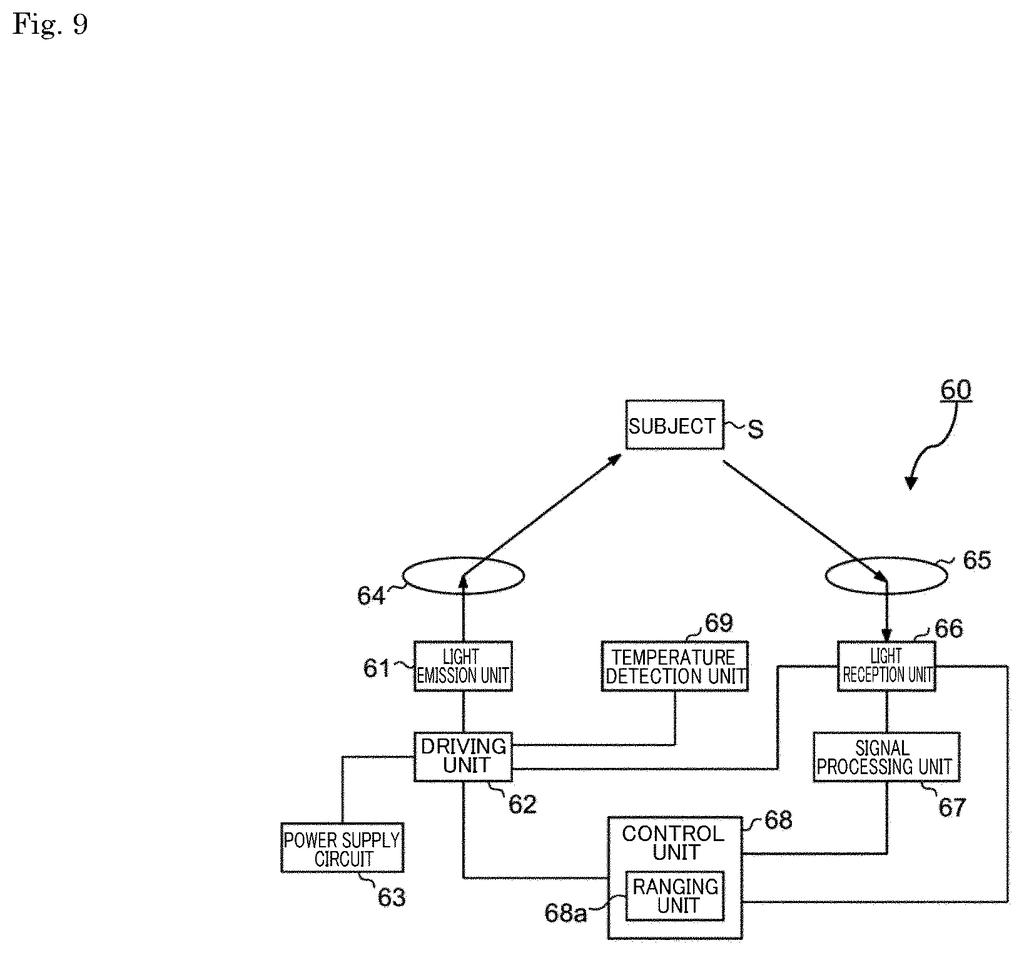
The filing names cars as one application and lists drones and robots among other machines that could carry it. Its own example is a ranging device that measures how far away a subject is, then picks the matching mode. Nothing here says when, or whether, it becomes a product, and the document gives no real specs on range.
Sony's 30th filing we've tracked in self-driving sensing since July builds on earlier applications like road projection and puddle avoidance and rating nearby object danger.
The problem here is a real one for any laser that scans the world around it. Strong pulses reach far, and strong pulses are exactly what you want to avoid pointing at something close, so a sensor stuck at one power level has to settle on a compromise. Sony's own filing says that once this style of laser is built, its strength is hard to change.
Putting the switch inside the laser itself matches the size of that problem well. It swaps extra optics and moving parts for a change in electric current, which is about the cheapest dial an engineer can ask for.
The filing gives no figures for how much power it can swing or how far the sensor can see, so the payoff is hard to size. As a fix for a narrow but practical headache, it looks sensible, and the checkered-pattern version, which measures near and far at the same moment, is the most interesting part.
Get our take in your Top Stories
Liked this breakdown? Add Patentlyze as a preferred source on Google, and our plain-English take shows up more often in your Top Stories the next time Sony patent news breaks.
There are more where this came from
We read every patent application Big Tech publishes and send you the ones worth knowing. Plain English, free, every week.
The drawings
20 drawing sheets from US 2026/0322071 A1 · click any drawing to enlarge


Show the other 12 sheets


Want this weekly breakdown for a company we don't cover? Patentlyze Pro →
Be the first to weigh in