
Sony Files Patent for Moving Studio LED Panels Without Hours of Recalibration
Big LED walls are now standard on virtual production sets, but moving one can force a film crew to stop and re-measure the whole tracking system for an hour or more. Sony's patent describes a shortcut that lets the camera work out how far a panel moved from a single look.
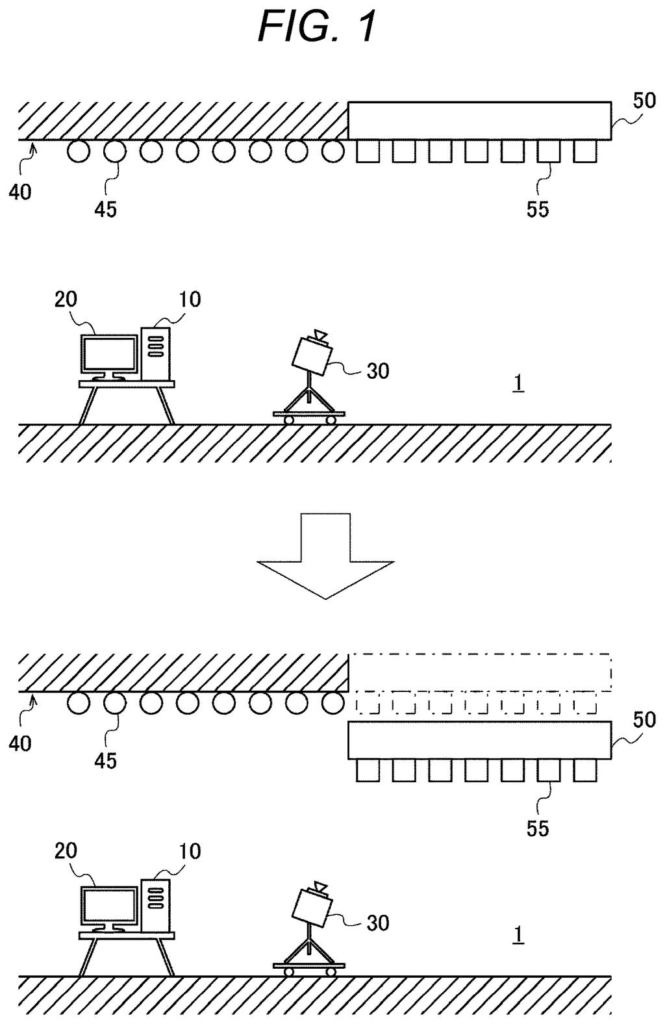
What Sony's moving-LED-panel patent does
Every time a film crew moves a giant LED panel to change the lighting, the system that tracks the camera loses track of where that panel's reference dots now sit. Fixing that can mean an hour or two of re-measuring, with actors and crew standing around waiting.
Sony's patent skips most of that work. The camera looks at two sets of markers at once: dots on the ceiling that never move, and dots on the panel that just did. The ceiling dots tell the system where the camera really is, so it can compare that against where the panel's old dots say the camera is. The gap between the two answers is exactly how far the panel moved.
Sony says that takes a few minutes in a typical large studio, and the system then simply updates the panel's saved positions.
… rewrites second map data including position information of a plurality of movable markers arranged on a movable rigid body, on a basis of a first position and orientation related to a camera …
Translation: The system updates where it thinks the moving display panel is based on what the camera sees.
How the camera measures how far a panel moved
The system keeps two "maps," which are just lists of 3D coordinates (left-right, up-down, forward-back) for marker dots. The first map covers fixed markers on something that never moves, such as a studio ceiling. The second map covers markers on a movable rigid body, such as an LED panel. The spacing among the panel's own markers never changes, even when the panel moves.
The starting setup is the slow part. A user films every marker from many angles, and a technique called structure from motion (building 3D positions out of many flat photos) produces one combined map. The user then splits it into the two maps using an on-screen interface. If the markers are infrared lights that broadcast an ID, the split can happen automatically.
After a panel moves, the patent describes this routine:
- Put the camera anywhere that can see at least four fixed markers and at least four movable markers (the filing suggests about ten for better accuracy).
- Estimate the camera's position and angle from one image using the fixed map, then again using the old movable map.
- The difference between the two estimates is how the panel moved, in all six directions of motion (three ways to slide, three ways to rotate).
- Apply that movement to rewrite the movable map. If the accuracy is poor, the user is asked to redo the shot.
The filing also describes a second version that replaces stuck-on markers with infrared laser dots. It checks how evenly those dots spread across the image, and it uses LiDAR (laser distance measuring) and a fast event-based sensor to identify each dot.
To greatly improve calibration efficiency of a movable marker arranged on a movable rigid body.
Translation: The goal is to make setting up movable studio equipment much faster and easier.
What this could mean for virtual production sets
The practical payoff is on virtual production sets, where LED panels show the digital backdrop and light the actors. The filing says crews increasingly want to move those panels to suit each scene, but a long recalibration after every move makes it hard to justify paying a cast and crew to wait. If recalibration takes a few minutes, as the filing claims, moving a panel becomes a normal creative choice.
For you as a viewer, the effect would be indirect: more flexible lighting and camera setups on the shows and films you watch. The patent itself describes only the tracking method and the studio hardware around it. It does not name a product, so it reads as behind-the-scenes infrastructure for Sony's studio technology.
Sony's 92nd filing in the Display patents we cover since May follows earlier work on a finger hovering above the screen and a screen that pushes back, showing continued focus on how touch surfaces sense and respond.
Studio time is expensive in a way that compounds quickly. Every hour a crew waits while someone manually re-measures and recalibrates moved display panels is an hour of actors, operators, and lighting staff burning through a budget without shooting a frame. Productions routinely avoid moving the panels at all, which shrinks what a director can do with a scene.
Sony's approach attacks that cost directly. The camera already reads fixed reference points around the room to locate itself in space, and the system simply compares that known position against where the panels were last recorded, catching any drift automatically rather than through manual measurement.
The honest constraints are that the panels must stay physically rigid and the camera needs a clear sightline to enough reference points to do the calculation. Within those conditions, a recurring production bottleneck shrinks into something a crew barely notices.
Get our take in your Top Stories
Liked this breakdown? Add Patentlyze as a preferred source on Google, and our plain-English take shows up more often in your Top Stories the next time Sony patent news breaks.
There are more where this came from
We read every patent application Big Tech publishes and send you the ones worth knowing. Plain English, free, every week.
The drawings
18 drawing sheets from US 2026/0320818 A1 · click any drawing to enlarge


Show the other 10 sheets


Want this weekly breakdown for a company we don't cover? Patentlyze Pro →
Be the first to weigh in