
Nvidia Files Patent to Store Your Videos Inside an AI Model
Nvidia has filed a patent for saving a video by teaching an AI to replay it, so the saved file is a trained network instead of a movie file. The same setup doubles as a lock: the filing says a thief holding only half the pieces gets nothing watchable.
What Nvidia's video-in-a-network patent does
You're out of phone storage again, and the culprit is a camera roll full of videos you can't bring yourself to delete. Nvidia's new patent describes a different way to keep them. Instead of saving the video as a file, you train a small AI network until it can replay the video, frame by frame, from memory.
The filing says that in one version the saved video ends up 15 to 30 times smaller. The AI doesn't store pictures at all. It stores the settings (called weights) it learned while practicing the video, and those settings are the video.
There's a privacy twist, too. The job is split between two pieces: one that produces a long string of random-looking noise, and one that turns that noise into frames. Keep one on your phone and the other in the cloud, and a thief who grabs only one gets nothing watchable.
… generates, using the one or more neural networks, one or more mappings between noise elements in the noise sequence to elements of the data sequence; and stores the generated parameters of the one or more neural networks, wherein the generated parameters are usable as an encoding of the data sequence.
Translation: The system links random noise to video parts and saves the AI settings as the video file.
How the noise generator and frame network pair up
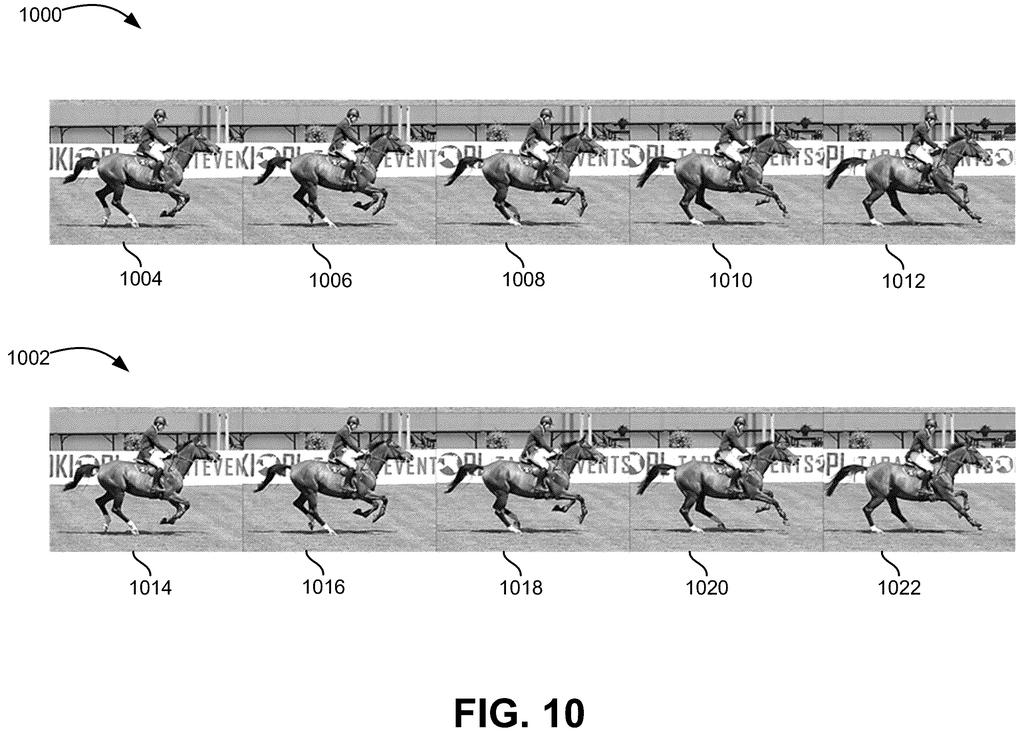
The claim covers a processor that encodes a sequence of data, such as video frames, by training neural networks (software that learns from examples) and saving what they learned. Those saved settings, called parameters or weights, are the encoded video. Run the networks again and they replay it.
Two cooperating networks do the work:
- A noise generator starts from a “key noise frame,” a grid of arbitrary numbers the size of one video frame, and builds each next noise frame from the previous one (the filing calls this autoregressive).
- A frame network, a convolutional network (an AI type built for images), turns each noise frame into one video frame.
Training continues until the replay is close enough to the original, such as scoring above 90 on a similarity index. The generator trains first until its noise flows stably, then is frozen while only the frame network keeps learning. The filing says this takes about an order of magnitude fewer training rounds than one network doing both jobs. One generator can serve many videos, each needing only its own frame network.
The filing also mentions sharper results for people in a scene, plus audio and non-video data like 3D medical scans.
Apparatuses, systems, and techniques to encode sequence data in one or more neural networks. In at least one embodiment, a video frame sequence is generated using a neural network to map noise frames to video frames.
Translation: Hardware and methods turn video frames into neural network rules by connecting them to random noise.
Why storing video as a network matters for privacy
For you, the pitch is smaller video files and safer cloud copies. The filing cites compression of 15 to 30 times in one version and describes a phone-plus-cloud setup: the cloud holds each video's frame network, you keep the noise generator, and a leaked cloud copy shows nothing without it. It contrasts this with the standard H.264 format, where a stolen file plays in any video player.
Cars get a mention too. The filing says a vehicle could store camera, radar and lidar recordings in compressed, secure form for later playback, such as in a crash investigation. The catch is that every video has to be learned by a network first, and replays only need to match the original within a set similarity level.
Nvidia's 52nd filing we've tracked in AI training and infrastructure since May adds to a run that includes one on self-driving blind spots and one on fixing AI compression math.
Software is the whole story here. The claim talks about processors, but the filing's examples run on ordinary graphics chips, a phone and a cloud server, so no new hardware has to exist first.
What does have to exist first is fast training. Every video must be taught to its own network before it can be saved, and the filing gives no timings for that step. Until saving a clip takes seconds instead of a long training run, this stays a lab idea.
The shortest route to a product is a cloud backup service that does the training on its servers and keeps your key on your device, which matches the split the filing describes. The size savings and the two-key privacy are the selling points, and whether they justify the training bill is the open question.
Get our take in your Top Stories
Liked this breakdown? Add Patentlyze as a preferred source on Google, and our plain-English take shows up more often in your Top Stories the next time Nvidia patent news breaks.
There are more where this came from
We read every patent application Big Tech publishes and send you the ones worth knowing. Plain English, free, every week.
The drawings
53 drawing sheets from US 2026/0320351 A1 · click any drawing to enlarge


Show the other 45 sheets


Want this weekly breakdown for a company we don't cover? Patentlyze Pro →
Be the first to weigh in