
Sony Files Patent for a Game Console That Slows Downloads When the Power Grid Is Strained
Sony has filed a patent application for a game console that checks how busy and how green your local power supply is, then adjusts itself. Downloads slow down, screens dim, and your game may even run from the cloud.
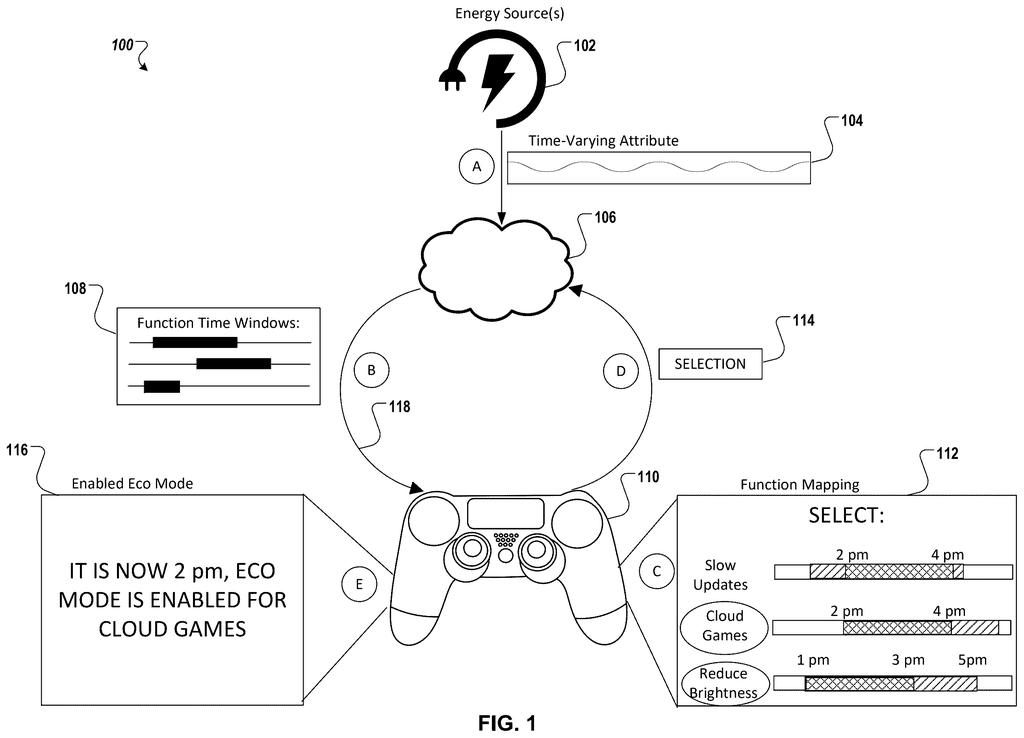
What Sony's grid-aware console does at 6 p.m.
A game console downloads a huge update at 6 p.m., just as every home on the street is cooking dinner and flipping on lights. The power grid is at its busiest, and the electricity feeding that console may come from its least sustainable sources.
A new Sony patent application describes a console that pays attention to this. It looks at energy data for your area, such as how strained the grid is and how much of the power is coming from solar, wind or other sources. When power is tight or less green, the console can slow or postpone downloads, lower the brightness, frame rate or sharpness of the picture, or let a server do some of the heavy lifting by running the game from the cloud.
You stay in charge. You choose which of these tricks are switched on, and the filing even imagines an "Eco Trophy" badge as a reward for playing during greener hours.
receiving electrical energy data associated with one or more electrical energy sources for the electronic gaming system, the electrical energy data comprising electrical energy usage data or electrical energy supply data associated with the one or more electrical energy sources …
Translation: The console monitors local power grid conditions and electricity supply levels.
How the console picks a greener time window
The system starts by collecting electrical energy data: how much power a source is supplying (supply data) or how much is being drawn from it (usage data). It can use real-time and historical figures for your region, pulled from utility sources or a subscription database. The sources can be on-site, like home solar panels or batteries, or off-site, like the wider power grid.
From that data it works out a time-varying attribute, meaning a measurement that changes through the day. Examples include the share of power coming from solar, wind, hydro, geothermal, nuclear or battery sources, or the load on the grid. Thresholds can vary by area: one example calls a window "sustainable" at 60% renewable power in one city and at 20% in another. The system can also predict future values, using machine learning or simple averaging, to choose a window.
In the chosen window, the console starts a function. The filing lists several:
- Downloading games or patch updates at a reduced speed, or putting them off until a greener time
- Lowering the frame rate, brightness or resolution of the picture
- Using a cloud version of the game, so a remote server handles more of the processing
- Suggesting that you play later or turn down your screen brightness
A server usually makes the call and instructs the console. You can turn on a "sustainability mode" and pick which functions run. One example screen marks 16:00 to 21:00 as peak hours.
… causing the electronic gaming system to initiate a function during the selected period of time.
Translation: The system triggers an action like delaying downloads when the grid is busy.
Why your console's power habits could change
If you play on a console, this could mean your system makes small choices about when it does power-hungry chores. Big updates might wait until off-peak hours, and the picture might get slightly dimmer when the grid is under strain. The filing says energy-saving steps would apply only in those less sustainable windows, so the rest of the time you would play as usual.
For Sony, the appeal is a sustainability story that costs players little. Scheduling downloads is nearly invisible, while features like badges, a sustainability report and rankings against other players in your region add a game-like layer. It is still a patent application, so nothing here says a feature is coming.
Sony's 624th filing in our Sony coverage since May follows dimming lights mid-game and cutting wireless signals before lag.
A single console uses little power next to an air conditioner or a car charger, so the savings from one living room are tiny. The idea matters only at scale, when millions of consoles pull the same giant update at the same dinner-hour moment.
Timing is where the problem becomes real. Piling load onto the grid when it is busiest, with power at its dirtiest, is a fair thing to fix, and slowing or postponing a download is a modest step that fits that problem well. You would barely notice it.
The weaker half is asking players to accept a dimmer, choppier picture during peak hours. Few people will trade image quality for the grid's benefit, and a trophy badge is a thin reward. Expect download scheduling to be the part that actually matters.
Get our take in your Top Stories
Liked this breakdown? Add Patentlyze as a preferred source on Google, and our plain-English take shows up more often in your Top Stories the next time Sony patent news breaks.
There are more where this came from
We read every patent application Big Tech publishes and send you the ones worth knowing. Plain English, free, every week.
The drawings
6 drawing sheets from US 2026/0315912 A1 · click any drawing to enlarge


Want this weekly breakdown for a company we don't cover? Patentlyze Pro →
Be the first to weigh in