
Google Files Patent for a Chatbot Screen Where You Can Reopen Any Earlier Question
Today, fixing a chatbot question you asked many messages ago means copying, pasting and resending it. Google's patent application lets you reopen that old message and rewrites only its answer.
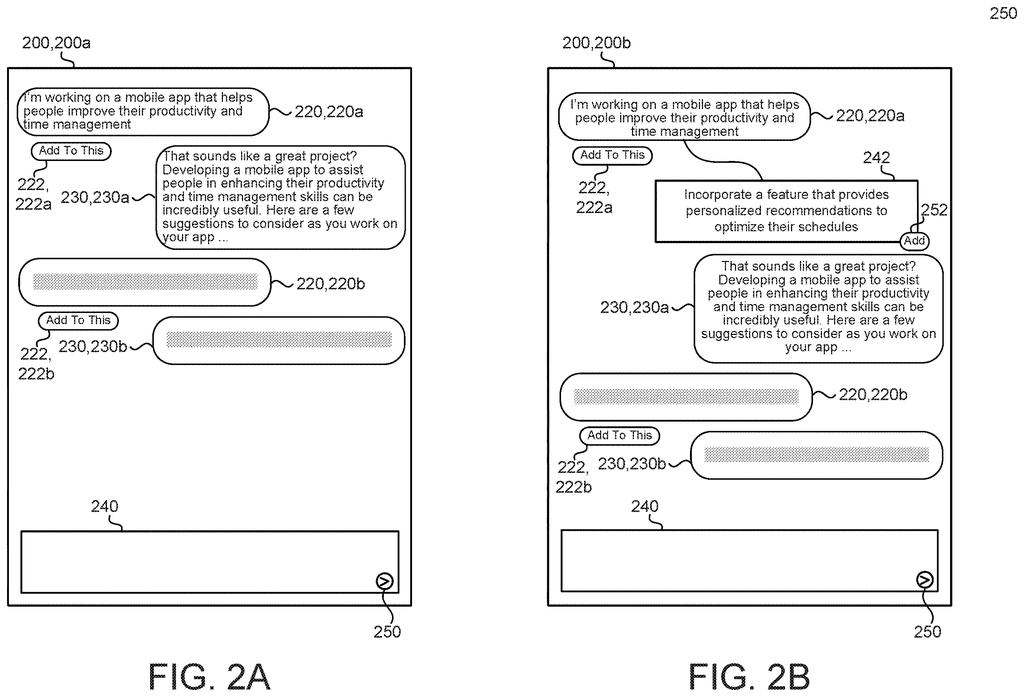
What Google's 'add to this' chat button does
Every time you chat with an AI, you think of the detail you forgot to mention about three questions too late. Today the fix is clunky: copy your old question, paste it, tweak it, and send it as a brand new message at the bottom of the chat.
Google's patent application describes a different approach. Each message you send gets an "add to this" button. Tap it, type (or speak) your extra thought, and the chatbot rewrites the answer to that earlier question while leaving your latest answer alone. A line on screen connects your original message to what you added.
Over time, your chat turns into a web of linked ideas, a bit like a mind map, and you can fold it back into a tidy list when you're done.
… receiving, in the user interface, a user input indication indicating selection of a selected entry of the plurality of entries, the selected entry being other than a last entry of the plurality of entries sequentially input by the user; …
Translation: Users can click on any previous question they asked earlier in the conversation instead of just the most recent one.
How an old chatbot answer gets rewritten
The patent describes a chat screen where every message you send carries an "add to this" button. Pressing it selects an earlier message (any one except your latest) and opens a small text box for an extra thought tied to that message.
Once you submit, the chatbot (the AI language model that writes the replies) regenerates the answer attached to that earlier message. The main claim is specific: the answer to the selected message gets updated, while the answer to your most recent message is left untouched. Both stay visible on screen together.
The filing also lists extras:
- Your original message and your addition can use different input types, such as typing first and speaking second.
- A connecting line links related messages, forming a mind map (a loose web of connected ideas) or a ranked hierarchy.
- Linked messages can collapse into one compact entry and expand again with a click.
The description says these are options, not the core idea. It also mentions several people sharing one chat, each adding to different messages, and a new message that links to more than one older one. The stated problem is that chatbots mostly focus on your latest message, so a long conversation gets fragmented.
… causing the chatbot to update one or more of the plurality of corresponding responses from the chatbot.
Translation: The system then changes the old chatbot answer to match the new details without breaking the rest of the chat history.
Why chat apps could stop being one long line
If you use a chatbot for research or brainstorming, the practical gain is that you stop retyping. You could drop a new thought onto the exact message it belongs to, and the answer to that message would update without you rebuilding the whole question from scratch.
The filing frames today's chat as a straight line with one input type at a time. This design turns the conversation into something closer to a workspace, where ideas can branch, link up and be revisited. Because it rests on text boxes, buttons and speech input, it is a change to the screen layout and how replies are handled, with no new device required.
Google's 40th filing we've tracked since May in our AI assistants that remember you watchlist builds on one that adjusts tone by relationship and fixed-size memory filing.
This one needs no new hardware. It is a button, a text box and a chatbot that can redo an earlier answer, which puts it about as close to shippable as a patent idea gets.
The hard part sits behind the screen. The filing shows the chatbot swapping in a new reply to the old question, but it does not spell out how the answers that came after stay consistent with it. A chat that contradicts itself would confuse you fast, so that has to be solved first.
The shortest route to a product is a small "add to this" feature in an existing chat app, with the connecting lines and collapsing mind map view coming later. The filing says it continues an application from August 2023, so the idea has been around for a while.
Get our take in your Top Stories
Liked this breakdown? Add Patentlyze as a preferred source on Google, and our plain-English take shows up more often in your Top Stories the next time Google patent news breaks.
There are more where this came from
We read every patent application Big Tech publishes and send you the ones worth knowing. Plain English, free, every week.
The drawings
6 drawing sheets from US 2026/0319594 A1 · click any drawing to enlarge


Want this weekly breakdown for a company we don't cover? Patentlyze Pro →
Be the first to weigh in