
Samsung Patents a Storage Device That Trains AI Models Internally
Instead of shipping raw data from storage to a CPU or GPU for AI model training, Samsung's patent proposes letting the storage device do the math itself — a classic 'bring compute to the data' move that could quietly reshape how machine learning hardware is architected.
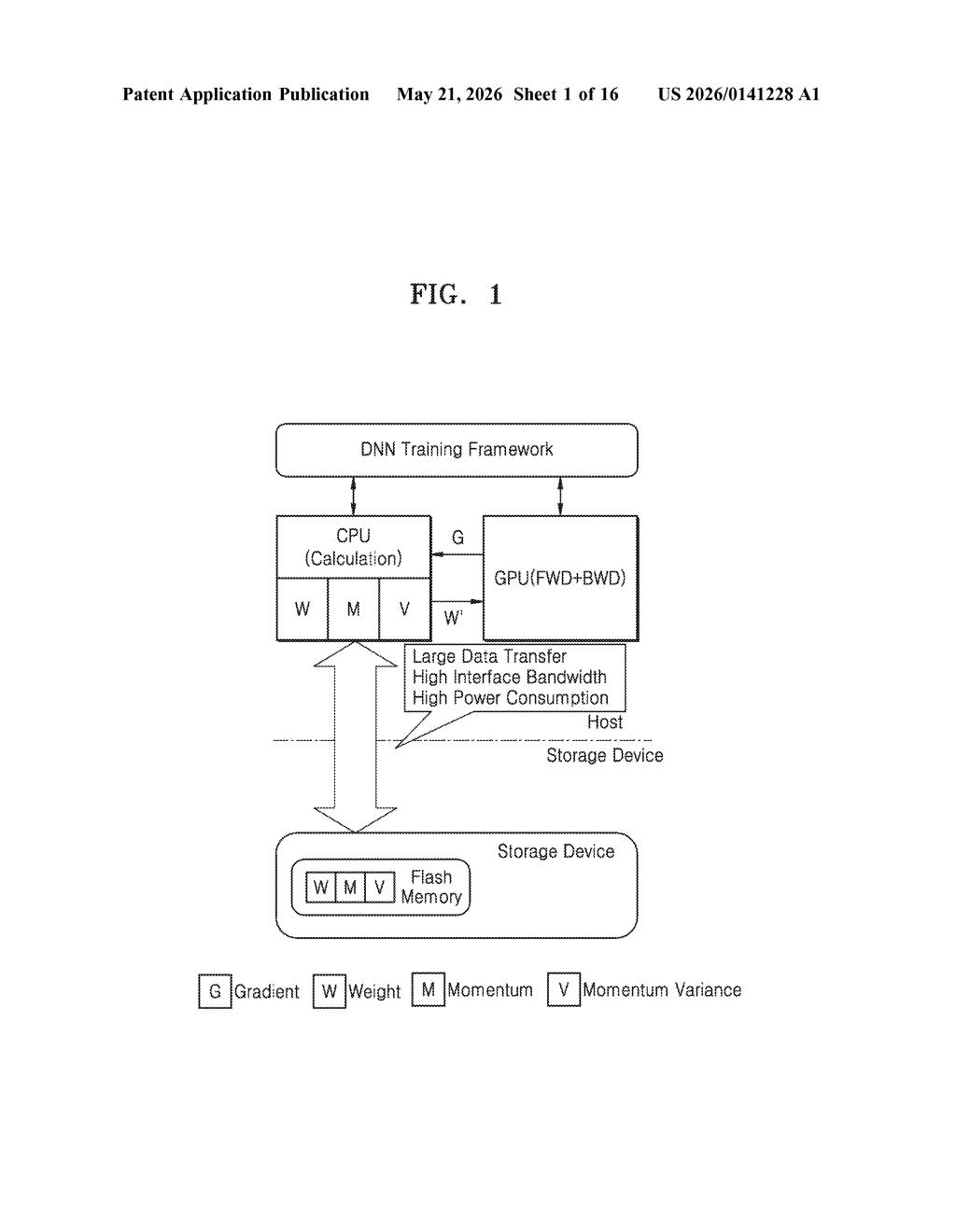
What Samsung's in-storage AI training actually does
Imagine every time you want to train an AI model, your computer has to haul enormous amounts of data from your hard drive all the way to the processor — over and over, billions of times. That data movement is slow, energy-hungry, and increasingly the thing that slows modern AI training down.
Samsung's patent flips that assumption. Instead of moving data to the compute, it proposes doing the AI training calculations inside the storage device itself. The drive receives a signal from the host system saying "update your model parameters," crunches the numbers using the data already sitting right there, and sends back just the results — not the raw data.
For you as an end user, this could eventually mean faster, cheaper AI training — because less data has to travel across the system bus, and the host processor gets to focus on higher-level tasks rather than shuffling numbers around.
How the storage device calculates DNN parameters on-device
This patent describes a computational storage architecture where a storage device — think an SSD or similar flash-based hardware — takes on active responsibility for calculating deep neural network (DNN) model parameters during training, rather than passively serving raw data to an external processor.
The workflow has three steps:
- The host sends input data to the storage device (or the device already holds it).
- When the host issues a parameter updating request — essentially saying "it's time to update the model" — the storage device computes the DNN parameters locally using that data. The patent abstract specifically calls out momentum and variance as values being calculated, which are key components of optimizers like Adam (a popular algorithm used to update neural network weights during training).
- The storage device transmits at least a portion of the calculated parameters back to the host — meaning it can selectively return only what the host needs, not the entire dataset.
This is a form of near-data processing (NDP) or computational storage — a long-studied idea in computer architecture where logic is embedded close to where data lives to avoid the expensive, high-latency round-trip across memory buses and PCIe interconnects.
What this means for AI training bottlenecks and data movement
The core bottleneck in large-scale AI training isn't always raw compute power — it's data movement. Shuttling training data between storage, DRAM, and GPU accelerators consumes significant energy and time. By offloading parameter calculations to the storage layer, Samsung's approach could reduce that overhead meaningfully, especially for workloads where the dataset is too large to fit in high-speed memory.
For the broader AI infrastructure market, this signals that Samsung — a dominant player in NAND flash and DRAM — is positioning its storage products as active participants in the AI compute stack, not just passive data containers. If this architecture makes it into real products, it could change the way data centers and edge AI systems are designed.
This is a genuinely interesting systems-architecture patent, not a flashy consumer feature. The idea of computational storage has been kicking around academia and standards bodies (like SNIA's Computational Storage Architecture spec) for years, but Samsung actually shipping this in training-oriented SSDs would give the concept real traction. The fact that the patent explicitly calls out momentum and variance — optimizer state, not just raw weights — suggests Samsung's engineers are thinking about real training loops, not toy examples.
There are more where this came from
We read every patent application Big Tech publishes and send you the ones worth knowing. Plain English, free, every week.
Want this weekly breakdown for a company we don't cover? Patentlyze Pro →