
Nvidia Files Patent to Stop One Dropped Frame From Wrecking Your Video Stream
When a video stream loses one piece of data, the damage usually spreads to every frame that follows. Nvidia's filing rearranges which frames lean on which, so a single loss stays contained.
What Nvidia's interleaved video chains do
You're deep into a match on a cloud gaming service when your Wi-Fi hiccups and one small piece of the video never arrives. Instead of a quick blip, the picture freezes or smears into blocky mush for a second or two.
That happens because compressed video is built from shortcuts: each frame is mostly a note saying "same as the last one, except for these changes." Lose one frame and every frame built on it is in trouble.
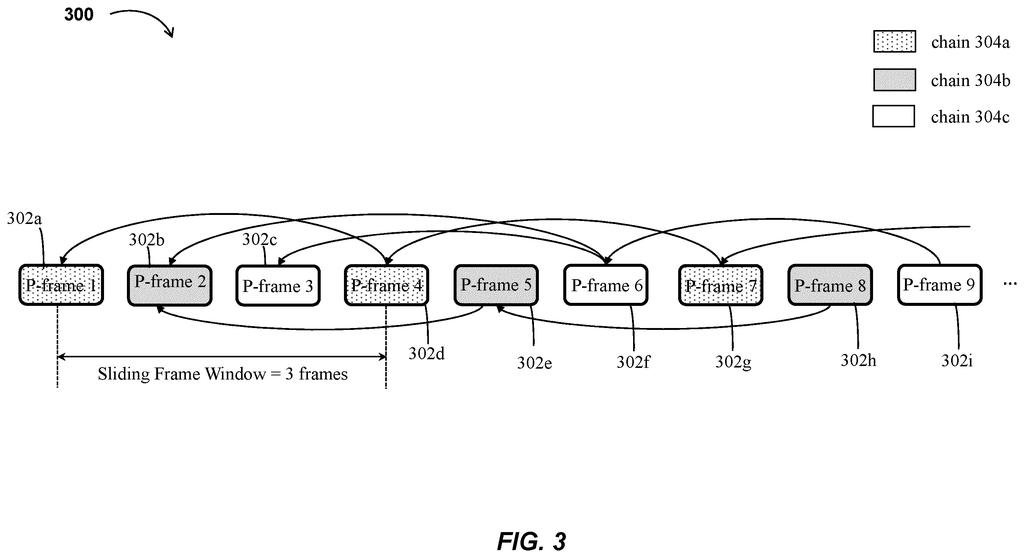
Nvidia's filing changes which frame each new frame leans on. Instead of always copying the frame right before it, the sender copies one a few frames back, so the video becomes several separate chains woven together. Lose a frame and only one chain gets hurt, while the others keep the picture moving. The sender also adjusts how far back to reach based on how long the connection takes to report trouble.
determine a size of a frame window for a video stream, the size of the frame window representing a minimum separation between at least one inter frame and a corresponding reference frame …
Translation: The processor calculates the minimum required distance between dependent video frames and their baseline reference frames.
How the encoder sizes its frame window
The filing describes a video encoder (the part that compresses video before it is sent) that enforces a sliding frame window: a minimum number of frames that must sit between a compressed frame and the earlier frame it copies from. In the main example the window is 3 frames, so the video splits into three independent, interleaved chains that share only the first full frame.
Claim 1 covers how the window gets sized. The encoder counts how many frames it sent after an earlier frame, and uses that count to set the gap. In the description, the viewer's device reports a missing frame and the sender counts what went out in the meantime. Those counts can be averaged, including as an exponential average (one that weights recent readings more). The window can also match the round trip delay plus the time the viewer's device waits before declaring a frame lost, and it stays at or below the size of the decoder's picture buffer (its memory for reference frames).
When a loss report arrives, the sender:
- Marks the lost frame, and any already-sent frames that depend on it, as invalid;
- Encodes the next frame that would have leaned on it so it uses an intact frame instead, or as a full frame, or drops it.
Claim 20 covers the viewing side: a device that declares a frame lost when a recovery timer expires, sends a message, then decides whether to drop or decode the frames that depended on it.
… such that a separation between any pair of video frames of the plurality of video frames including a reference frame and a corresponding inter-frame is greater than or equal to the size of the sliding frame window.
Translation: This ensures frames stay far enough apart in the transmission stream that a single lost frame does not corrupt the entire video.
Why game streaming could feel less glitchy
If you stream games or video from a server, one dropped scrap of data can freeze the picture or smear it into blocks for a moment. Spreading frames across independent chains aims to turn that into brief, scattered blips, and the sender adapts the spacing as your connection gets better or worse. The filing names game streaming (such as NVIDIA GeForce NOW), remote desktops, and VR and AR streaming as example uses.
The filing also notes a trade-off: spacing frames farther apart means the receiving device must hold more reference frames in memory, which is why the window is capped by that buffer's size. For you, the payoff would be fewer long freezes on shaky Wi-Fi, if a company ever builds this into a product. The filing itself promises none.
Nvidia's 591st filing in our Nvidia coverage since May joins earlier applications like the face-as-dots video call idea and the lost-car self-check.
Claim 1 is short. It covers a processor that sets a minimum gap between a frame and the earlier frame it copies from, using counts of frames sent after earlier frames, and then compresses video to respect that gap. It says nothing about lost frames, separate chains, or the receiver's memory limit; those arrive only in later claims.
That breadth is the interesting part. If granted, wording this general would reach any video chip or encoder software that sets its gap by counting frames, however it handles the rest. Companies that build video calls or game streaming would want to read it closely.
Claim 20 flips to the viewer's side: a device that declares a frame lost when a timer runs out, sends a message, and then chooses whether to drop or decode the frames that leaned on it. Together the independent claims cover both ends of the connection, which makes this a thorough piece of plumbing and a fairly routine one in subject matter.
Get our take in your Top Stories
Liked this breakdown? Add Patentlyze as a preferred source on Google, and our plain-English take shows up more often in your Top Stories the next time Nvidia patent news breaks.
There are more where this came from
We read every patent application Big Tech publishes and send you the ones worth knowing. Plain English, free, every week.
The drawings
9 drawing sheets from US 2026/0332782 A1 · click any drawing to enlarge


Show the other 1 sheets

Want this weekly breakdown for a company we don't cover? Patentlyze Pro →
Be the first to weigh in