
Qualcomm Files Patent to Catch Garbled Data When Phones Teach an AI Together
When many phones help train one AI model, their signals are added together in the air, and a burst of static can ruin the total without anyone knowing. Qualcomm's filing attaches a small set of check numbers to each transmission so the network can tell.
What Qualcomm's check-number idea actually does
Ever tried to add up a dozen people's answers while they all shout at once? If a truck rumbles past, you could mishear the total and never realize it.
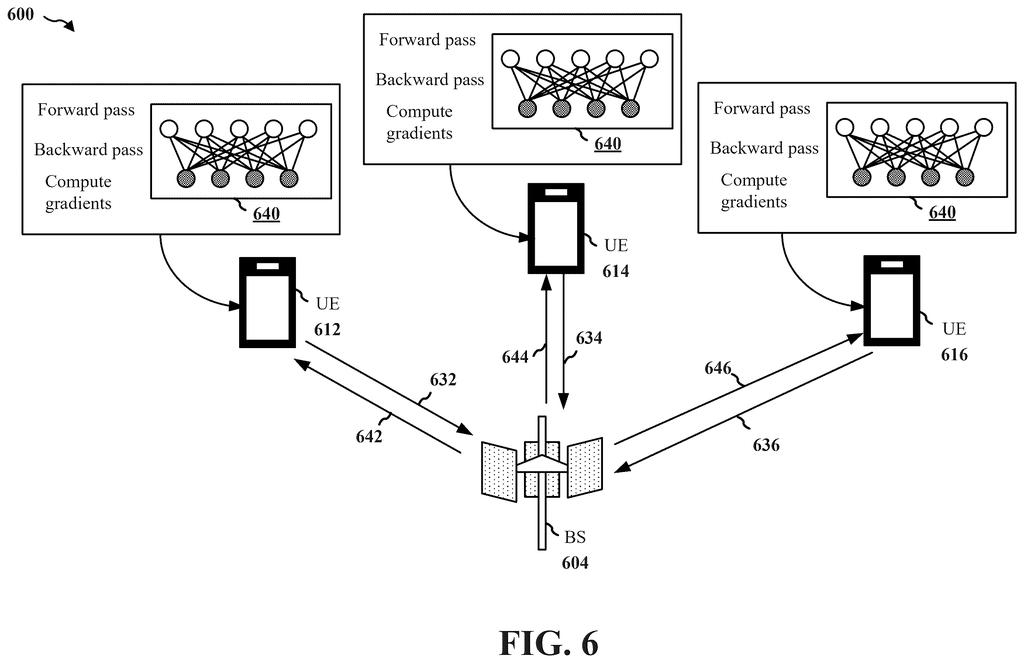
Phones can help train an AI model without handing over your personal data. Each phone learns from its own information and sends only a summary of what it learned. To save airtime, all the phones transmit at the same moment, and their radio signals simply add together on the way to the cell tower.
The risk is that static corrupts that combined total without anyone noticing. Qualcomm's patent application has each phone also send a few extra check numbers worked out from its own data. The tower redoes the math on the total it received and compares. If the two disagree, it asks for a resend.
receive, from each user equipment (UE) of a set of multiple UEs, communication information, wherein for each UE in the set of multiple UEs, the communication information includes: one or more data values associated with communication between the UE and the network entity, and one or more error detection values associated with the one or more data values …
Translation: The server collects updates and error checks from multiple phones at the same time.
How the tower compares totals to catch bad data
The setup is federated learning (many devices train a shared AI model on local data and send updates, not raw data). The filing targets over-the-air aggregation: every phone transmits at once, the signals add together in the air, and the base station receives the sum directly.
To catch errors, each phone multiplies its K data values by a redundancy matrix (a fixed grid of numbers shared with the tower), producing a smaller set of C check values. It sends both. The tower runs the same math on the total it received and compares that with the sum of the check values.
The filing describes two ways to compare:
- Analog version: the tower measures the gap (a straight-line distance) and flags trouble past a threshold. Checking each value separately shows which pieces were hit.
- Lattice version: values snap to points on a regular grid so small noise rounds away, and the check values must match exactly. Wrap-around math using a prime number keeps them small.
On a mismatch, the tower can ask for a resend, even of just the affected values, or start an update of the pre-equalization settings (adjustments that offset how the radio channel distorts each phone's signal). Claims cover the tower side and the phone side.
Why shared AI training needs a safety check
If networks train AI models across many phones at once, your phone could help improve jobs like beam prediction (choosing the best direction for radio signals) without uploading your personal data. The training also uses less airtime because everyone transmits together. That efficiency only pays off if the combined result can be trusted, and a check like this protects it when a moving phone or a burst of noise garbles a transmission.
The filing also stresses reproducibility: engineers should be able to retrace and debug a training run, even when errors look minor. Resending only the damaged values instead of the whole batch trims the cost of fixing mistakes. It is aimed at 5G and future 6G network gear, so any benefit would reach you indirectly, through better network behavior.
Qualcomm's 20th filing we've tracked since July in our on-device AI privacy watchlist builds on earlier ideas like a backup AI plan and training without your data.
The problem is easy to overlook and costly to ignore. When signals add together in the air, one stretch of static can corrupt the total, and the tower has no way to know. A model trained on bad totals can drift, settle on wrong answers, or become impossible to debug.
The fix is sized sensibly. Each phone adds only a handful of extra numbers, far fewer than the data itself, and the tower can ask for just the damaged pieces again. That is cheap insurance on a trick designed to save airtime in the first place.
You will never see this feature on a screen. It sits inside network equipment and matters only if carriers and phone makers adopt over-the-air training at scale. As plumbing goes, it has a clear job and a believable price tag.
Get our take in your Top Stories
Liked this breakdown? Add Patentlyze as a preferred source on Google, and our plain-English take shows up more often in your Top Stories the next time Qualcomm patent news breaks.
There are more where this came from
We read every patent application Big Tech publishes and send you the ones worth knowing. Plain English, free, every week.
The drawings
14 drawing sheets from US 2026/0332499 A1 · click any drawing to enlarge


Show the other 6 sheets


Want this weekly breakdown for a company we don't cover? Patentlyze Pro →
Be the first to weigh in