
Google Files Patent to Make AI Pictures Match Your Written Description
Ask an image generator for a white boat on the water and you want exactly that. Google's patent application trains one to check every word of your request against every region of the picture.
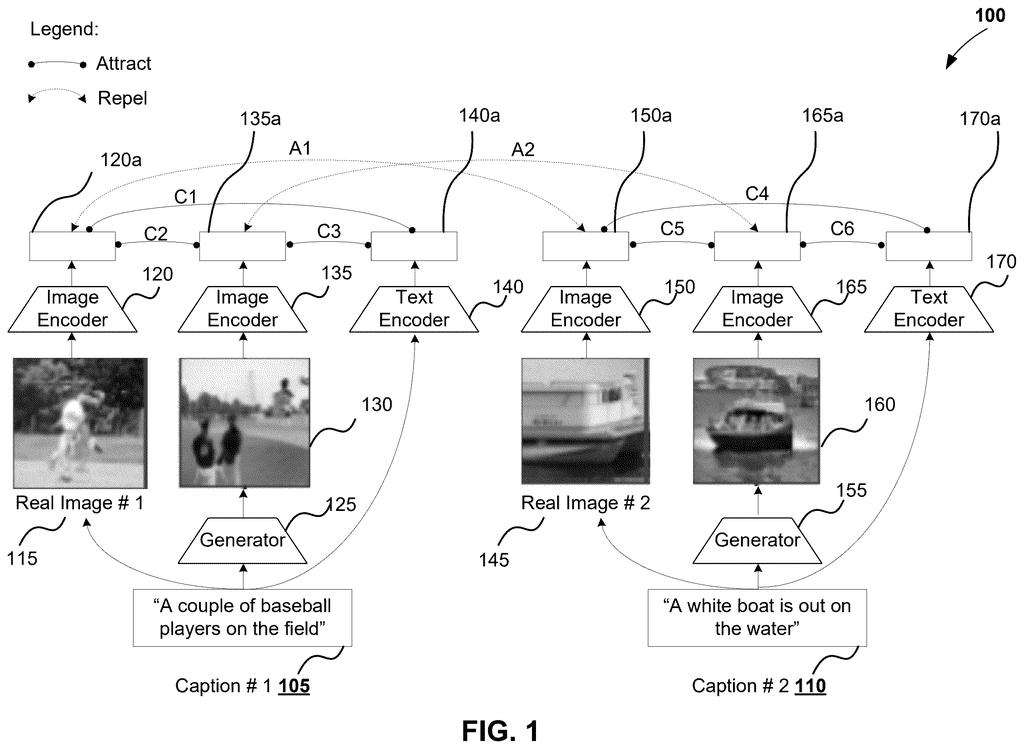
What Google's word-to-picture training does
Every time you type a description into an AI image tool, you hope the white boat ends up on the water and the baseball players end up on the field. Older image generators struggled most with busy scenes that have many objects, according to the filing.
Google's patent application covers a way to build a generator that stays close to your words. As it draws, the system checks each word of your description against each region of the picture, so boat shapes the boat area and water shapes the water. Training adds a push and pull: a picture and its own caption get drawn together, while a picture and a mismatched caption get pushed apart.
In Google's own tests, human reviewers ranked this model's pictures best for realism 77.3% of the time and best for matching the text 74.1% of the time, against three rival models.
… word-region attention mechanism configured to determine an alignment between specific words in the sequence of words and specific regions of the output image rendition …
Translation: The AI connects specific written words to the exact parts of the picture they describe.
How Google's generator links words to regions
The claims describe a three-part recipe. First, your text is converted into numbers by a language model (the filing names BERT, a widely used text-reading model), producing one summary of the whole sentence plus a set of numbers for each word. That sentence summary is joined with random noise, the starting point every new image grows from.
Second, a generator (the network that does the drawing) builds the picture. Inside it, a word-region attention step (a way of deciding which words matter for which part of the image) scores every word against every region and mixes the relevant word information into that region. The filing says this avoids the object boxes and outlines that earlier methods needed.
Third, training uses a contrastive loss (a score that rewards matches and punishes mismatches) to raise the mutual information (how much knowing the picture tells you about the text) between image and caption. It works at three levels:
- The whole picture against the whole sentence
- A generated image against a real photo with the same caption
- Individual regions against individual words
The filing also describes spoken requests, art and photo styles, virtual reality scenes, game scenes, and video frames as optional uses.
… trained to cause two image renditions associated with a same textual description to attract each other and two image renditions associated with different textual descriptions to repel each other …
Translation: The system learns by pulling pictures of the same text closer together and pushing different ones apart.
What this means for Google's image tools
If you use an image tool that draws from a text box, the practical stake is fewer retries. A model that ties words to regions is aimed at the familiar failure where objects go missing or land in the wrong place, especially with long descriptions. The filing tested descriptions averaging about 42 words and reports gains there too.
For Google, what this describes is a training recipe, and the filing names no product. It does list places the output could go: virtual and augmented reality scenes, game environments, screenplay scenes, and strings of video frames. This application continues a family begun in 2021, and one earlier member has since been granted.
Google's 70th filing we've tracked since May in our AI photo editing race watchlist follows one on turning photos into ad scenes and another on reaction video capture.
Shipping this would take almost no new hardware: the filing needs software and a large pile of captioned pictures. Its own tests use public photo collections with captions, and it describes running the finished model on one device or on a server that other devices ask.
The shortest route to a product is to train a model this way and put it behind a text box, the same place every image tool already lives. The filing continues an application first filed in 2021, which tells you the research itself is mature. What the document cannot tell you is whether this recipe still beats whatever Google trains on today, so the gating item is a head-to-head test.
Verdict: a believable, low-drama piece of engineering with a clear path to a feature.
Get our take in your Top Stories
Liked this breakdown? Add Patentlyze as a preferred source on Google, and our plain-English take shows up more often in your Top Stories the next time Google patent news breaks.
There are more where this came from
We read every patent application Big Tech publishes and send you the ones worth knowing. Plain English, free, every week.
The drawings
15 drawing sheets from US 2026/0330706 A1 · click any drawing to enlarge


Show the other 7 sheets


Want this weekly breakdown for a company we don't cover? Patentlyze Pro →
Be the first to weigh in