
Apple Files Patent to Spare Headset Wearers a Fresh Eye Scan Every Time
A headset that tracks your eyes needs a detailed map of them, and that map changes when you swap glasses for contacts. Apple's filing describes a quick check that finds the right saved map, or asks you to make a new one.
How Apple's headset picks your saved eye profile
Every time you put on a headset that tracks your eyes, it has to work out whose eyes it is looking at, and what is sitting in front of them. Your eyes look different through glasses, contact lenses or clip-on lenses, and the device's eye tracking depends on a detailed 3D model of your eye.
Apple's filing describes a quick check that runs as you put the device on. It snaps a picture of your eye, compares it against the eye profiles you saved earlier during setup, and picks the closest one. The description says this can happen without you noticing.
If nothing matches well enough, the device asks you to set up a new profile. That way you only repeat the scan when something really changed, like a new pair of glasses.
… responsive to none of the eye models in the set of one or more eye models satisfying the threshold, triggering an eye model enrollment process to obtain a new eye model for the set of one or more eye models.
Translation: If no saved eye profile matches closely enough, the headset forces the user to go through a fresh eye scan.
How residual error picks the winning eye model
The process starts when a camera detects your eye, for example when you put on a head-mounted device (a headset or glasses-style display). It captures one or more images and pulls out eye properties, such as the outline of your cornea (the clear dome over the iris) and features of your pupil.
The device also holds a set of saved eye models. These are mathematical stand-ins for your eye, built during an earlier enrollment (a setup step where you look in different directions while the screen brightness changes). For each saved model, the device works out what your eye should look like and compares that to the live image.
The gap between the two is called residual error, meaning the difference between where the model predicts a feature to be and where it actually shows up. Smaller error means a higher matching score. The best-scoring model is only used if it clears a set threshold:
- If a model passes, it feeds gaze tracking or biometric authentication (identifying you by your eye).
- If none pass, the device triggers a new enrollment to add another model.
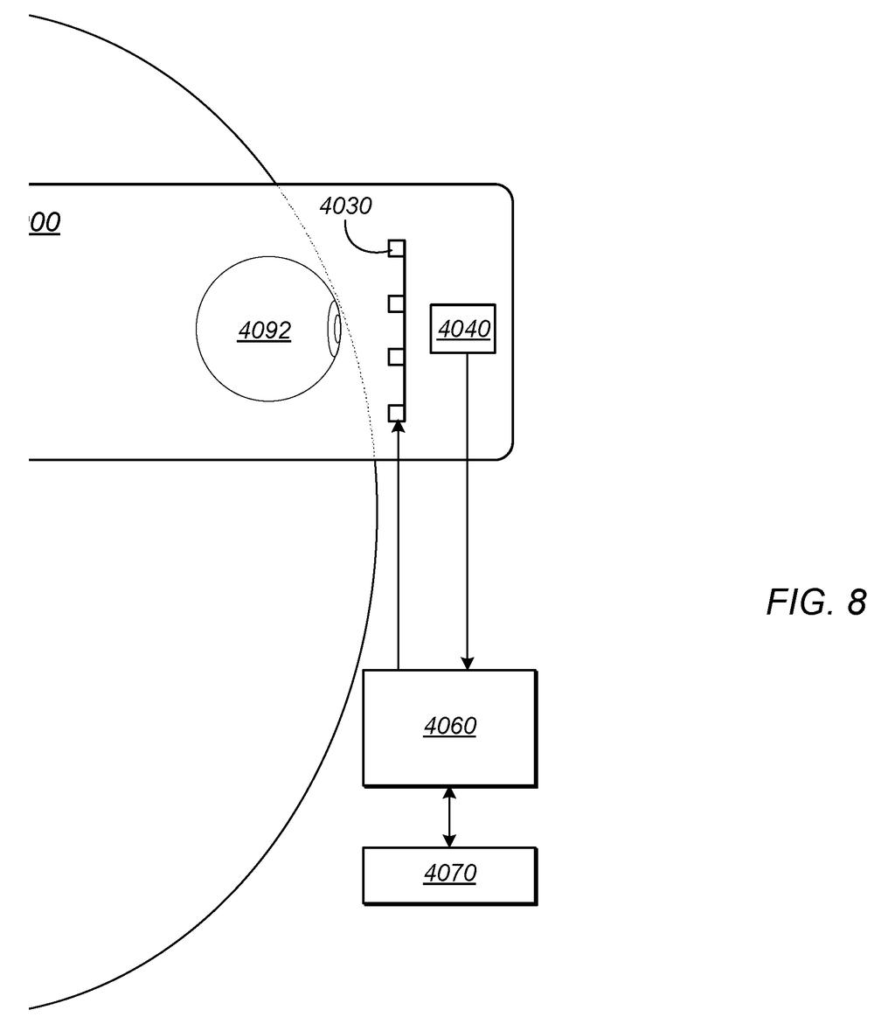
The filing also describes running this separately for the left and right eye, using one or two cameras and infrared LEDs to light the eye.
An eye model matching process is then implemented to determine a stored eye model (e.g., an eye model stored after enrollment of the eye on the device) that best matches the eye in the captured image.
Translation: The system compares a fresh picture of your eye against previously saved profiles to find the right match.
What this means for glasses wearers in headsets
For you, the payoff is fewer setup chores. The filing says matching reduces the need to enroll your eyes before every use, and it can pick the right profile when you switch between glasses, contacts or no correction. It could also tell different people apart when they share a device and their eye models differ.
For Apple, accurate eye tracking supports things the filing lists, like choosing where the camera focuses and letting you interact with on-screen content by looking at it. The filing never names a product, but headsets such as Apple Vision Pro could be a natural home for this kind of check.
Apple's 99th filing we've tracked since May in our Apple AR glasses work builds on earlier applications like one on headset sleep intervals and one on upload conflict sorting.
Claim 21 is wide. It asks for a camera, a memory holding one or more eye models, and a controller that tests a saved model against a threshold. Even a device with a single saved model fits that wording.
The claim names two uses for a passing model, gaze tracking or biometric authentication, so it reaches past eye tracking into using your eye to prove who you are. Later claims add headsets, handheld devices and wall-mounted devices, so the wording covers several kinds of hardware.
The distinctive step is the fallback: when no saved model passes, the device starts a fresh enrollment. That pass-or-re-enroll loop is the core of what the claim describes. It is a modest idea with a practical payoff, since it saves wearers from repeating setup every time they put the device on.
Get our take in your Top Stories
Liked this breakdown? Add Patentlyze as a preferred source on Google, and our plain-English take shows up more often in your Top Stories the next time Apple patent news breaks.
There are more where this came from
We read every patent application Big Tech publishes and send you the ones worth knowing. Plain English, free, every week.
The drawings
10 drawing sheets from US 2026/0330872 A1 · click any drawing to enlarge


Show the other 2 sheets


Want this weekly breakdown for a company we don't cover? Patentlyze Pro →
Be the first to weigh in