
Sony Files Patent to Freeze Your VR Game When You Near a Wall
A new Sony patent has your VR game stop and show you the real room before you walk into a wall. Along the way, it tries to make the warnings feel less like being boxed in.
What Sony's VR boundary warning actually does
A player in a VR headset takes a big step backward in the middle of a fight scene. Behind them sits a coffee table they can't see.
Sony's answer, in this patent application, is a safety net with two layers. As you drift toward the edge of the play area you set up, a glowing section of virtual wall appears only near you, so the whole room doesn't fill with grid lines. If you get too close, or step out of the zone, the game pauses and the headset shows you the real room through its own camera.
The idea is to warn you early without making a small play space feel like a cage. Sony's background section says showing the entire wall can feel oppressive, especially in a narrow space. A full freeze is the last resort.
… determine, based on the position of the user, whether the user has approached a boundary surface that divides a permitted region in the real space where the user is allowed to exist from an unpermitted region in the real space where the user is not allowed to exist …
Translation: The system tracks if you are getting too close to the edges of your safe playing area.
How the headset decides which wall to show
The core of the filing is a safety rule. The headset's software tracks where you are in your real room. You mark off a permitted region (the area where you can safely move) with a virtual boundary surface (an invisible wall the system remembers). If you get close to that wall or cross it, the game program is suspended (paused) and the headset's front camera feed replaces the virtual scene.
Before that point, the description lays out gentler warnings:
- Only the part of the wall near you is drawn. The system checks which sections fall inside a set distance around you, and that distance grows as you get closer, so more wall appears.
- Sections nearest you turn redder and farther ones turn yellower. The rest of the wall fades in from invisible to fully solid as you approach.
- Ripples spread along the wall, and a colored band lights up the screen edge on the side nearest it. If the wall is behind you, all four edges light up.
The filing also covers some practical details. Walls can be shaped differently at different heights, so the headset's position is used to warn you about your feet even without a foot sensor. Camera-based hand tracking can notice a hand or foot nearing the wall, and you can set up the boundary by sticking out an index finger instead of using a controller. Sound and text warnings can run at the same time.
… reducing an oppressive feeling of a user when a virtual object representing a boundary surface dividing a region in a real space in which the user is permitted to exist from a region in the real space in which the user is not permitted to exist is displayed …
Translation: Sony wants to stop boundary warnings from feeling scary and claustrophobic.
Why showing less wall matters in a small VR room
If you've played VR in a cramped living room, you know the dilemma. Warnings are either too faint to save your shins or so heavy they ruin the game. This filing tries to scale the warning to how close you are, and it keeps a hard stop, a pause with the real room on screen, as the backup.
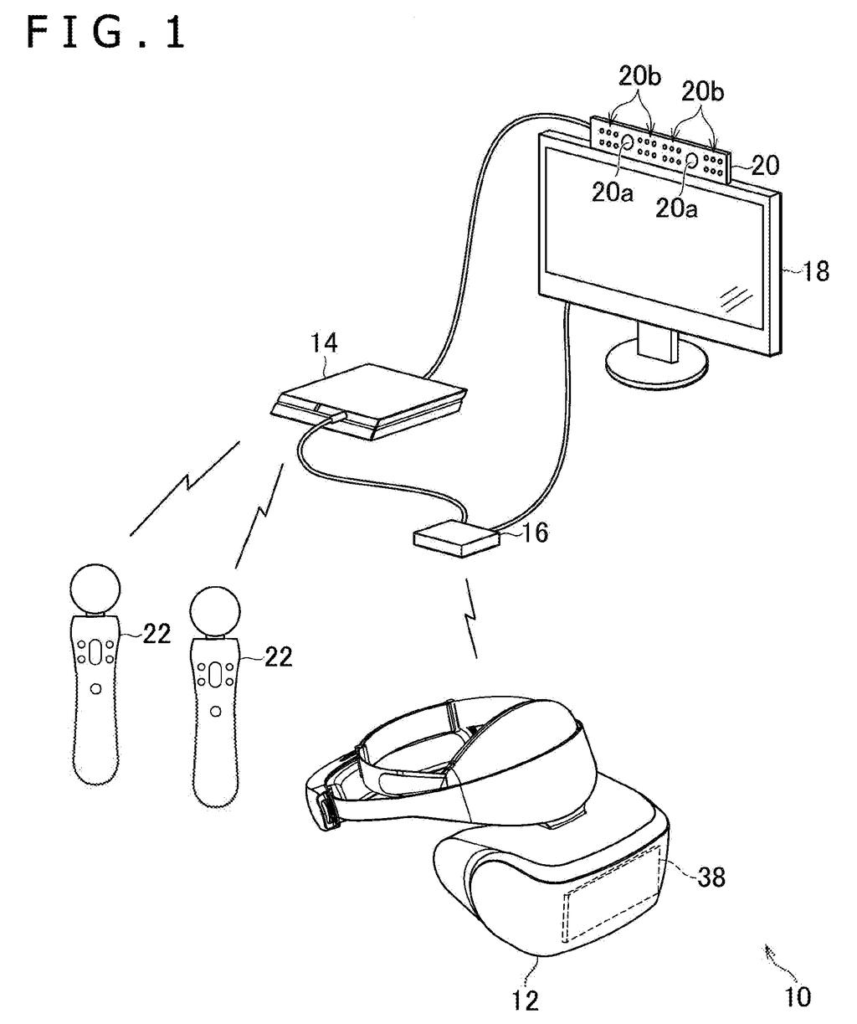
The filing describes a game console, a headset, and controllers, so it fits a living-room setup. It is also a continuation of an application with a 2019 Japanese priority date, so the core idea has been around for a while. Whether it shows up in a product is unknown, since the filing names none.
Sony's 43rd filing we've tracked since July in the AR glasses race adds to earlier work on tiny picture-evening structures and slimmer eye-tracking glasses.
Every VR safety system trades immersion for protection, and this one draws only the nearby slice of wall to keep a tight room from feeling like a cage. The cost is less awareness of the rest of the boundary, which looks like a fair price.
The hard stop costs more. Freezing the game and flipping to the camera view protects your shins. It also yanks you out of the moment, and a pause makes little sense for anything you can't stop, like a live match with other people. The filing doesn't say how it handles that.
The whole system depends on the headset knowing exactly where you are. If tracking drifts, the warnings land late. The gentle fades plus the pause backup make a sensible pair, since neither alone covers a player who is looking the wrong way.
Get our take in your Top Stories
Liked this breakdown? Add Patentlyze as a preferred source on Google, and our plain-English take shows up more often in your Top Stories the next time Sony patent news breaks.
There are more where this came from
We read every patent application Big Tech publishes and send you the ones worth knowing. Plain English, free, every week.
The drawings
10 drawing sheets from US 2026/0325955 A1 · click any drawing to enlarge


Show the other 2 sheets


Want this weekly breakdown for a company we don't cover? Patentlyze Pro →
Be the first to weigh in