
Meta Files Patent for Glasses Batteries Shaped to Fit Inside Slimmer Frames
Smart glasses have to hide a battery inside an arm built to look like regular eyewear, and boxy batteries make that hard. Meta's answer is a battery shaped like the arm itself.
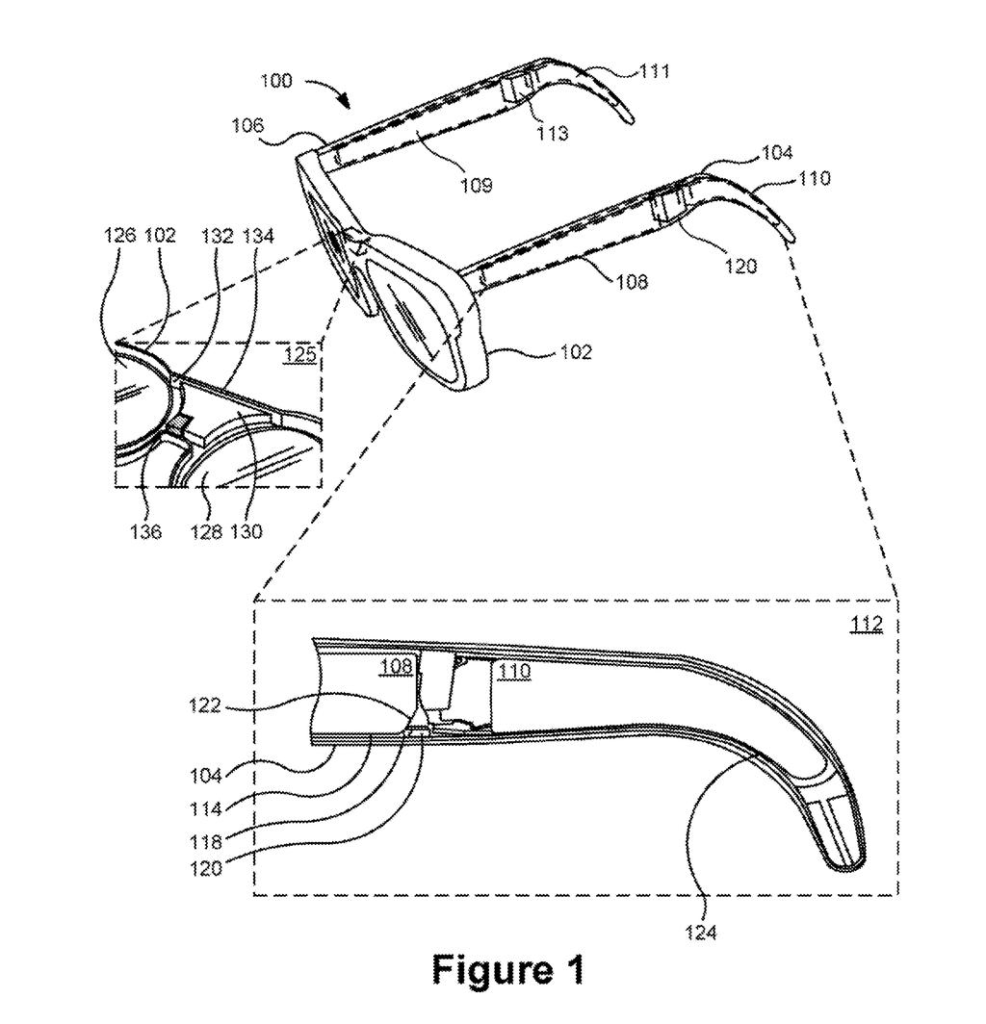
What Meta's custom-shaped glasses battery does
A pair of smart glasses has to cram a battery, a speaker and a microphone into an arm that is supposed to look like ordinary eyeglasses. Off-the-shelf batteries are boxy rectangles, so designers end up with thick, square arms just to hold them.
Meta's filing goes after that by changing the battery instead of the frame. The metal-cased cell is tapered and trimmed to match the inside curve of the arm, with an angled corner that leaves room for parts like a speaker.
The company says the payoff is twofold: frames that look more like sunglasses or regular prescription glasses, and more battery packed into the same space, so you go longer between charges.
… a metal-encased battery having an exterior surface that defines a non-rectangular shape, wherein: the metal-encased battery is configured to be housed within the temple arm; the metal-encased battery tapers in thickness across two axes; and the non-rectangular shape of the exterior surface follows an interior shape of an internal surface of the temple arm …
Translation: The glasses use a custom-shaped metal battery that thins out to fit snugly inside the curved arm.
How the battery gets built to fit the arm
The main claim covers glasses with a front frame, an arm attached by a hinge, and a metal-encased battery inside that arm. The battery's outer shape is not rectangular and follows the inside surface of the arm, and its thickness tapers in two directions, so it is not a plain slab. Electronics in the front frame draw power from it.
The filing describes several variations:
- An edge can be chamfered (cut at an angle) so a speaker or microphone can partly overlap it.
- An arm can hold two differently shaped batteries, both arms can have their own, and another cell can sit in the nose bridge of the frame.
- Hooks, tabs, springs or screws hold the battery in place.
It also explains how the cell is built. Two metal shells (steel in one claim) are laser welded together with no ledge, which the description says can make the cell up to 20% bigger than one that needs a ledge. The walls are 100 to 300 micrometers thick so the weld holds.
Inside, the stacked electrodes (the thin layers that store and release charge) are die-cut in different sizes as they are layered, which creates the taper. The description says this can add 10 to 30% in energy density compared with a rolled cell in the same space. It adds that the battery can stiffen the arm and counterbalance parts in the front frame.
An example augmented-reality headset comprises a frame portion, a temple arm portion coupled with the frame portion, and a metal-encased battery cell having an exterior surface that defines a non-rectangular shape.
Translation: Smart glasses use a specially shaped battery housed inside the arm of the frame.
What this could mean for everyday smart glasses
Battery life is one of the biggest limits on glasses that need to look like glasses. Every cubic millimeter in an arm counts, so a battery that fills the space instead of sitting in a boxy case could give you more hours without making the frame thicker. Weight behind your ears can also balance the parts up front, which affects how comfortable they feel after an hour.
The filing gives percentages for cell size and energy density but no battery-life figures, so the real-world gain is unknown. The examiner's first review rejected the claims as filed, which is routine at this stage and usually followed by amendments.
That makes this Meta's 83rd filing we've tracked since May, joining one that maps walks in 3D and one on a tiny vibrating mirror, in our Meta smart glasses watchlist.
Battery life and looks are the first two things you notice on smart glasses. A chunky arm tells everyone around you that you are wearing a computer, and a dead battery by mid-afternoon tells you. Shaping the cell to the arm goes after both at once.
You would feel the change in small ways: arms that pass for regular frames, a bit of weight balanced behind your ears, and a longer stretch before you reach for the charger. The filing gives percentages for the gain in cell size and energy, but no hours of use, so how much extra time you actually get is unknown.
The idea is simple, and the hard work sits in the manufacturing details, such as walls thick enough to weld without a ledge. Treat it as a sensible engineering step that matters to you only if it reaches a shipped pair of glasses.
Get our take in your Top Stories
Liked this breakdown? Add Patentlyze as a preferred source on Google, and our plain-English take shows up more often in your Top Stories the next time Meta patent news breaks.
There are more where this came from
We read every patent application Big Tech publishes and send you the ones worth knowing. Plain English, free, every week.
The drawings
26 drawing sheets from US 2026/0341775 A1 · click any drawing to enlarge


Show the other 18 sheets


Want this weekly breakdown for a company we don't cover? Patentlyze Pro →
Be the first to weigh in