
Meta Files Patent for a Shock-Absorbing Lens to Keep Dropped Smart Glasses From Cracking
Smart glasses with a built-in display hide a thin, expensive piece of glass that does not like being dropped. Meta's patent puts a tougher plastic lens in the way of the shock.
How Meta shields AR glasses glass in a drop
Every time you knock your glasses off a nightstand or fumble them onto a kitchen floor, the frame takes a hit. With ordinary glasses, that means a scratch. With display glasses, there is a thin piece of glass inside, called a waveguide, that carries the image to your eye, and it can crack.
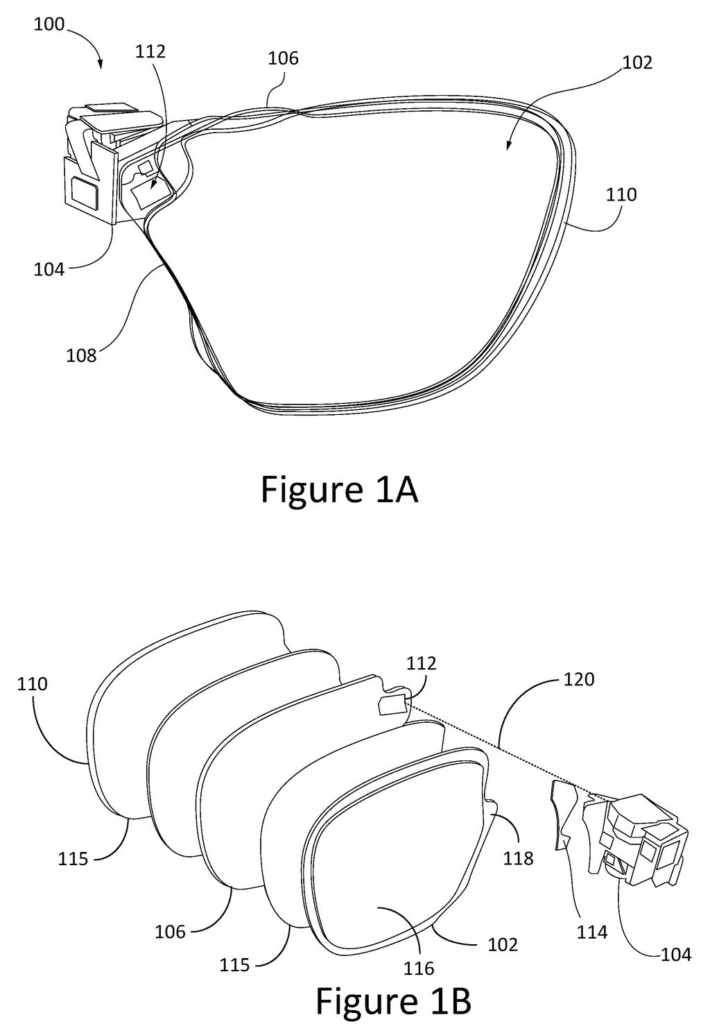
Meta's filing blames the way these parts are usually built. The tiny projector that makes the image normally touches the glass directly, so a jolt to the projector goes straight into the glass. Meta's version glues the projector to a tougher plastic lens instead, and leaves a small air gap between the projector and the glass. Only light crosses that gap.
The plastic lens has a hole where the light passes through, and it is thicker in the areas outside your line of sight, where extra material can soak up more of a bump.
… a lens coupled to the display projector assembly, wherein: the lens is configured to dampen vibrations from the display projector assembly to the waveguide, the lens has a first material having a first shape with a first toughness …
Translation: A specially toughened lens absorbs the shock when glasses are dropped.
Inside Meta's tougher lens and air gap design
The patent describes a display assembly for smart glasses with four main parts: a display projector (the tiny unit that makes the image), a waveguide (a thin sheet of glass that carries that image to your eye), a lens, and an air gap. The claims hinge on one rule: the lens must be made of a material with greater toughness than the waveguide. Toughness here means how much energy a material can absorb before it breaks.
The projector is bonded to the lens, using a liquid optically clear adhesive (a see-through glue), and is not bonded to the waveguide. Light travels across the air gap to a spot on the waveguide called the display window. A shock to the projector lands on the lens first.
The filing describes several variations:
- A cutout in the lens, so light goes from projector to waveguide without passing through it. The cutout can be larger than the display window to avoid visual glitches at the image edges.
- A thinner section in your viewing area and a thicker section outside it, for more shock absorption.
- Foam around the projector, and a mirror assembly that bounces light toward the waveguide.
The description lists polycarbonate and acrylic as example lens plastics. It also says matching the lens thicknesses can reduce uneven stress when the glass and plastic expand at different rates as the glasses heat up.
The first material has a greater toughness or greater thickness than the second material. A gap separates the display projector assembly from the waveguide along the projection axis.
Translation: The protective lens is tougher than the display part to prevent shattering.
Why drop damage matters for display glasses
If you wear display glasses all day, the odds of dropping them at some point are high. Meta's own filing calls the waveguide the most vulnerable and expensive component in the display assembly, so a drop that cracks it could mean a costly repair or a dead display. A design that sends the shock into a cheap, tough plastic part instead makes the glasses more forgiving of ordinary clumsiness.
There is also a heat angle. Because the projector and the glass are no longer fused together, the filing says they can warm up and expand at different rates without straining the glass. For you, that could mean a display that holds up better over months of daily wear, not just a single dramatic fall.
Meta's smart glasses patents reach their 76th filing we've tracked since May, adding to work like hike highlight reels and a multi-band antenna.
Dropping your glasses is among the most common accidents in daily life, and a display that cracks when that happens is a real problem for a product you would wear on your face. Meta's filing says the glass is the costliest and most fragile part of the display, so the target is well chosen.
The fix matches the problem. A tougher lens that already has to sit in the glasses takes on a second job as a shock absorber, and the air gap keeps the projector from hammering the glass directly. That is a modest, practical answer to a modest, practical problem.
The filing gives no drop-test results, only example reductions in force that start as low as 1%. Until real numbers appear, this reads as a sensible design idea. It could matter more to repair bills than to anything you see on screen.
Get our take in your Top Stories
Liked this breakdown? Add Patentlyze as a preferred source on Google, and our plain-English take shows up more often in your Top Stories the next time Meta patent news breaks.
There are more where this came from
We read every patent application Big Tech publishes and send you the ones worth knowing. Plain English, free, every week.
The drawings
6 drawing sheets from US 2026/0319262 A1 · click any drawing to enlarge


Want this weekly breakdown for a company we don't cover? Patentlyze Pro →
Be the first to weigh in