
Nvidia Files Patent for Cars That Guess Which Turn You Plan to Take
Your turn signal tells a car you're turning, but not which of two nearby streets you mean. Nvidia's patent application tries to settle that by letting every possible road collect points until one wins.
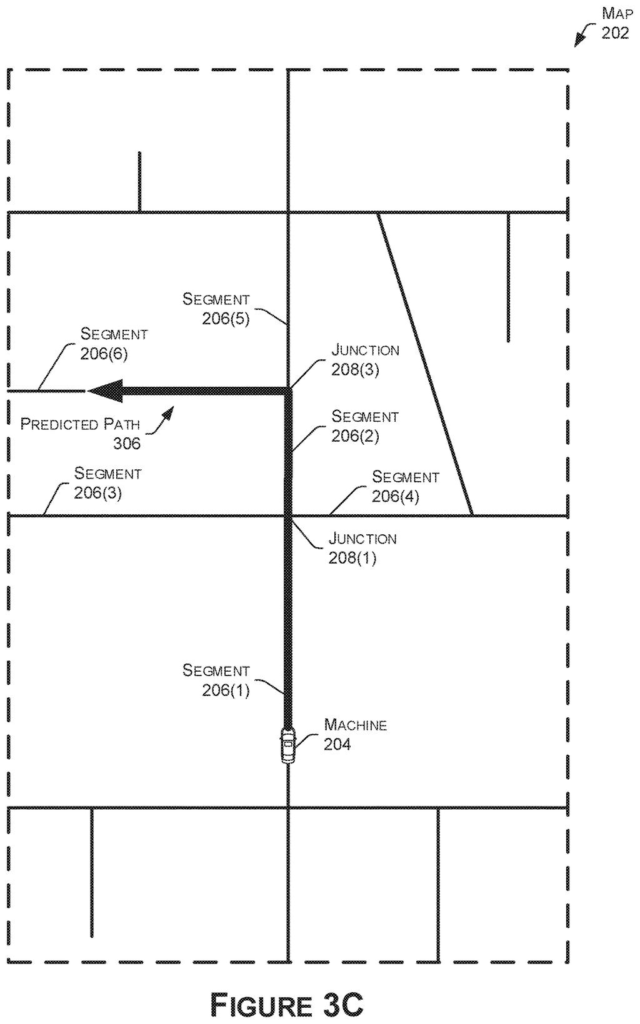
What Nvidia's turn-guessing car patent describes
Your turn signal says you're about to turn left, but not which left. If two side streets are coming up close together, a car that relies on fixed rules can easily guess wrong, and the filing says every system that depends on that guess inherits the mistake.
Nvidia's patent application describes a scorekeeping approach. For each road option at the upcoming junctions, the car hands out points based on clues from you and your surroundings: your turn signal, which lane you're in, how you're steering, even a spoken instruction like turn left at X road. It keeps adding to those points over time, then picks the road with the most.
It also weighs how believable each clue is. If you're going too fast to slow down comfortably for the first turn, the blinker probably means the second one.
determine a plurality of candidate path options for a machine based at least on input data indicative of one or more occupant-intent signals …
Translation: The car looks at clues about what the driver wants to do to figure out where they might drive.
How the scores pile up at each junction
The claims describe a system that lists candidate path options (the roads that lead out of upcoming junctions), scores each one for how likely it is to be the route the occupant actually intends, picks a predicted path from those scores, and then has the machine plan or control its movement based on that path.
The scores come from occupant-intent signals, meaning clues about what the person in the car means to do:
- Whether the turn signal is on
- Steering angle and yaw rate (how fast the car is rotating)
- The lane you are in and any turn arrows painted on it
- Lane changes spotted by comparing your position to a map
- Spoken instructions such as turn left at X road
Scores add up frame after frame into a running total. The filing's example has one road's total climbing from 11 to 20 after another round of data. A cap limits how many points one signal can contribute, so a long-lasting clue cannot drown out the rest, and weights can rank a turn signal above merely sitting in a turn lane, since drivers sometimes wander into those by mistake.
This only applies to junctions within a threshold, with examples of 100 meters, 200 meters or about 5 seconds. Farther out, default rules use map details like road class, turn angle and lane count. When a turn signal could mean either of two turns, confidence scores split the credit, for instance by checking whether slowing for the first turn would exceed a 3.5 meters per second squared comfort limit.
… at a junction(s) where multiple road segments meet, the highest scoring road segment(s) may be selected as the predicted path …
Translation: When approaching an intersection, the system picks the route it thinks the driver will take.
What Nvidia's patent means for driver assist
The payoff is smoother driving help. The predicted path feeds braking and acceleration decisions: the filing describes adding speed to merge onto a freeway, or braking early for a sharp turn so it feels comfortable. For you, that would mean fewer abrupt moves from a car that knows where you are headed. It can also work from standard-definition maps rather than only the detailed high-definition kind.
The claims reach well beyond cars. Trucks, warehouse vehicles, drones, boats and humanoid robots are all listed, and one claim covers a machine with a chip combining CPUs, GPUs and accelerators plus outward-facing sensors. The filing does not tie the idea to any named car or feature, so treat it as a building block for now.
That makes this Nvidia's 106th filing we've tracked since May in the self-driving sensing race, joining one on lane choice without maps and one on spotting pedestrians from sensors.
Most of the pieces here are things a modern car with driver assist already has: a turn signal reading, a camera that sees lanes and arrows, a location fix and a basic map. The scoring is addition with a few weights, and the filing does not call for any new sensor. That puts it much nearer to a shippable feature than most filings.
The shortest route to a product is a software update to a system that plans ahead, with the guess feeding braking and acceleration. What has to exist first is a planner that trusts the guess, plus real driving data to tune details like the 3.5 meters per second squared comfort limit and the point caps.
Bottom line: modest, sensible engineering with a short road to a car. A wrong guess at a junction could mean braking when you don't expect it, so getting the weights right decides whether the feature feels natural or twitchy.
Get our take in your Top Stories
Liked this breakdown? Add Patentlyze as a preferred source on Google, and our plain-English take shows up more often in your Top Stories the next time Nvidia patent news breaks.
There are more where this came from
We read every patent application Big Tech publishes and send you the ones worth knowing. Plain English, free, every week.
The drawings
16 drawing sheets from US 2026/0336638 A1 · click any drawing to enlarge


Show the other 8 sheets


Want this weekly breakdown for a company we don't cover? Patentlyze Pro →
Be the first to weigh in