
Samsung Files Patent for a Headset Dial That Gradually Hides Augmented Reality
Samsung describes a headset control that works like a dimmer switch for reality. Hold the turn and the real room slowly takes over from the virtual one, while the app you're using stays the same size.
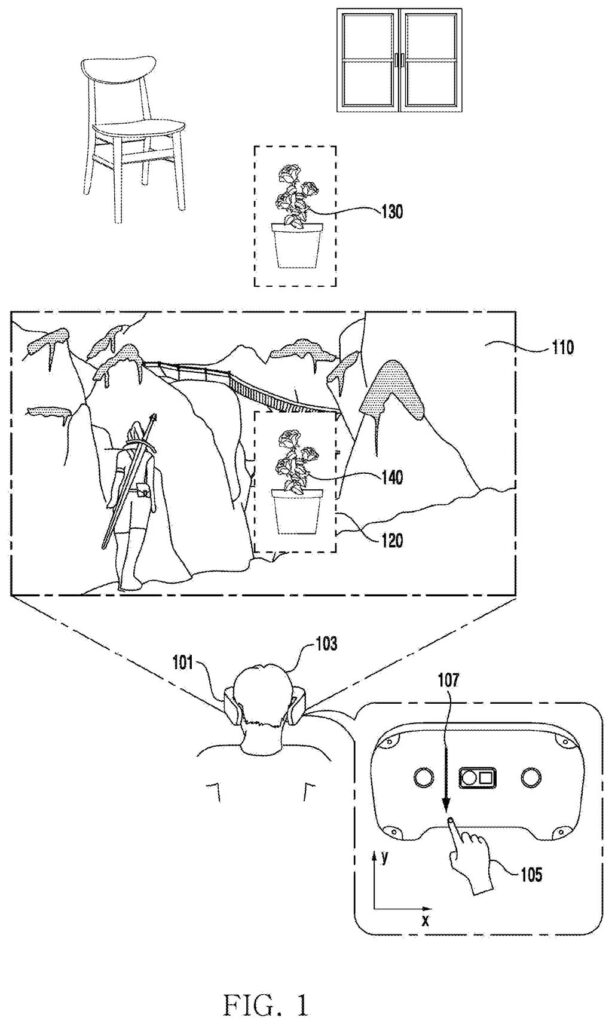
What Samsung's headset dial actually does
A headset that covers your eyes shuts out the room by design. If you want to see who walked in or where your coffee is, the headset has to switch from its virtual mode to one that shows the outside world through its cameras. Samsung's filing is about making that switch quick and gradual.
Here is the idea. You turn a dial on the headset and keep turning. While you hold it, the virtual backdrop shrinks away and a live camera view of your room grows in. In one version, the room appears at the edges of your vision first and spreads toward the center.
The app window or object you were using doesn't shrink or move while this happens. Turn the dial the other way and the real world fades back out, so you can return to the virtual space.
gradually reduce an area where the virtual space is displayed; and gradually enlarge an area where the at least portion of images obtained via the one or more cameras is displayed, and wherein a size of the virtual object is maintained while the first input is received.
Translation: Turning the dial slowly shrinks the virtual background while letting the real world in, but keeps any floating app windows the same size.
How the camera view replaces the backdrop
The first independent claim covers a headset with a housing that covers your eyes, a display in front of each eye, one or more cameras, and a processor. The headset shows a virtual object (an app window, say) on top of a virtual space, which is the computer-made background.
When it detects an input, it starts showing images from its cameras so you can see the environment outside. This is called video see-through: the cameras film the room and the screens play it back in front of your eyes. If the input keeps coming, the headset gradually shrinks the area showing the virtual space and gradually enlarges the area showing the camera view. The virtual object stays the same size the whole time.
The dependent claims add details:
- The camera view can grow from the edges of the display toward the center.
- A second input reverses the effect, shrinking the camera view and bringing the virtual space back.
- A dial can supply both inputs, with one turning direction fading the room in and the other fading it out.
- A third input on the same control can bring up icons for installed apps.
- A visual cue can show how much of the display the virtual space still fills.
The description also covers related ways to trigger the same switch, including dragging a finger across the outside of the headset, hand gestures seen by the cameras, and a handheld controller.
… receives an input for rotating a dial in a first direction while the superimposed virtual object is displayed in the virtual space.
Translation: Sensors track when you physically turn a dial on the headset to shift between virtual reality and the real world.
Why a gradual fade matters for headset users
If you use a headset for work or games, the awkward moment comes when someone speaks to you or you need to find your keyboard. A held dial turn would let you pull in only as much of the room as you need, while the thing you were using stays where it is and keeps its size.
The filing says its goal is easier mode switching, and the hardware it describes is ordinary for this kind of device: screens over the eyes, outward-facing cameras, and one control. That points to a comfort feature, the sort of small control that decides whether a headset feels annoying or easy to wear for an hour.
That makes this Samsung's 75th filing we've tracked in our AR glasses race watchlist since May, adding to work like selective 3D depth and low-light camera correction.
Of all the ideas in a headset patent, this one sits close to ready. A headset that already shows the room through cameras has the screens, the cameras and a place for a dial or touch strip, so what remains is software that blends two video layers while an app window holds still.
The shortest route to a product is a software update plus a decision about which control does the job. The claims cover any input that is held down, and the filing itself lists a dial, a touch-sensitive outer face, hand gestures and a handheld controller.
That makes it a modest comfort feature, a better way to glance at your desk. People who wear a headset for an hour at a time are the ones who would use it constantly.
Get our take in your Top Stories
Liked this breakdown? Add Patentlyze as a preferred source on Google, and our plain-English take shows up more often in your Top Stories the next time Samsung patent news breaks.
There are more where this came from
We read every patent application Big Tech publishes and send you the ones worth knowing. Plain English, free, every week.
The drawings
49 drawing sheets from US 2026/0340968 A1 · click any drawing to enlarge


Show the other 41 sheets


Want this weekly breakdown for a company we don't cover? Patentlyze Pro →
Be the first to weigh in