
A New Adobe Patent Finds the Repeating Tile in Photos of Fabric and Brick
Cutting one clean, repeatable tile out of a photo of bricks or fabric usually takes trial and error. Adobe's patent application tries to get the answer from just two strips of the image.
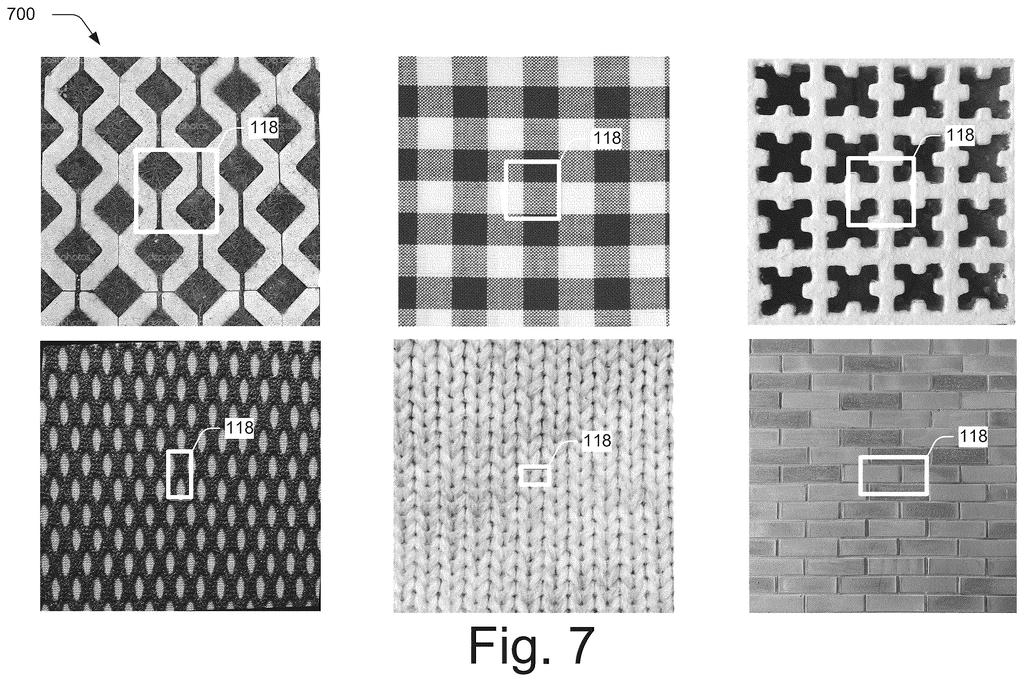
What Adobe's repeating-pattern finder does
Every time a designer wants to cover a 3D shape with brick, fabric or honeycomb, someone first has to find the one small tile in a photo that can be repeated to fill the surface. Where does that tile start, and where does it end? Today that often means cropping and nudging by hand until the seams look right.
Adobe's filing describes a shortcut. Instead of trying lots of possible tiles, the software turns the photo into a map of how well the image matches itself, then reads just one horizontal strip and one vertical strip through the middle. Bumps in those strips show how far you have to slide the image before it lines up with itself again. That distance is the tile size.
The software then double-checks with a second method, keeps the larger answer, and hands back a height and width you can use to cut out the tile.
… identifying, by the processing device, a slice along a first axis of the digital image and a slice along a second axis of the digital image …
Translation: The software cuts horizontal and vertical lines across the photo to analyze its contents.
How Adobe finds the tile from two pixel strips
The claims cover a straightforward chain: receive an image, pick one slice along each of two axes, generate data about pixel color along those slices, and use that data to identify the part of the image that is a visually repeating pattern. A dependent claim makes the two axes perpendicular, and another says both slices pass through the center.
In the description, the slices come from an autocorrelogram (a map showing how strongly an image matches a copy of itself as you shift the copy bit by bit). It is computed quickly with a Fast Fourier Transform (a math tool that breaks a signal into repeating waves). The steps run roughly like this:
- Build the autocorrelogram, optionally cropping the photo to a square and smoothing it to avoid false peaks.
- Take a horizontal and a vertical strip through its center.
- Remove the big central peak, which only says the image matches itself with no shift.
- Find the highest remaining peak in each strip. Its position gives the tile's width and height.
- Run a Fourier transform as a second estimate by counting repetitions, convert it back to pixels, and keep the larger of the two sizes.
Another independent claim focuses on counting how many times the pattern repeats. The filing also says a machine learning model can be used for the estimates, and the output can be applied to cover a 3D virtual object.
… the pattern system identifies a portion of the digital image depicting a visually repeating pattern …
Translation: The system uses those lines to pinpoint where textures like bricks or fabric repeat.
Why texture artists could skip hand cropping
If you have ever tried to make a tiling texture for a game, a room mockup or a 3D model, you know how fiddly it is to find a square that repeats without visible seams. This filing describes doing that automatically, so your photo of a woven basket or tile floor could turn into a usable repeating swatch with far less hand adjustment.
Adobe says the older approach tests many candidate sections and needs people to crop and shift them, which is slow and heavy on computing resources. Checking only two strips is described as faster and lighter. That matters most to graphic designers, interior designers and game artists, who repeat this chore constantly.
Adobe's 242nd filing in our Adobe coverage since May adds to a run that includes the self-writing AI tool and the photo-sharing QR code.
Of all the filings you could picture reaching a real product, this one sits near the front of the line. It needs no new hardware, only software that already runs on a laptop, a phone or a server, and it applies well-known math in a clever order. The filing itself says it can run locally or in the cloud.
What has to exist first is a place to use it: an image editor or 3D tool that takes the tile size and fills a surface with it. The shortest route is a single button that suggests a tile from a photo of fabric or brick, and the output the filing describes (a height and width in pixels) is exactly what such a button would need.
The examples shown are tidy ones like a honeycomb. How well it copes with messy, uneven photos is the open question, although the filing says patterns can be partly hidden or mixed with other content. Expect a modest but useful time-saver rather than a headline feature.
Get our take in your Top Stories
Liked this breakdown? Add Patentlyze as a preferred source on Google, and our plain-English take shows up more often in your Top Stories the next time Adobe patent news breaks.
There are more where this came from
We read every patent application Big Tech publishes and send you the ones worth knowing. Plain English, free, every week.
The drawings
10 drawing sheets from US 2026/0350968 A1 · click any drawing to enlarge


Show the other 2 sheets


Want this weekly breakdown for a company we don't cover? Patentlyze Pro →
Be the first to weigh in