
Apple Files Patent to Keep Airplane Connections Alive Between Cell Towers
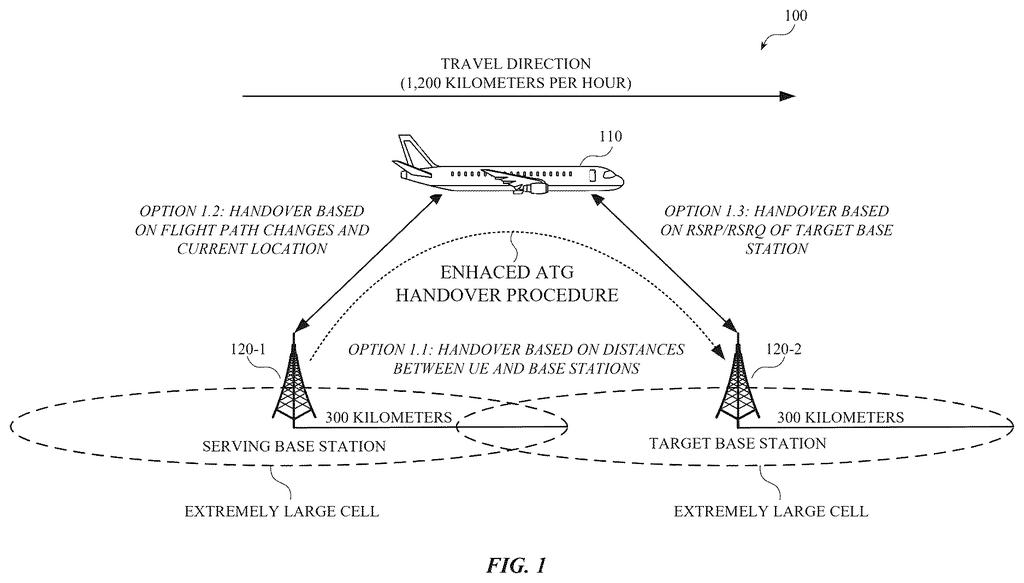
A phone in a moving car already hops between cell towers without you noticing. Apple's patent goes after a harder case: a jet at 1,200 kilometers per hour talking to towers that reach 300 kilometers.
What Apple's jet-and-drone handoff patent does
You're on a jet moving about 1,200 kilometers per hour, and the plane's radio link to the ground has to hop from one cell tower to the next. Your phone does this in a car all the time. A plane does it with towers whose coverage can stretch 300 kilometers, and Apple's filing says current methods fall short at that speed.
So Apple describes a few ways to pick the right moment to switch. In one, the aircraft checks how far it is from its current tower and how strong the next tower's signal is, then tells the network when both look right. In another, the aircraft makes the call on its own using distances.
A third idea uses the flight plan. Points along the route act as checkpoints, and reaching one sets off the switch. If the plane strays from its plan, the distance and signal checks take over.
Techniques for enabling enhanced air-to-ground (ATG) handover procedures for high-velocity user equipment (UEs), such as an airplane, jet, drone, etc.
Translation: Methods for keeping fast moving aircraft connected to ground networks.
How the aircraft decides it's time to switch
The patent covers the radio gear on a fast-moving aircraft or drone (the filing calls it a "user equipment," or UE) and how it moves its connection from the tower it's using (the serving base station) to the next one (the target base station). That swap is called a handover.
In the first independent claim, the serving tower sends the aircraft a distance threshold and a signal condition for the target tower. The aircraft checks whether its distance from the current tower meets the threshold and whether the target's signal meets the condition. It then reports back to trigger the handover. Signal conditions use RSRP (how strong the signal is) and RSRQ (signal quality, which also counts interference).
A second claim lets the aircraft decide by itself. It receives the next tower's location plus distance rules, works out its distance to both towers, and starts the handover when the rules are met.
The description adds more:
- Flight-path checkpoints: each one is tied to a handover when the aircraft gets within a set distance of it.
- Sudden route changes: if the aircraft strays from its plan, the distance and signal checks run instead.
- Timing advance: a timing adjustment that accounts for how long the signal takes to travel, worked out from the distance to the target tower.
Why high-speed aircraft strain phone-tower handoffs
The filing doesn't name a product, so nothing here points to a feature on your iPhone. The people who would notice are those who depend on a steady link to a plane, helicopter or drone, where a late or missed handoff could mean a dropped connection.
It's also a reminder that cellular standards cover more than phones. The claims are written from the aircraft's radio side, using plain ingredients like distance thresholds and signal readings. This is a patent application, and nothing says it will become a product.
Apple's 621st filing in our Apple coverage since May follows work like cutting headset lag and reading 3D sensors accurately.
A jet can cross a tower's coverage area in well under an hour, so handoffs come often and each one has to land on time. At that speed, the signal-strength rules built for walking and driving can easily pick the wrong moment. The problem is real, but it is narrow: it affects a small set of fast vehicles and the networks that serve them.
Apple's answer is modest. Pre-set distance lines, a check on the next tower's signal, and waypoints along a flight plan. These are ordinary tools aimed at a specific gap, and the size of the fix matches the size of the problem.
For most readers, nothing changes. This is groundwork for cellular standards, filed in the usual dense style, and it matters mainly to the airlines and drone operators who would rely on it.
Get our take in your Top Stories
Liked this breakdown? Add Patentlyze as a preferred source on Google, and our plain-English take shows up more often in your Top Stories the next time Apple patent news breaks.
There are more where this came from
We read every patent application Big Tech publishes and send you the ones worth knowing. Plain English, free, every week.
The drawings
11 drawing sheets from US 2026/0353201 A1 · click any drawing to enlarge


Show the other 3 sheets


Want this weekly breakdown for a company we don't cover? Patentlyze Pro →
Be the first to weigh in