
Apple Files Patent for Signing Your Gadgets Onto a Cell Network All at Once
Every gadget you connect to a cell network normally has to prove who it is on its own. Apple's patent has one hub do the talking for all of them at once.
What Apple's one-hub sign-in actually does
Right now, each device that joins a cell network goes through its own sign-in with that network. The patent points out that when you own a pile of connected gadgets, such as earbuds, a ring, a door sensor and a motion detector, all those separate sign-ins add up to a lot of messages.
Apple's fix is to pick one device as the group's hub. The hub tells the network about everyone at once. The network sends back a single random challenge, the hub checks that the message really came from the network, and then it hands the challenge to each device. Every device works out its own answer.
The hub collects the answers, sends them back in one reply, and the network signs the whole group in together. In a second version described in the filing, each device gets its own challenge instead of sharing one.
transmitting to an access mobility function entity (AMF) of the communication network a subscriber identifier of the gateway and a subscriber identifier for each of a plurality of user equipments (UEs) in a registration request …
Translation: The gateway asks the cellular network to register itself and all its connected gadgets at the exact same time.
How the hub passes one challenge to every device
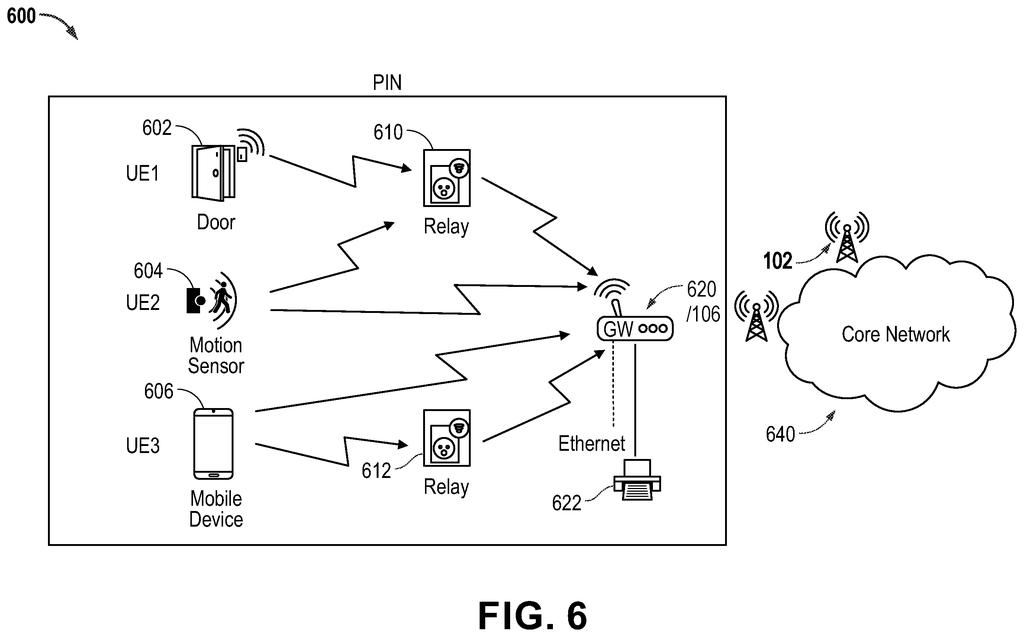
The filing describes a gateway (the hub device in a person's Personal IoT Network, meaning their own collection of connected gadgets) that registers itself and every device behind it with the cell network's AMF (the network component that handles sign-ups and keeps track of devices). The registration request lists the gateway's subscriber ID plus an ID for each device, which can be sent in sequential order.
The network answers with one RAND (a random number used as a challenge) and one authentication token (a code that lets the gateway confirm the request truly came from the network). The request can also carry a bitmap (a row of on-off flags) that marks which devices are being checked, in order.
From there the steps run like this:
- The gateway verifies the token and works out its own response.
- It passes the RAND to each device, and each device computes its own answer and sends it back to the gateway.
- The gateway bundles all the answers, in the same order as the bitmap, into a single reply to the AMF.
- The AMF accepts the registration for the gateway and every device together.
The filing also describes a variation where the network sends a separate RAND for each device. For very long device lists, the gateway can split its reply across several linked messages, each numbered and flagged when it is the last, so a lost one can be requested again.
… transmitting an authentication response to the AMP including the gateway authentication response and the authentications responses from each of the UEs …
Translation: The gateway bundles up security replies from every single device and sends them back to the network in one go.
What this means for rings, earbuds and sensors
If you wear a smart ring, earbuds and glasses, and have connected sensors around your home, each one signing into a cell network separately means a lot of chatter between your gear and the network. Bundling those sign-ins into one exchange could cut that traffic and speed up getting a whole set of devices online.
The description names glasses frames, earbuds, a blood pressure monitor, a pacemaker, rings, thermostats and cameras as example devices. The examiner's first review rejected the claims as filed, which is routine at this stage and usually followed by amendments. Nothing in the filing points to a specific Apple product that works this way.
Apple's 622nd filing in our Apple coverage since May adds to a run of wireless work that includes keeping plane connections alive and cutting headset lag.
The saving in this design comes from shared trust. Devices behind the hub are set up to rely on the hub to check that the network is genuine, so they skip that step themselves. Anyone who has handed a chore to the one coworker who always does it knows the cost: everything now depends on that one coworker getting it right.
The second version has its own price. Giving each device its own challenge means more data packed into the network's message, and the filing admits a long device list can make the reply too long. That is why it adds numbered, linked messages with a retransmit option, which is extra bookkeeping the first version avoids.
For a home full of tiny sensors, the trade reads as worth it, since a handful of messages beats a pile of separate sign-ins. It is plumbing that most people will never see, and its value depends on how much you trust the one hub in the middle.
Get our take in your Top Stories
Liked this breakdown? Add Patentlyze as a preferred source on Google, and our plain-English take shows up more often in your Top Stories the next time Apple patent news breaks.
There are more where this came from
We read every patent application Big Tech publishes and send you the ones worth knowing. Plain English, free, every week.
The drawings
10 drawing sheets from US 2026/0353075 A1 · click any drawing to enlarge


Show the other 2 sheets


Want this weekly breakdown for a company we don't cover? Patentlyze Pro →
Be the first to weigh in