
Nvidia Patents Camera Software That Learns Normal Traffic and Flags Anything Strange
Most of what the world's cameras record is boring, so Nvidia's new filing teaches an AI what boring looks like and flags whatever breaks the pattern.
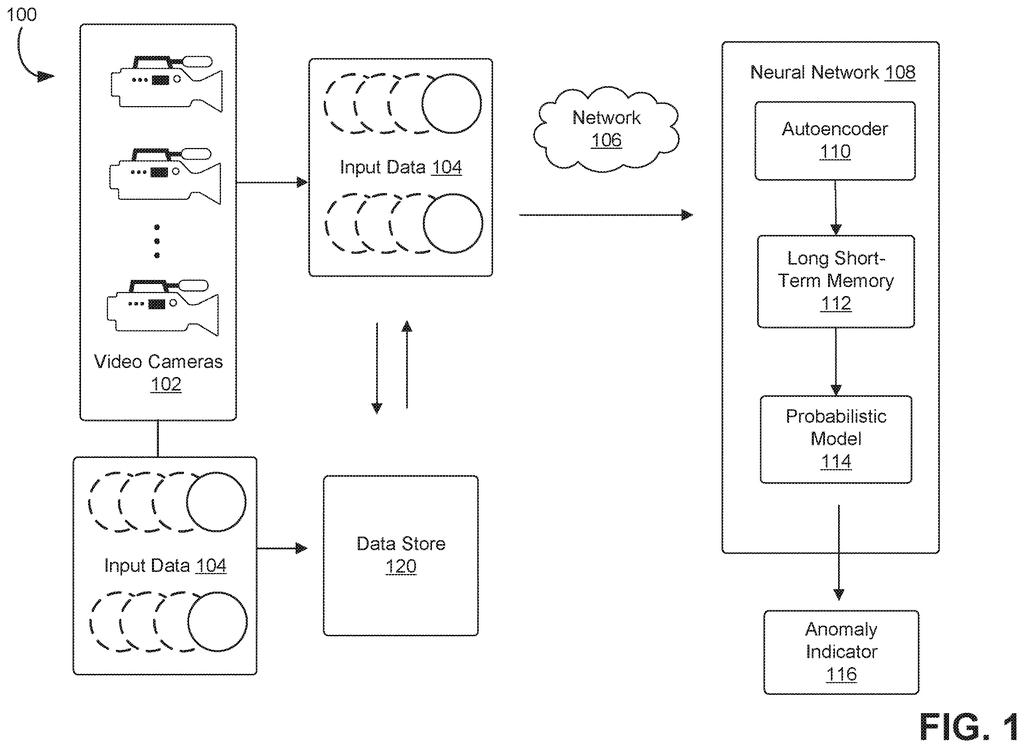
What Nvidia's anomaly-spotting camera AI does
Millions of cameras watch roads, walkways and buildings around the clock, and almost everything they record is uneventful. Nobody can watch it all. Building a separate detector for every strange thing that might happen (a car going the wrong way, a vehicle stuck in an intersection) would take far too many examples and too much computing power.
Nvidia's filing takes a different route. Instead of teaching a system what bad looks like, it studies lots of ordinary video from fixed cameras until it learns what normal looks like. When something doesn't fit, such as traffic suddenly flowing the opposite way, it raises a flag.
The system then sends a message pointing to the odd frames, so a person can check just those instead of scrubbing through hours of footage.
use an autoencoder to transform images of a sequence into latent-space feature vectors encoding spatial content; input the latent-space feature vectors to a neural network to generate temporal feature outputs representing changes between previously received images and newly received images in the sequence …
Translation: It turns video frames into mathematical maps and compares them to track how things change over time.
How the system learns what normal looks like
The claims describe a three-stage pipeline that works on a stream of video frames. First, an autoencoder (a neural network that squeezes each frame into a compact numeric summary, then tries to rebuild the frame from it) captures what is in each picture. The filing also describes feeding it optical flow, a measure of how things move between frames.
- Memory of change: a recurrent network (here an LSTM, a type of AI that remembers earlier inputs) takes those summaries and tracks how things change from frame to frame, such as which way a car is heading.
- Reconstruction check: the system rebuilds each frame from its summary and measures the gap, called the reconstruction error. A big gap hints at something unfamiliar.
- Probability judge: a Gaussian Mixture Model (a statistical tool that maps what normal data looks like) takes the change features and the errors together and scores how likely the new footage is to be normal.
The model is trained on normal footage, so a low score means the behavior falls outside what it learned. Each new frame is compared with a sliding window of earlier footage, from 10 seconds up to a total of 30. In the filing's examples, a car heading the wrong way, or sitting in an intersection longer than ten seconds, would trigger an alert.
… infer content of individual frames in a sequence of images and to further infer changes to content in sequence of images over time to determine whether one or more anomalous events are present in sequence of images …
Translation: The system studies normal video footage so it can spot unusual events happening on the road.
Why this matters for traffic and security cameras
For anyone who has stared at a wall of security monitors, the appeal is simple: the cameras that already exist could do more of the watching. The filing stresses that the cameras don't need reconfiguring and that you don't have to build a separate detector for each odd event. That could cut the labeling and tracking work the filing says overwhelms setups with limited computing power.
The open question is what counts as normal. The system only knows what it was trained on, so harmless oddities could get flagged along with real problems. This is also a continuation of an application first filed in 2019, so it is an older idea with a fresh set of claims.
Nvidia's 110th filing we've tracked since May in the self-driving sensing race adds to a run that includes filling in unseen street sides and deduplicating objects across cameras.
The big trade here is that the system learns only from what it has seen. That saves the huge job of labeling every possible oddity. It also means anything unusual gets flagged, whether it's a real hazard or a delivery truck parked in a strange spot, and someone has to sort through those false alarms.
The second cost is computing. Running three layers of analysis on video, frame after frame, across many cameras, takes serious hardware, and the filing describes running it on Nvidia's own GPUs (graphics chips used for AI).
For a camera network too big for people to watch, the trade is worth it. A flag that sends a person to the right ten seconds of footage beats watching everything or watching nothing.
Get our take in your Top Stories
Liked this breakdown? Add Patentlyze as a preferred source on Google, and our plain-English take shows up more often in your Top Stories the next time Nvidia patent news breaks.
There are more where this came from
We read every patent application Big Tech publishes and send you the ones worth knowing. Plain English, free, every week.
The drawings
10 drawing sheets from US 2026/0350357 A1 · click any drawing to enlarge


Show the other 2 sheets


Want this weekly breakdown for a company we don't cover? Patentlyze Pro →
Be the first to weigh in