
IBM Files Patent for an AI That Quizzes Itself and Learns From Expert Corrections
IBM's filing describes an AI that writes practice questions for itself, gets graded by a human expert, and saves the corrections so the same mistake does not come back.
What IBM's expert-corrected AI actually does
Every time a work chatbot confidently gets something wrong, a human has to notice, correct it, and hope the same slip doesn't come back next week. AI mistakes like this, where the system makes up or garbles facts, are called hallucinations, and they are a big headache when employees rely on the answers.
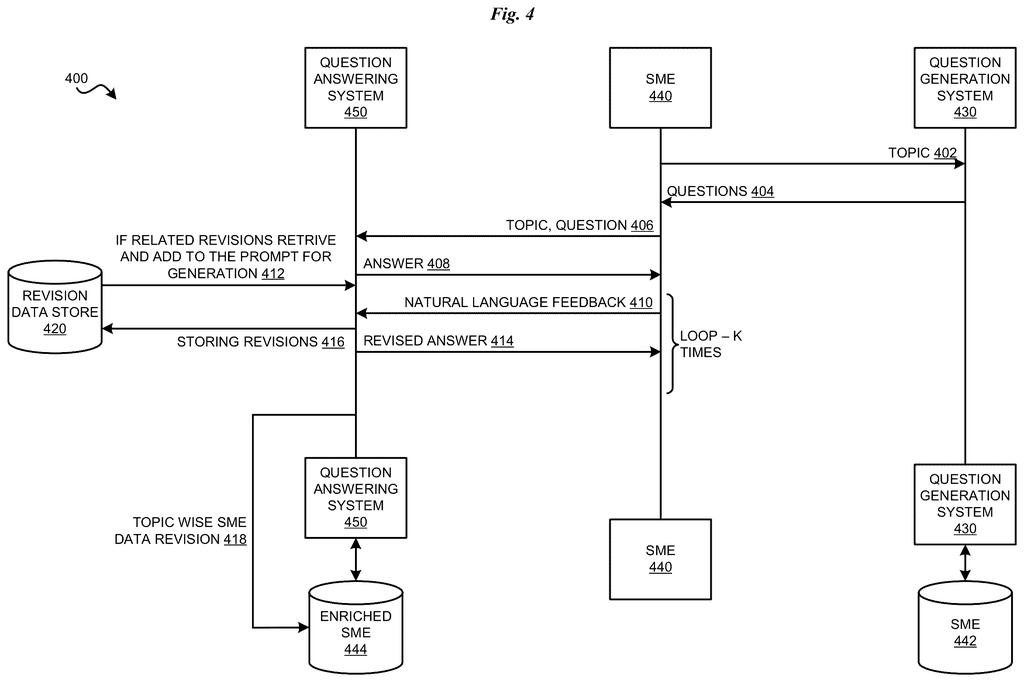
IBM's patent application describes a three-part setup to cut them down. One AI program writes practice questions about a topic. A second one answers them. Then a subject matter expert (a person who knows the field well) reads each answer and says what's missing or wrong, in ordinary sentences.
The AI rewrites its answer, and the corrected facts are written back into the company's own reference database. The next time someone asks, the chatbot has better material to draw from, and nobody has to retrain the AI itself.
… generating using the question generating agent a first set of question based on the first input topic; generating using a question-answering agent a first answer to a first question of the first set of questions; …
Translation: The AI creates a batch of questions about a topic and then answers one of them on its own.
How the AI quizzes itself, then gets fixed
The claims cover a loop run by software agents, which are AI programs that each handle one job. A question-generating agent takes a topic and produces a list of questions. A question-answering agent picks one and writes an answer, pulling facts from a company database. That lookup-then-answer technique is called retrieval augmented generation, or RAG: the AI searches relevant documents before it responds.
Feedback produced by analyzing the answer goes back to the answering agent, which rewrites part of the answer. In the description, that feedback usually comes from a human expert typing plain sentences like "explain what an activation function is," though an AI trained on past expert reviews can fill that role. The patent's example is a neural-network entry that says "a mathematical function" until feedback gets it to name the activation function.
Other details the filing describes:
- The rewrite can repeat until an exit point, such as a confidence threshold being met or the expert saying the answer is fine.
- Feedback can ask to add information or to remove it.
- The system compares new feedback with stored past feedback and reuses a similar earlier fix.
Once the answer is approved, the database entry for that topic is edited with the corrected facts. A further step, topic-wise refinement, produces an "enriched" database where related topics are linked to each other.
The embodiment executes a first program instruction to transmit feedback data to the question-answering agent, the feedback data produced by analyzing content of the first answer.
Translation: The system analyzes the initial answer and sends feedback back to the answering agent.
Why wrong AI answers cost businesses real time
If your employer rolls out an AI assistant, its answers are only as good as the documents behind it. The filing's own example is a bank whose engineers ask an AI to help debug system failures, where a made-up answer can lead to a wrong fix and new bugs. With this setup, a correction made once gets saved, so the same mistake is less likely to repeat for the next person.
The filing also says this avoids retraining the AI model, which costs computing power, and suits company information that changes often, since only the database is edited. It is a patent application, so it says nothing about whether IBM will turn it into a product.
IBM's 74th filing we've tracked since May in our AI safety guardrails work adds to a run that includes a secret AI identity quiz and blocking name-based tricks.
Wrong answers from AI are a costly problem for any company that wants staff to trust a chatbot. One bad answer about a bank's system errors can waste hours, and people stop using a tool that burns them twice.
The fix described here puts an expert in the loop, which fits the problem: the person who knows the right answer corrects it once, and the correction is saved for everyone. The catch is that experts are busy and scarce, and the filing offers no figures on how many fewer mistakes this produces. The option of an AI standing in for the expert could ease that, but an AI grading an AI can share the same blind spots.
Verdict: a sensible, modest idea that matches a real pain point, and its value will come down to how little expert time it needs.
Get our take in your Top Stories
Liked this breakdown? Add Patentlyze as a preferred source on Google, and our plain-English take shows up more often in your Top Stories the next time IBM patent news breaks.
There are more where this came from
We read every patent application Big Tech publishes and send you the ones worth knowing. Plain English, free, every week.
The drawings
6 drawing sheets from US 2026/0350422 A1 · click any drawing to enlarge


Want this weekly breakdown for a company we don't cover? Patentlyze Pro →
Be the first to weigh in