
IBM's New Patent Teaches AI to Learn from How an Industry Actually Works
Getting a general-purpose AI to give reliable answers in a specialized field, like finance, medicine, or law, is harder than it sounds. IBM has filed a patent for a training method that bakes expert knowledge directly into the model before it ever answers a question.
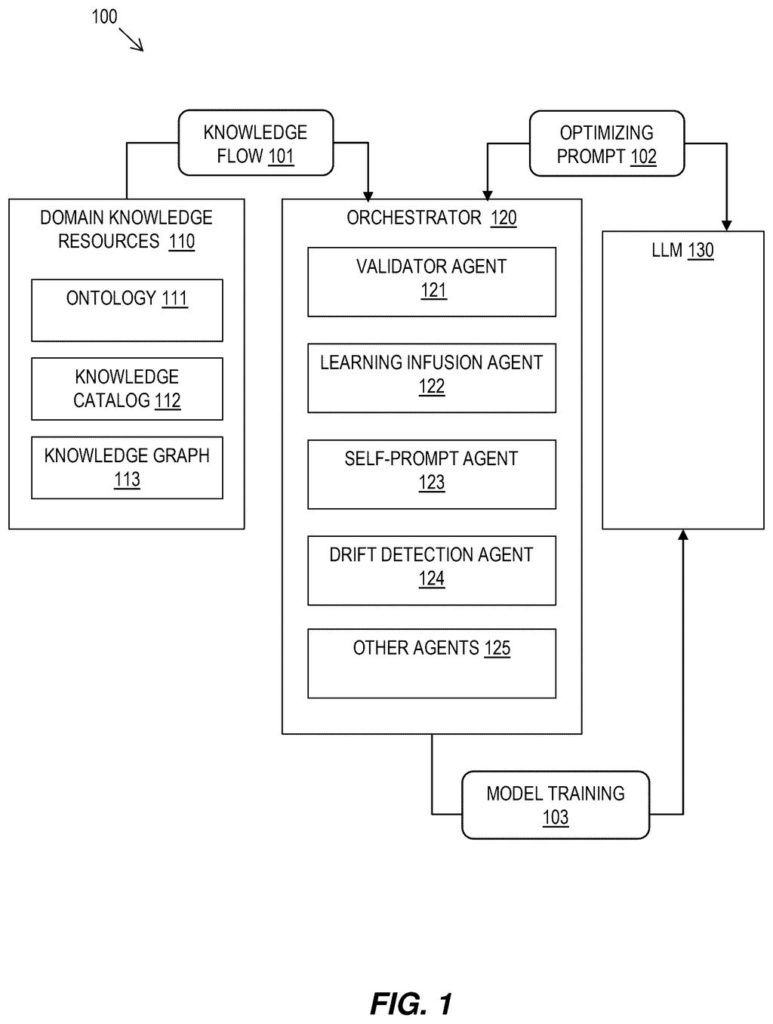
What IBM's knowledge-map AI training actually does
Imagine asking an AI chatbot a question about hospital billing codes, and it gives you an answer that sounds confident but misses a key regulatory rule that any expert would know. That gap between general AI knowledge and specialist knowledge is a real problem.
IBM's patent describes a way to close that gap during training. The idea is to take a formal map of a specific field, think of it as a flowchart of concepts and how they connect, and use that map to teach the AI what matters, what the key metrics are, and how ideas in that field relate to each other. The AI doesn't just read text about the subject; it absorbs a structured picture of the field's logic.
The result is an AI that has been tuned to a domain's rules and priorities before it ever sees your question, so its answers reflect real expert judgment rather than educated guessing.
accessing a domain-specific ontology and generating a knowledge graph based on a domain-specific ontology of concepts and relationships; extracting ontological semantics and factors from the knowledge graph using a semantic query; enhancing an input prompt with the extracted ontological semantics and factors; …
Translation: The system maps out industry rules into a structured network to add real world context to AI prompts.
How the ontology feeds concepts into the training loop
The patent describes a multi-step training pipeline built around what's called a domain-specific ontology (a formal, machine-readable map of the concepts, rules, and relationships in a particular field, like healthcare or legal compliance).
Here's how the process works:
- Build a knowledge graph: The ontology is converted into a knowledge graph, a network of connected nodes representing concepts and the relationships between them.
- Extract semantics: A semantic query (essentially a structured question posed to the graph) pulls out the most meaningful concepts and their contextual factors.
- Enhance the prompt: The user's input prompt is rewritten to include that richer contextual information before it reaches the model.
- Infuse training with KPIs: During the model's training phase, key performance indicators and conditional parameters drawn from the ontology are built into the learning process itself, so the model learns to weight domain-relevant signals more heavily.
- Fine-tune on infused prompts: The enhanced prompts are used to fine-tune the model's outputs.
- Compare against feedback: The model's responses are checked against reference answers to measure accuracy and adjust.
The core distinction from standard fine-tuning is that domain knowledge isn't just present in the training data; it's encoded structurally into how the model is trained to reason.
… during training of the LLM, infusing the LLM with key performance indicators and conditional parameters; generating one or more infused input prompts based on the enhanced input prompt infused with the key performance indicators and conditional parameters for fine-tuning the LLM output to obtain a response; …
Translation: It trains the language model using specific industry metrics and rules to make its output more accurate.
What this means for AI used in specialized industries
For industries where getting things wrong has real consequences, including healthcare, finance, and legal services, a general AI trained on broad internet text is often too unreliable to trust. This approach tries to make domain expertise something an AI carries with it rather than something it has to guess from context clues in a query.
That said, the value depends entirely on the quality and completeness of the ontology you start with. If the knowledge map has gaps or encodes outdated rules, the AI will learn those flaws faithfully. For enterprise AI buyers, this kind of structured training pipeline could be a selling point for IBM's Watson and related products, but it shifts a significant burden onto whoever builds and maintains the underlying knowledge maps.
IBM files its 37th application in AI training and infrastructure we've tracked since May, building on earlier work on keeping AI current with changing data and training on messy questions.
The design trade here is clear: you get a more disciplined AI by adding a rigid, hand-built knowledge structure at the start. The cost is that someone has to build and maintain that structure, and ontologies in complex fields like healthcare or financial regulation go stale fast. If the map is wrong, the model is wrong in a way that's harder to spot than random errors.
There's also a depth question. Encoding key performance indicators into training is a reasonable idea, but KPIs are often proxies for what experts actually care about. Training a model to hit the metric is not the same as training it to understand the domain.
That trade reads as worthwhile for narrow, high-stakes applications where the field changes slowly and an organization already has good structured documentation of its rules. For faster-moving domains, the maintenance cost of the ontology could easily swallow the accuracy gains.
There are more where this came from
We read every patent application Big Tech publishes and send you the ones worth knowing. Plain English, free, every week.
The drawings
7 drawing sheets from US 2026/0300371 A1 · click any drawing to enlarge


Want this weekly breakdown for a company we don't cover? Patentlyze Pro →
Be the first to weigh in