
Samsung Files Patent for a Walking Aid That Corrects Its Own Hip Readings
Samsung's walking-assist wearable can twist around your waist as it pushes back against you. This patent application has it use your own step count to straighten out the sensor readings that twisting throws off.
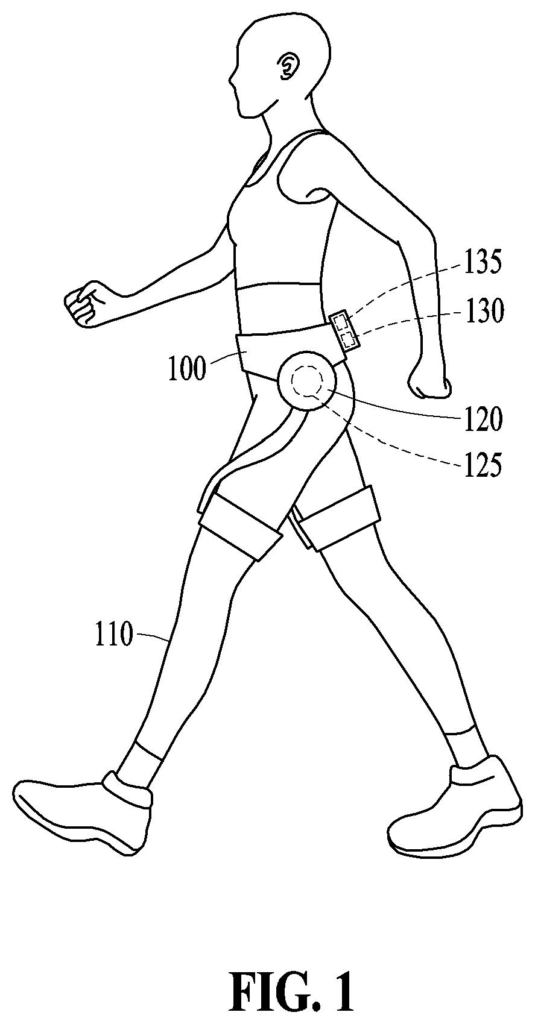
What Samsung's twist-correcting hip belt does
Imagine you're wearing a walking-assist belt with a motor at each hip, and you turn the resistance up for a workout. Every stride tugs the frame a little sideways, like a belt slowly rotating around your waist. The sensors now report that one leg swings farther forward than it really does, and the other leg swings farther back.
Samsung's filing describes a fix that needs no extra hardware. The device counts your steps, and after each one it checks the highest and lowest angle each leg reached. In normal walking, both legs should swing around the same middle point. If the two middles don't match, the gap is treated as twist and subtracted out of the readings. The motors then use the corrected angles to decide how hard to push and when.
… tracking an angle range of the joint angle of the user; determining a joint angle calibration value based on the tracked angle range; determining a calibrated joint angle based on the measured joint angle and the determined joint angle calibration value …
Translation: It figures out how much the sensor is off and adjusts the measurements accordingly.
How step counts reveal a crooked-fitting frame
The wearable has a motor at each hip, a frame that carries the motor's torque (twisting force) to each thigh, and an angle sensor that reports how far each frame has swung. The device uses that angle to decide how hard to push and when. Under heavy resistance the waist frame can twist slightly, or the device may simply be worn crooked, so the readings shift: one side looks more positive, the other more negative.
To correct this, the processor works in four steps:
- Counts steps when a signal from a motion sensor (an IMU, the same kind of chip a phone uses to detect movement) passes a threshold, or from the angle data itself.
- Tracks the angle range by pulling the highest and lowest angle each leg reached since the previous step. The filing's example uses up to 200 readings, one every 10 milliseconds, per stride.
- Finds the error by averaging the high and low for each leg and comparing the two averages. With no twist they should match.
- Applies the correction by adding a value that drives the gap to zero. One option is a PID controller (a standard feedback formula that keeps nudging a number until an error disappears).
The filing also describes pausing the correction when your walking speed drops below a threshold, when you stop, or when something unusual happens, like a fall, a ramp or stairs. A simpler version just adds half the error to each reading, with no such checks. The same idea is said to work for arm devices that swing around the shoulder.
… controlling the torque output of the wearable device on the basis of the corrected joint angle.
Translation: The device uses these corrected angles to decide how much motor power to apply.
Why a few degrees matter to a walking aid
A walking aid is only as good as its timing. If the device thinks your leg is somewhere it isn't, it can push too hard, too soon or too late. That matters most for people who rely on these devices to walk, and for anyone using resistance modes for exercise, which is exactly when the frame twists the most, according to the filing.
The fix runs on sensors the device already has, and it adjusts while you walk. You wouldn't have to stop and recalibrate, and a slightly crooked fit would matter less. The filing says more accurate angles allow more accurate torque, which cuts down the annoyance of a device that feels off. It's a patent application and names no product, so treat it as a look at how Samsung is thinking about the problem.
Samsung's 56th filing in the wearable patents we cover since May adds to a run that includes a thumbnail matching fix and a sound to vibration converter.
Claim 1 covers five steps: count the user's steps, track how far a joint swings across those steps, calculate a correction from that swing range, apply the correction to the raw angle reading, and drive the motor from the result. Nothing in that claim limits it to hips, to twisting motions, or to any particular body part. Those details appear only in later, narrower claims.
That breadth matters. Any wearable that watches joint swing across steps and uses it to clean up angle readings before sending power to a motor would fall inside this claim, regardless of which joint or which correction formula the maker chose.
If granted, this patent puts a fence around the whole idea of step-by-step angle calibration in powered wearables, not just Samsung's specific approach to it. That is a wide fence for what is, underneath, a tidy piece of arithmetic.
Get our take in your Top Stories
Liked this breakdown? Add Patentlyze as a preferred source on Google, and our plain-English take shows up more often in your Top Stories the next time Samsung patent news breaks.
There are more where this came from
We read every patent application Big Tech publishes and send you the ones worth knowing. Plain English, free, every week.
The drawings
16 drawing sheets from US 2026/0345420 A1 · click any drawing to enlarge


Show the other 8 sheets


Want this weekly breakdown for a company we don't cover? Patentlyze Pro →
Be the first to weigh in