
Google Files Patent for a Watch That Knows When You're Wearing It Wrong
Your smartwatch's heart readings depend on how snugly it sits, and Google's patent application has the watch tell you when it sits wrong. In one version, the watch moves its own back plate to fix the fit.
What Google's fit-checking watch actually does
Every time you strap on a fitness watch, you make a guess about how snug is snug enough. Many people wear it too loose, and the sensors on the back of the watch pay for it. A weak connection to your skin means shakier heart readings, and you usually never find out.
Google's patent filing has the watch check itself. It measures how strong the signal from its body sensor is, and if the reading is too weak, it steps in. It can show you a live number or a green, yellow or red light while you adjust the band. Another version has the watch push or pull its own back plate against your wrist.
The filing also describes a band clasp that tightens in tiny steps instead of fixed holes, so you can dial in the fit.
… determine a signal strength of the biometric signal does not satisfy a threshold signal strength; and responsive to determining the signal strength of the biometric signal does not satisfy the threshold signal strength, triggering a control routing comprising one or more control actions for altering the signal strength of the biometric signal.
Translation: The watch figures out when the sensor reading is too weak and takes steps to fix the problem.
How the watch tunes its own back plate
The claims cover a wearable with a housing, a base plate on the bottom that touches your wrist (or another limb), a display, and a biometric sensor (a sensor that reads signals from your body, such as heart activity). The device collects the signal and checks whether its strength meets a threshold. If it does not, the device triggers a control routine, meaning a set of actions meant to improve the signal.
The actions described include:
- Showing a prompt that asks you to adjust how the watch sits.
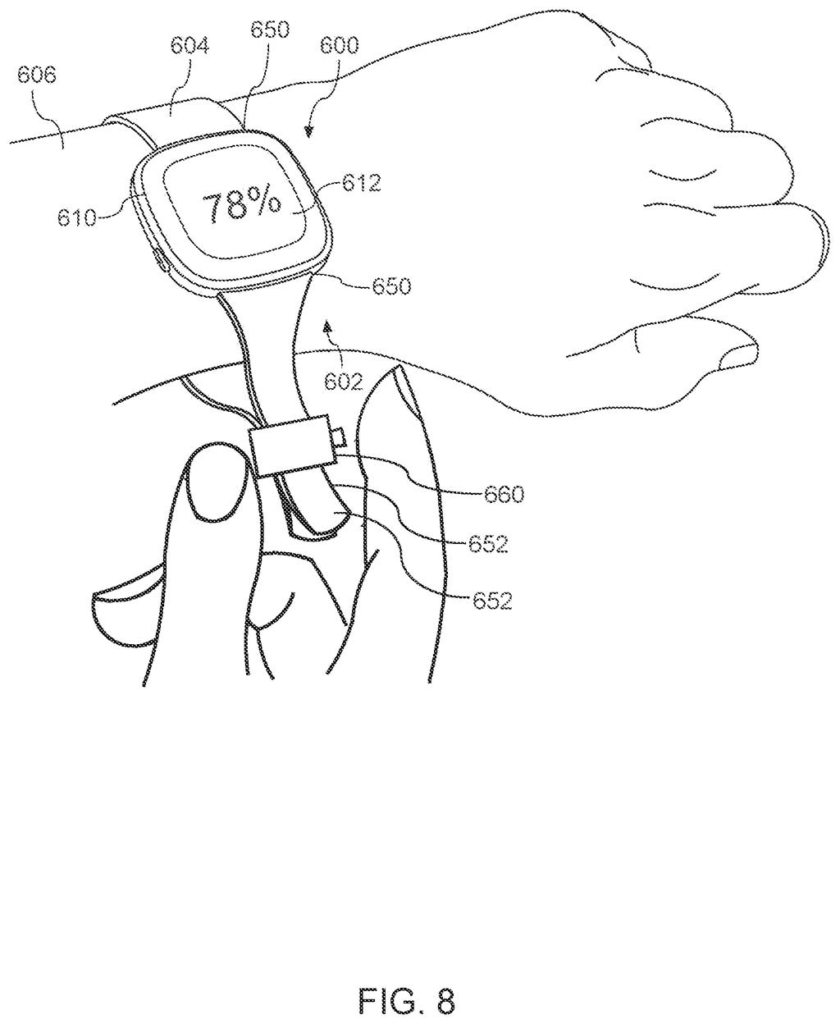
- Displaying a live signal strength value, for example a percentage where 80% to 100% counts as good, or a green, yellow or red emblem.
- Keeping that notice on screen until the signal is good, then telling you (the filing also mentions sound or vibration alerts).
- Running small motors, called actuators, that move the base plate toward or away from your wrist until the threshold is met.
Moving in both directions matters. A PPG sensor (it shines light into your skin and measures what bounces back) loses signal when the watch is loose, but a watch that is too tight can squeeze blood out of the skin and weaken it too. Electrode-based sensors need steady skin contact. The motors can be controlled one by one so the plate can adapt to a wrist bone, and the processor tries a move, checks whether the signal got worse, and tries the other way.
The filing also describes a spring-mounted base plate, a spring-loaded clasp, an elastic band prong, and a ratchet that tightens both bands evenly. The watch can detect when it is on your wrist, and in a low-battery mode it only checks the signal when you ask.
Why fit matters for your watch's heart readings
Watch health features like heart rhythm checks and stress tracking only work if the sensors touch your skin well. The filing cites an estimate that wearables can be out of good contact up to 10% or more of the time you wear them, usually without you knowing. A watch that flags a bad fit, and tells you when you have fixed it, could make the numbers you rely on more trustworthy.
The filing also says the approach needs no extra position or pressure sensors, because the signal itself reveals how the watch sits. That keeps the hardware small. The examiner's first review rejected the claims as filed, which is routine at this stage, so the final scope may change. For anyone who wears a tracker for health data, the idea is simple and easy to picture.
That makes this Google's 23rd filing we've tracked since May in our wearables reading your body watchlist, joining earlier applications on a too-loose watch band and health risks from blood.
If you wear a fitness watch, you have probably never been told it was sitting wrong. You just got an odd heart rate reading, or none at all, and shrugged. A live fit check fixes that moment, and you would notice it the first time you strap the watch on and watch a light turn green.
The self-adjusting back plate is the flashier piece of the filing, but moving parts inside a device that gets sweaty and bumped all day are a hard ask. The on-screen prompt and the clasp that tightens in small steps are the parts you would use most.
Verdict: a modest idea and a useful one. The watch judges its own fit from the signal it already collects, so you pay nothing extra in sensors, and you get readings you can trust a bit more.
Get our take in your Top Stories
Liked this breakdown? Add Patentlyze as a preferred source on Google, and our plain-English take shows up more often in your Top Stories the next time Google patent news breaks.
There are more where this came from
We read every patent application Big Tech publishes and send you the ones worth knowing. Plain English, free, every week.
The drawings
14 drawing sheets from US 2026/0334877 A1 · click any drawing to enlarge


Show the other 6 sheets


Want this weekly breakdown for a company we don't cover? Patentlyze Pro →
Be the first to weigh in