
Google Patents Vibrations That Tell You How Sure Its AI Is
Your phone could tell you how sure its AI is by how hard it buzzes, so a shaky answer feels different from a confident one. Google's filing turns the AI's self-doubt into something you can feel in your hand or on your wrist.
What Google's confidence-buzz patent does
A man dictates a text message to his phone on a loud street. The phone turns his words into text, and some of it is probably wrong, but nothing on screen tells him which parts to trust.
Google's patent describes a fix: let the AI report how sure it is, and let your hand feel the answer. When you tap or select a result, your phone vibrates, strongly for high confidence and weakly for low. If you get a faint buzz on a dictated sentence, you know to say it again instead of proofreading every word.
The idea reaches beyond phones. The filing describes the same signal coming through a smartwatch, wireless earbuds, AR glasses, or even a thermostat dial that pushes back harder on the temperatures the AI is confident about.
obtaining, by a user computing device comprising one or more processors, an output of a machine-learned model and an associated confidence metric, wherein the confidence metric is indicative of a degree of confidence in the output of the machine-learned model; …
Translation: Your phone receives an AI response along with a measurement of how sure the AI is about that answer.
How the buzz changes with the AI's certainty
The system starts with an AI model's answer and a confidence score, a number such as 90% that says how sure the model is. The score can come from the model's track record: if its earlier answers turned out wrong, confidence drops. For a model that does many jobs, each type of task can have its own accuracy history.
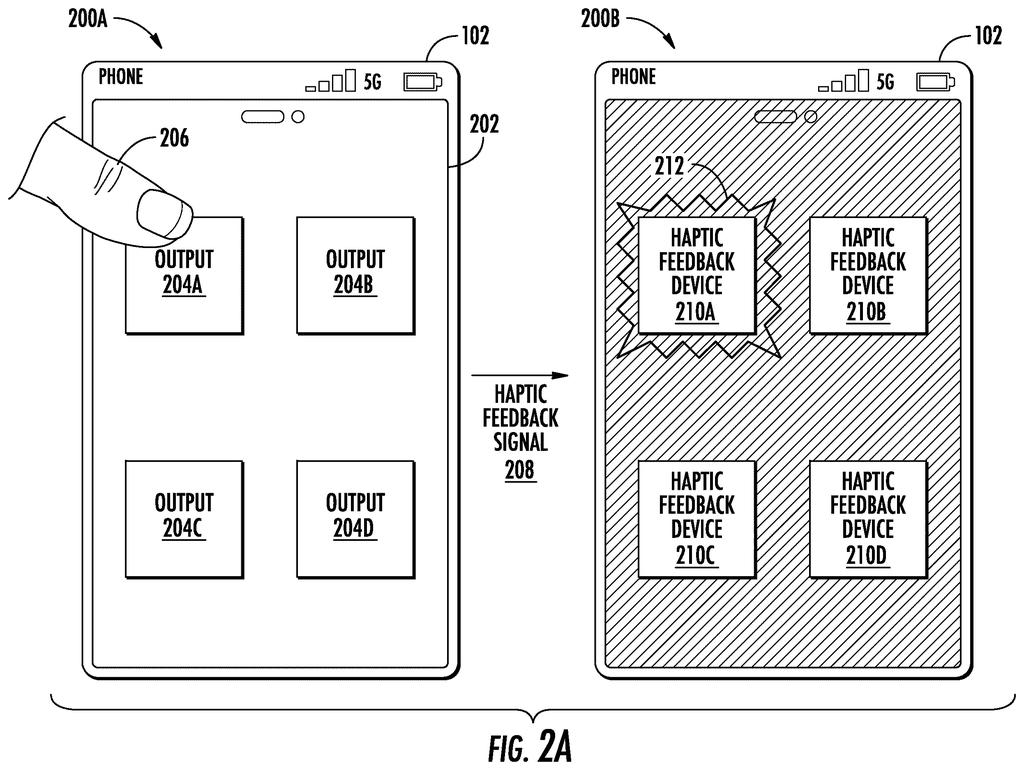
The device then turns that score into a haptic signal (a pattern of vibration, resistance or texture you can feel). It plays when you act on an answer by tapping it, speaking, or making a gesture. The filing's examples include:
- Vibration motors under different parts of the screen, buzzing harder under a high-confidence image and softer under a doubtful one.
- A touchscreen that simulates a rough texture over shaky results and a smooth one over solid results.
- A scroll wheel or thermostat dial that changes how hard it pushes back.
- Sound or screen changes, such as volume or brightness, tuned to confidence.
A finger held on the screen can feel the buzz grow as it slides toward a result. If a second answer has a higher or lower score, the signal gets stronger or weaker to match. The device can also check past signals and switch to a different feedback device if vibration seemed to go unnoticed.
Another independent claim drops the confidence idea: the feel can describe the answer itself, such as urgency (a tiny buzz for spam, a big one plus a sound for an emergency weather alert).
Systems and methods for indicating confidence in a machine-learned output via haptic feedback are provided.
Translation: The patent describes ways to use physical vibrations to communicate the certainty of an AI system.
Why checking by feel could save you time
Today, AI answers usually look equally sure of themselves whether they are right or wrong. Adding a signal you feel through your hand or wrist could help you decide faster, and it works when your eyes are busy, such as when you dictate on the move. Because the filing covers watches, earbuds and AR glasses, the buzz could follow you from device to device.
It is still a patent application, and it names no product. The practical questions are whether people would learn the buzz language and whether it would blend into the notification vibrations you already get. The filing's examples range from dictation to streaming recommendations (a vibration for a video you've already watched or one with mature content), which suggests Google sees this as a layer that could sit on top of many AI features.
Google's 27th filing we've tracked since May in the AI safety guardrails race follows its patents for a fact-checking editor and step-by-step AI reasoning.
The failure this prevents is a familiar one: you dictate a message, glance at it, hit send, and your boss reads a word you never said. A quick buzz that says "shaky" would tell you to look twice, and the rest of the time you could skip the proofreading.
You would have to learn a new vocabulary through your fingertips, and that is the hard part. A weak buzz could also mean your phone is in a coat pocket, and plenty of people switch vibration off entirely. The filing even covers this by moving to a different feedback device when vibration seems to go unnoticed.
You would notice it most in dictation and voice assistants, where checking by eye is slowest. On something like a thermostat dial, it is a pleasant extra that few people would miss.
Get our take in your Top Stories
Liked this breakdown? Add Patentlyze as a preferred source on Google, and our plain-English take shows up more often in your Top Stories the next time Google patent news breaks.
There are more where this came from
We read every patent application Big Tech publishes and send you the ones worth knowing. Plain English, free, every week.
The drawings
9 drawing sheets from US 2026/0349510 A1 · click any drawing to enlarge


Show the other 1 sheets

Want this weekly breakdown for a company we don't cover? Patentlyze Pro →
Be the first to weigh in