
Google
Google · Software · Filed Jun 13, 2025 · USPTO published Nov 12, 2026 · This week's release
Google Files Patent for a Wearable Test of Whether Your New Habit Works
Google has filed a patent application for an app that turns a new habit into a personal experiment. It then checks whether your body data moved by more than the normal day-to-day swings.
- Publication number
- US 2026/0360503 A1(US20260360503A1)
- Applicant
- Google LLC
- Filed · Published
- Jun 13, 2025 · Nov 12, 2026
- Inventors
- Naghmeh Rezaei, Hulya Emir-Farinas, Qian He
- Status when we published
- Examiner raised objections; the company can respond
- Document
- 20 claims
- US classification
- 705/2
- Examiner
- PATEL, SHERYL GOPAL (Art Unit 3685)
- Parent application
- National Stage Entry of PCT/US2022/053876 (filed Dec 22, 2022)(PCTUS2022053876)
What Google's habit-testing wearable app does
Your resting heart rate bounces around from day to day, and so does your sleep. That makes it hard to tell whether the new habit you started three weeks ago is doing anything, because small improvements get buried in the everyday noise. Google's patent application describes an app that tries to dig them out.
You pick a goal, such as walking briskly for 30 minutes a day or going to bed earlier, and the app runs it like a small personal experiment. Each day it asks whether you stuck to it, while your wearable keeps recording things like resting heart rate and sleep. The filing uses a 28-day run as its example.
At the end, the app checks whether your numbers moved by more than ordinary ups and downs would explain. Then it sends you a report with suggestions for what to try next.
monitoring one or more metrics of physiological data of a user based at least in part on a health behavior goal of the user, the one or more metrics being associated with the health behavior goal; tracking adherence to the health behavior goal by the user over a defined time; …
Translation: The wearable watches your body data while you try to stick to a new health routine.
How the app compares your 28 days to a baseline
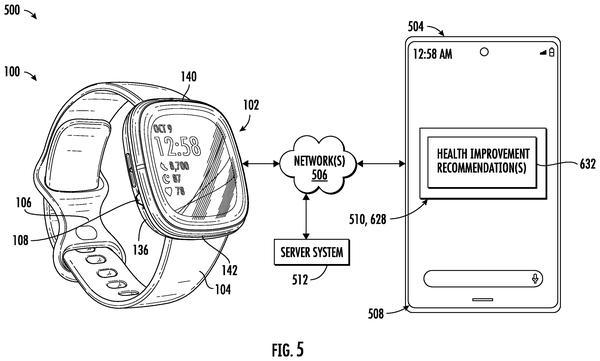
The claims cover a computing device (a wearable, a phone or a server) that does four things. It monitors body measurements tied to a goal the user chose, tracks adherence to that goal over a set period, detects a statistical change in the measurements (a shift bigger than normal day-to-day wobble), and then takes an action based on what it finds.
The filing fills in the details. Goals come from a predefined list covering fitness, mindfulness, sleep and nutrition, and the user can rate how achievable a goal feels. Tracked measurements include resting heart rate, heart rate variability, sleep stages, weight and a "restoration score." Adherence can be logged with a yes or no slider, or picked up automatically when the wearable can see it.
To judge a change, the system can compare against a baseline collected in an earlier period, so a few odd days don't throw it off. It can use machine learning models (software trained on the user's own data to spot patterns) and check whether a change is positive or negative and above or below a significance threshold. It can also ask how you feel and check whether your gut sense matches the data.
The resulting "intelligent notification" can compare you with your past self or with other users and recommend new goals based on your history. It can even pick the best time to message you based on when you usually respond.
Why this matters for your smartwatch data
Most wearable apps show you numbers and leave the interpretation to you. This filing describes one that treats your habits like an experiment and tells you whether the result is bigger than everyday variation. If it works, you get an answer to "is this earlier bedtime helping?" instead of a pile of charts. The report also shows how many days you stuck with the plan, so you can see your effort next to the outcome.
There are open questions. The claims describe a general method, and the filing gives no accuracy figures. A few weeks of data from one person can only say so much about cause and effect. The examiner's first review rejected the claims as filed, which is routine at this stage and usually followed by amendments.
Google's 27th filing we've tracked since May in our wearables that read your body watch covers body sensing, following applications like radar gestures that learn and earbuds that feel you chew.
Source: US 2026/0360503 A1 at the USPTO (PDF). Full patent text and figures are in the official publication.
Get our take in your Top Stories
Liked this breakdown? Add Patentlyze as a preferred source on Google, and our plain-English take shows up more often in your Top Stories the next time Google patent news breaks.
Add Patentlyze on Google
One click.
There are more where this came from
We read every patent application Big Tech publishes and send you the ones worth knowing. Plain English, free, every week.
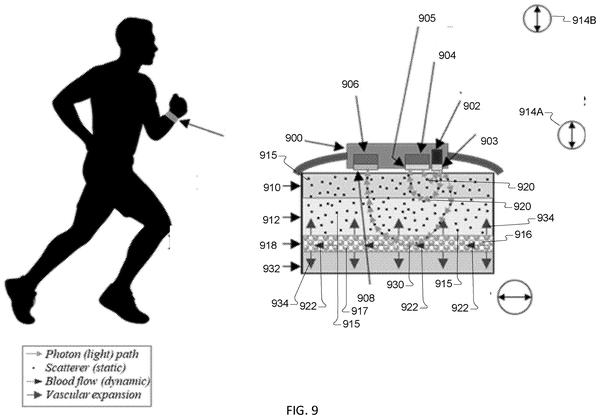
The drawings · 13 sheets
13 drawing sheets from US 2026/0360503 A1 · click any drawing to enlarge


Show the other 5 sheets


More from Google
All 1,079 Google patents →
More in Software
All 753 Software patents →
Apple
Apple Patents an iPhone That Switches Modes at Bedtime and Tracks Your Sleep Consistency
IBM
IBM Files Patent for Pain Treatment Matched to Sleep, Mood and Activity Patterns
IBM
IBM Patents a Dimpled Chip Surface That Helps Sensors Spot Proteins in Blood
Samsung
No comments yet