
Google
Google · AI / ML · Filed May 8, 2025 · USPTO published Nov 12, 2026 · This week's release
Google Files Patent for AI Video That Grows Forward and Backward From One Photo
Most AI video tools start at a picture and only move forward. Google's patent application treats that picture as the middle of the clip and builds both the past and the future around it.
- Publication number
- US 2026/0360054 A1(US20260360054A1)
- Applicant
- Google LLC
- Filed · Published
- May 8, 2025 · Nov 12, 2026
- Inventors
- Xinwei Yao, Weizhe Hua, Ruben Eduardo Villegas, Orly Liba, Mitchell Wayne McIntire, Poorva Ganesh Rane
- Status when we published
- Examiner raised objections; the company can respond
- Document
- 20 claims
- US classification
- 345/660
- Examiner
- RENZE, GEORGE NICHOLAS (Art Unit 2613)
What Google's two-way video generator does
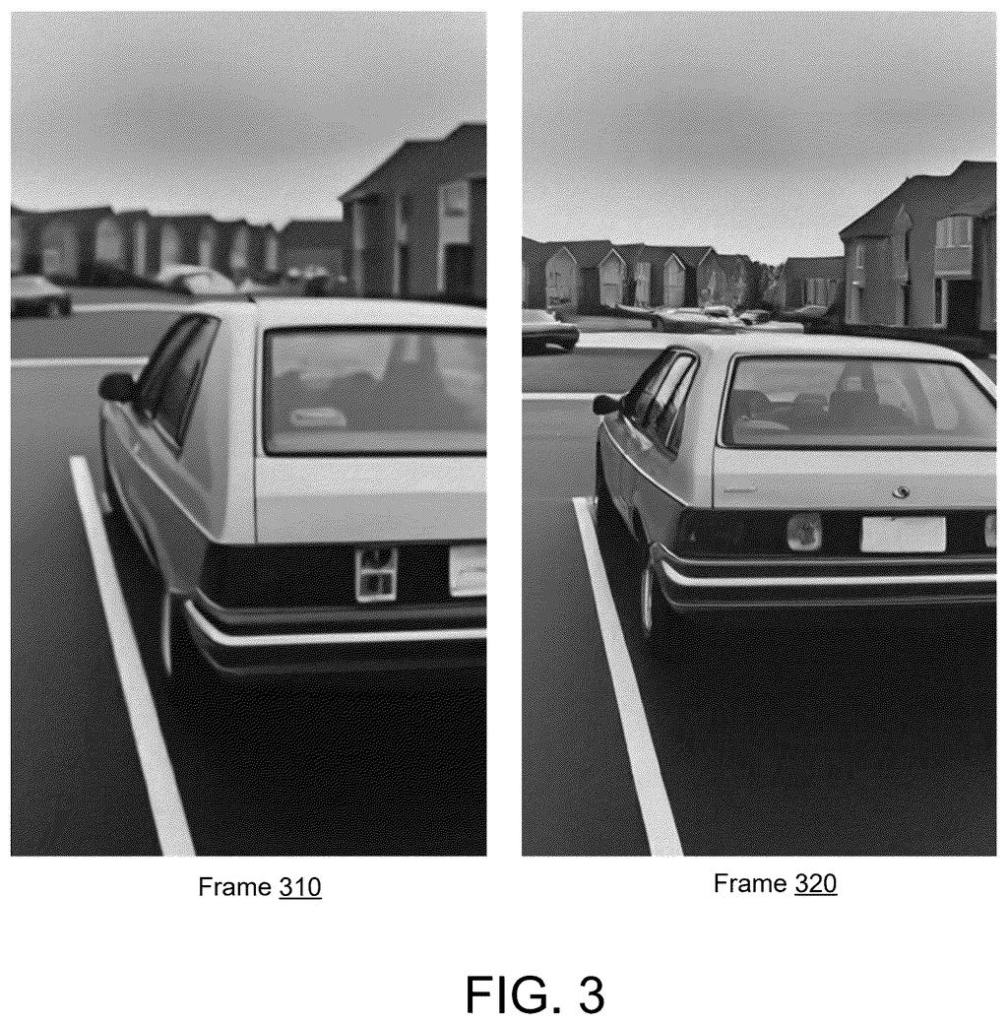
You type "a car pulling up to a parking space in a suburb in the 1980s" and an AI makes one still image. Now it has to turn that picture into a moving clip. Most AI video tools start at that image and only build forward, with each new chunk of frames based on the last one. Small flaws pile up, so the end of the clip turns blurry and the textures go flat.
Google's filing treats the starting image as the middle of the video instead of the beginning. The AI builds the "future" frames after it and the "past" frames before it, then stitches the two halves together in the right order. No frame ends up very far from the sharp original.
The filing also says the two halves can be made at the same time, which it describes as cutting the wait for a clip roughly in half.
obtaining a reference video frame; generating, using a video generation neural network and conditioned on the reference video frame, a first forward segment of the video …
Translation: The system starts with a single photo and uses artificial intelligence to create new scenes that come after it.
How Google builds video outward from one frame
The system starts with a reference frame, which can be a real photo or an image the AI makes from a text prompt. A video-generating neural network (software trained on huge amounts of video to predict what frames come next) then produces a forward segment of frames right after that image and a backward segment of frames right before it.
Each direction can repeat. After the first batch, the system makes another batch by looking at the last few frames it just produced (the filing gives examples of three, five or ten). This step-by-step style is called autoregressive generation. For the backward direction, the system works in reverse time order, feeding in the "later" frames to guess the "earlier" ones.
Because the two directions don't depend on each other, they can run on separate sets of AI chips at once. The filing also describes:
- Direction-specific tuning: small add-on layers (LoRA, a lightweight way to adjust a model without retraining all of it) trained on reversed video, so the backward frames flow naturally into the forward ones.
- Sharpening: a second model that raises the resolution, working outward from the sharp reference frame in both directions.
- Assembly: the backward frames are flipped back into normal order and joined to the forward frames. The original frame can be dropped to avoid a visible glitch at the seam.
… generating, using the video generation neural network and conditioned on the reference video frame, a first backward segment of the video, wherein the first backward segment comprises a second number of video frames immediately prior to the reference video frame …
Translation: The same technology creates earlier video frames to show what happened just before that starting photo.
Why sharper, faster AI video matters for Google
If you use AI video tools, the pitch is simple: clips that stay sharper for longer and show up faster. In Google's own test, 450 text prompts were turned into videos and shown to human reviewers, three per prompt. Most saw similar match between prompt and video, but about 30% said the bidirectional version looked better overall. That is a modest gain, not a dramatic one.
The filing also points to making game worlds and scenes, and to producing practice footage for training robots and other AI systems. On the legal side, the examiner's first review rejected the claims as filed, which is routine and usually followed by amendments. It does not mean the idea is dead.
Google's 82nd patent application we've tracked since May in our AI photo editing race watchlist builds on earlier work like erasing text from photos and fixing blurry photos.
Source: US 2026/0360054 A1 at the USPTO (PDF). Full patent text and figures are in the official publication.
Get our take in your Top Stories
Liked this breakdown? Add Patentlyze as a preferred source on Google, and our plain-English take shows up more often in your Top Stories the next time Google patent news breaks.
Add Patentlyze on Google
One click.
There are more where this came from
We read every patent application Big Tech publishes and send you the ones worth knowing. Plain English, free, every week.
The drawings · 5 sheets
5 drawing sheets from US 2026/0360054 A1 · click any drawing to enlarge


More from Google
All 1,079 Google patents →
More in AI / ML
All 2,637 AI / ML patents →
Microsoft
Microsoft Files Patent for AI That Rewrites What Speakers Said in Recorded Video
Nvidia
Nvidia Patents Camera Tuning That Fixes One Part of a Photo Without Wrecking the Rest
Adobe
Adobe Files Patent to Speed Up AI Repair of Blurry, Noisy Photos
Qualcomm
No comments yet