

Apple
Apple · Automotive · Filed Feb 27, 2026 · USPTO published Nov 12, 2026 · This week's release
Apple Files Patent for Setting Up a Digital Car Key With a Card Tap
Apple's filing starts with a plastic card that comes with your car and aims to end with a digital key on your phone, with no carmaker account in between.
- Publication number
- US 2026/0359401 A1(US20260359401A1)
- Applicant
- Apple, Inc.
- Filed · Published
- Feb 27, 2026 · Nov 12, 2026
- Inventors
- Matthias LERCH, Frank R. BAYERBACH, Li LI, Sven J. HOFMANN, Yogesh D. KARANDIKAR
- Status when we published
- Waiting for an examiner
- Document
- 25 claims
- US classification
- 713/190
- Parent application
- Claims priority from a provisional application 63887261 (filed Sep 24, 2025)
What Apple's car-key card tap actually does
Ever bought a new car, been handed a key fob that simply works, and then spent an evening wrestling with an app to get the same key onto your phone? That's the hassle this Apple filing is aimed at. Today, many carmakers make you create an account and install their app before you can even start.
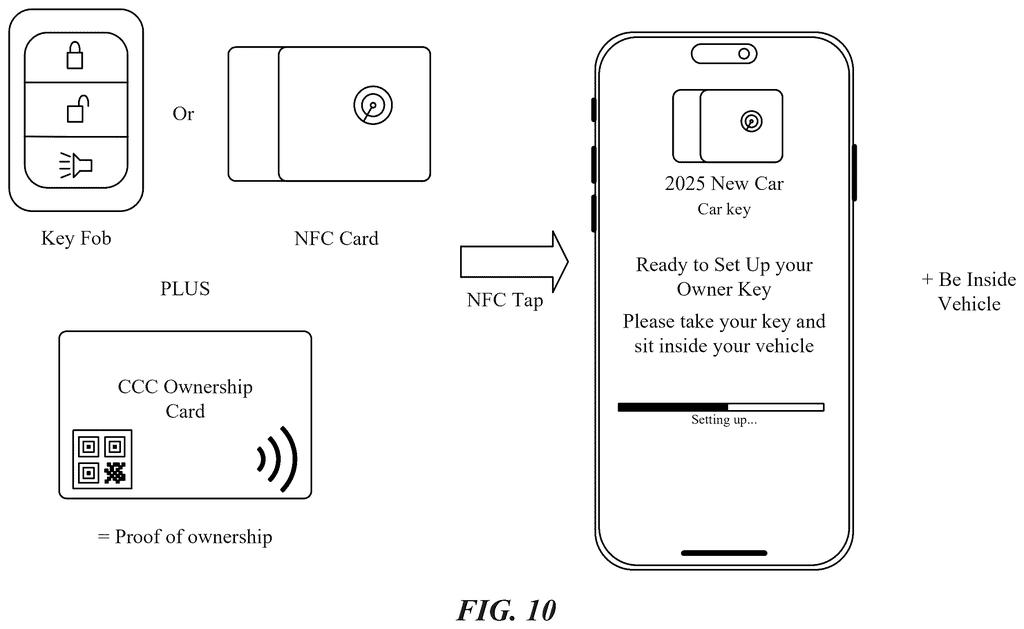
In the filing's main example, the starting point is a plastic ownership card that comes with the car. You hold your phone against it, and the card hands over a digital proof that it belongs to your specific car. Your phone passes that proof to the carmaker's server, which sends back a pairing code. The phone then uses that code to link up with the car.
The stated goal is a setup no harder than getting a regular key fob. Once you're paired, the carmaker's server can send your phone a digital key that unlocks the doors.
receiving, from a hardware component, a credential in conjunction with the device detecting the hardware component; in response to receiving the credential, sending, to a server separate from the device, the credential; after sending the credential, receiving, from the server, a pairing code corresponding to another device …
Translation: Your phone gets security data from a physical card tap and sends it to a server to get a pairing code.
How the card, the server and the car trade codes
The first claim is a short chain of steps run by your phone. When the phone detects a hardware component (in the main example, an NFC tag, a tiny chip that talks to a phone held a few inches away), it receives a credential, meaning a piece of digitally signed data. In the description, the card's chip holds a secret key and a certificate tied to the car's vehicle identification number, so the data shows this card belongs to this car.
- The phone sends the credential to a server, which in the main example belongs to the carmaker.
- The server replies with a pairing code, a string of characters that can be tucked inside a web link and is meant for the car.
- The phone uses that code to start pairing with the car.
The other claims and the description add safeguards. The phone can send its own identifier so the code is tied to your device. The server can hand out a short-lived one-time number (a nonce, valid for roughly 15 to 60 seconds) so a copied tap cannot be replayed. A QR code on the card can show on-screen instructions first, and after pairing the phone can confirm to the server and receive a digital credential for the car.
The present disclosure generally relates to pairing with a device. Some techniques are for obtaining a pairing code in accordance with some embodiments. Other techniques are for establishing different types of ownership …
Translation: The patent describes how devices connect to each other and prove who owns them.
Why setting up a digital car key is such a chore
For you, the payoff would be a car key on your phone without first creating an account with the carmaker or proving you own the car again and again. The filing's own background says setup is complicated compared with picking up a key fob, and that many automakers require an account and app before you can start. In this design, the card plus one key fob stands in as proof that the car is yours.
For carmakers, it shifts who controls the front door. The setup would run on its own, with the carmaker's account and app offered afterward as an optional extra. The description admits automakers may push back, and that legal or structural limits might force changes, so this reads as a proposal to talk through with them, not a finished design.
Apple's 666th filing in our Apple coverage since May adds to a run that includes handwritten note rewrapping and virtual hand jumping fixes.
Source: US 2026/0359401 A1 at the USPTO (PDF). Full patent text and figures are in the official publication.
Get our take in your Top Stories
Liked this breakdown? Add Patentlyze as a preferred source on Google, and our plain-English take shows up more often in your Top Stories the next time Apple patent news breaks.
Add Patentlyze on Google
One click.
There are more where this came from
We read every patent application Big Tech publishes and send you the ones worth knowing. Plain English, free, every week.
The drawings · 22 sheets
22 drawing sheets from US 2026/0359401 A1 · click any drawing to enlarge


Show the other 14 sheets


More from Apple
All 672 Apple patents →
More in Automotive
All 360 Automotive patents →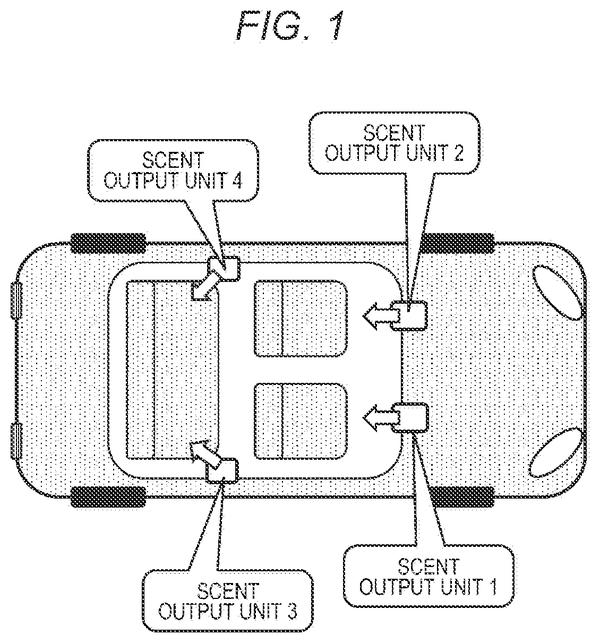
Sony
Sony Patents In-Car Scents That Match the Burger Ads You Drive Past
Tesla
Tesla Files Patent to Spray Car Seat Surfaces Instead of Sewing Them
Waymo (Google)
Waymo Files Patent for Freeze-Frame Replays of Its Self-Driving Car's Decisions
Intel
No comments yet