
Google
Google · AI / ML · Filed Jul 21, 2026 · USPTO published Nov 12, 2026 · This week's release
Google Files Patent for Saving Any Piece of Your Screen Into AI-Sorted Collections
Google's patent application describes a circle-to-save feature for your phone that clips part of any screen, remembers where it came from, and lets an AI sort your clips into collections for you.
- Publication number
- US 2026/0359368 A1(US20260359368A1)
- Applicant
- Google LLC
- Filed · Published
- Jul 21, 2026 · Nov 12, 2026
- Inventors
- Erin Shea Lynch, Clement Dickinson Wright, Rosemary Margaret La Prairie
- Status when we published
- Waiting for an examiner
- Document
- 20 claims
- US classification
- 707/722
- Parent application
- Continuation of 18/591,514 (filed Feb 29, 2024)(18591514)
What Google's circle-and-save snippets do
Ever screenshotted a pair of boots, a recipe, or a travel tip, then lost it in a camera roll full of other images? Google's patent application goes after that mess.
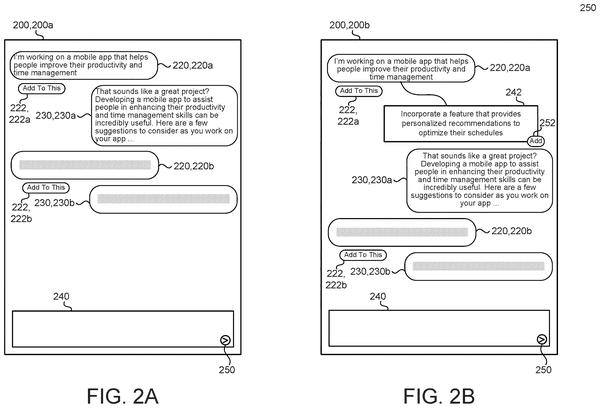
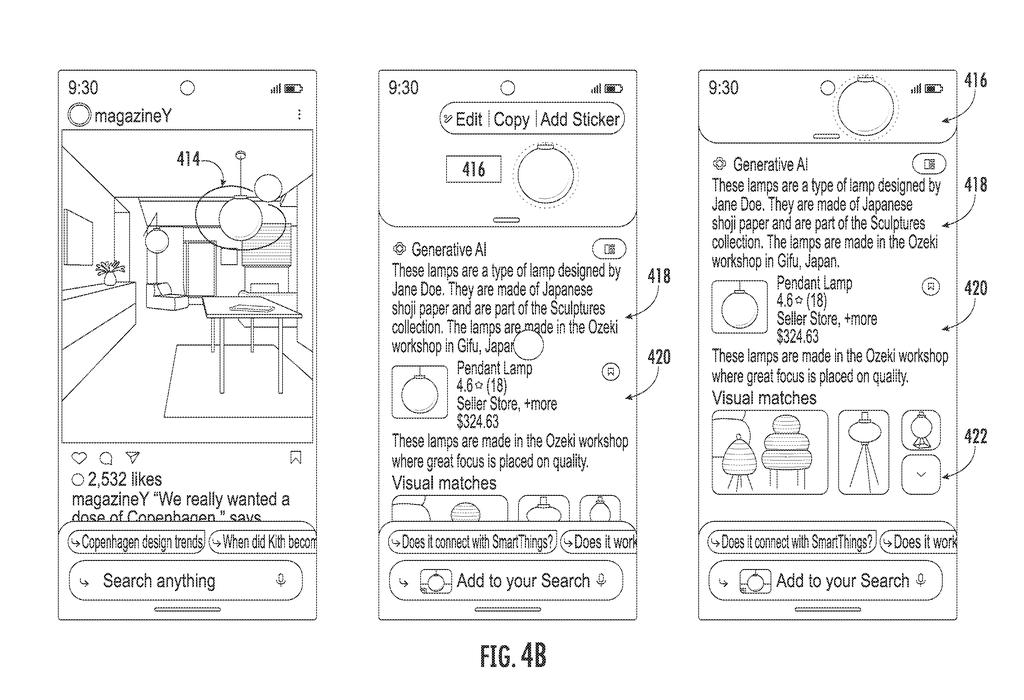
You would open an overlay that sits on top of any app on your phone, then circle or scribble over just the thing you care about. The phone saves that cutout along with where it came from, such as a web address or the app, so one tap later takes you back to the original spot.
Then an AI model looks at everything you have saved and groups related items together. All your boot finds could land in one collection with a label. The AI can also decide when to bring a saved snippet back, for example when your location, recent searches, or a calendar event suggest it is relevant.
obtaining, via an overlay interface at an operating system level of a user computing device, a user input and display data descriptive of content provided for display, wherein the user input is descriptive of a selection of a sub-portion of the content …
Translation: The system uses a systemwide screen overlay to let you highlight any piece of what you are looking at.
How the overlay captures a snippet and its source
The claims describe an overlay interface that runs at the operating system level (the core software that runs the phone), so it works across many different apps instead of just one. You select part of what is on screen with a tap, a lasso (circling it), or a scribble.
The system then builds a selected content dataset with two pieces. The visual piece is a small image of the cutout, which can be a bitmap, made with a segmentation model (software that outlines an object pixel by pixel). The source piece records where the content came from, such as a web address and an API call (a standard instruction that lets one program talk to another) for navigating back.
Next, the system pulls in your other saved snippets and feeds them, along with the new one, to a generative model (the same family of AI as large language models). The model produces a content grouping: the new snippet plus related older ones, tied together by a shared topic, task, or entity such as a particular product. The group appears in a collection interface, optionally with a label.
The filing also describes using context like time, location, and recent searches. The model could infer a proactive candidate search intent (a search you are predicted to want next) and surface a matching snippet or fresh results. Other variations tune a personalization model on your saved clips.
A generative model can be leveraged to categorize the content snippet, determine similar content, and determine when to surface the content snippet to a user.
Translation: An AI model automatically organizes your saved snippets and decides when to show them to you again.
Why this could replace your screenshot pile
The practical payoff is for anyone who saves things from their phone and never sees them again. Instead of a cropped screenshot with no context, you would get a clip that remembers its source and arrives already filed with similar finds. Sharing could also get lighter: the filing says a friend sees the picture first, then taps through to the original page, which avoids sending a whole web page.
It also shows how Google wants generative AI to work on your personal stuff, not just on web search. The tradeoff is data. The filing describes storing groupings alongside your search and browsing history, so the convenience comes with a more detailed picture of your interests.
Google's 94th filing in the AI assistant and agent patents we've tracked since May follows filings like cheaper long-document processing and on-device heat scaling.
Source: US 2026/0359368 A1 at the USPTO (PDF). Full patent text and figures are in the official publication.
Get our take in your Top Stories
Liked this breakdown? Add Patentlyze as a preferred source on Google, and our plain-English take shows up more often in your Top Stories the next time Google patent news breaks.
Add Patentlyze on Google
One click.
There are more where this came from
We read every patent application Big Tech publishes and send you the ones worth knowing. Plain English, free, every week.
The drawings · 39 sheets
39 drawing sheets from US 2026/0359368 A1 · click any drawing to enlarge


Show the other 31 sheets


More from Google
All 1,079 Google patents →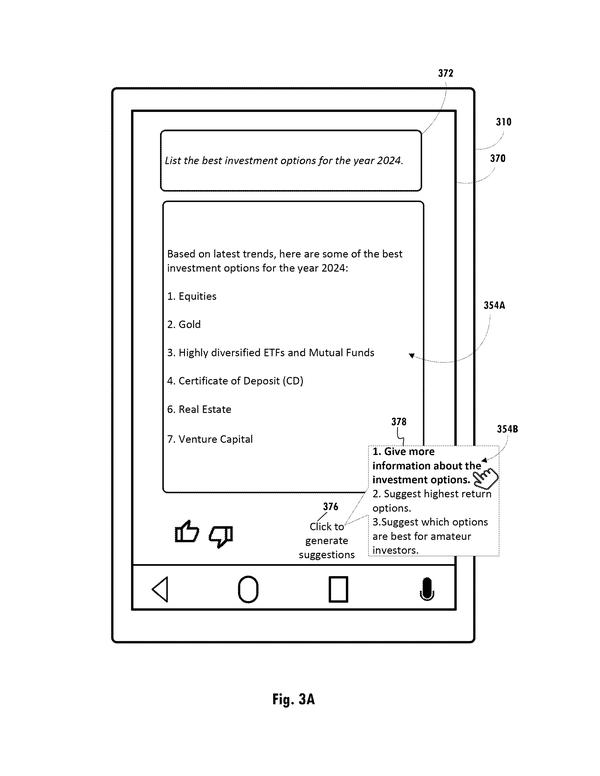

More in AI assistant & agent
All 413 AI assistant & agent patents →
IBM
IBM Patents a Memory-Saving Compression System for AI Text Generation
Microsoft
Microsoft Files Patent for an AI Assistant That Knows What's Open on Your Screen
Nvidia
Nvidia Patents Technology to Give Autonomous Software an Instant Briefing on Any Database

Microsoft
No comments yet