
Qualcomm
Qualcomm · AI / ML · Filed May 9, 2025 · USPTO published Nov 12, 2026 · This week's release
Qualcomm Files Patent for a Common-Phrase Cheat Sheet to Speed Up AI Replies
AI chatbots can speed up by guessing ahead, but the trick has little to work with at the start of a reply. Qualcomm's fix is a cheat sheet of common phrases.

- Publication number
- US 2026/0359566 A1(US20260359566A1)
- Applicant
- QUALCOMM Incorporated
- Filed · Published
- May 9, 2025 · Nov 12, 2026
- Inventors
- Apoorva Pushkar GOKHALE, Natarajan VAIDHYANATHAN
- Status when we published
- Waiting for an examiner
- Document
- 20 claims
- US classification
- 704/9
- Examiner
- GAY, SONIA L (Art Unit 2657)
What Qualcomm's phrase-table patent actually does
You ask an AI assistant to summarize a long article, and the answer crawls out a few words at a time. That's because big language models write in small chunks, and each chunk takes a lot of computing.
One speed-up trick uses a cheap helper that guesses upcoming words while the big model checks the guesses in bulk. A common way to guess is to look back through your request and the reply so far for repeated phrases. The catch: at the start of an answer, there's almost nothing to look back at.
Qualcomm's patent application adds a fallback cheat sheet. It's a table of common phrases and what usually comes next, built from public text like books, articles, code and chat. When your conversation gives no clues, the helper checks the table instead of giving up.
perform a first lookup for the one or more draft tokens within the input using a first lookup function associated with the draft model; upon determining that the first lookup satisfies a first condition, perform a second lookup for the one or more draft tokens within a lookup table associated with the draft model using a second lookup function …
Translation: The system searches the original input and then checks a special reference table if needed.
How the fallback table fills in the first guesses
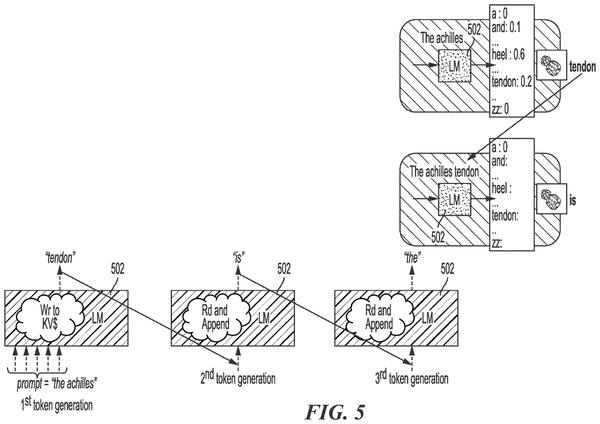
The patent speeds up speculative decoding: a small, cheap helper (the draft model) guesses the next few chunks of text, called tokens, and the big model (the target model) checks all the guesses at once and keeps the good ones.
Here the helper is a search routine. It looks for the latest run of tokens (an n-gram) elsewhere in your prompt or the reply so far and copies what followed. Early in a reply there is little to search, which the filing calls a 'cold start.'
The addition is a second search that runs when the first meets a condition, such as finding no match. It checks a lookup table built ahead of time from public text:
- Each entry pairs a common n-gram with a likely continuation and how often it appears in the source text.
- The table is a two-level key-value layout, stored on disk and loaded into memory at run time.
- With several matches, the system can pick the most frequent one or choose by a set probability distribution.
If both searches come up empty, the helper sends padding tokens (an empty guess) and the big model carries on alone.
Why faster AI guessing matters on your phone
The practical point is speed and power. Every guess the big model gets to skip is computing, memory and heat you don't spend, and the filing names all three as costs of running large models. For you, that could mean chatbot answers that start flowing sooner, especially in the opening words, where the old shortcut had little to work with.
One claim mentions a mobile device, and the description lists parts common in phones, such as an NPU (a chip built for AI tasks), Wi-Fi and 5G. It also says the helper and the big model can run on different machines, like a portable device and a server. The filing gives no numbers for how much faster this gets, so the size of the gain is unknown.
Qualcomm's 68th filing we've tracked since July in the AI chip wars adds to a run that includes one skipping repeated context and one sending key update parts first.
Source: US 2026/0359566 A1 at the USPTO (PDF). Full patent text and figures are in the official publication.
Get our take in your Top Stories
Liked this breakdown? Add Patentlyze as a preferred source on Google, and our plain-English take shows up more often in your Top Stories the next time Qualcomm patent news breaks.
Add Patentlyze on Google
One click.
There are more where this came from
We read every patent application Big Tech publishes and send you the ones worth knowing. Plain English, free, every week.
The drawings · 5 sheets
5 drawing sheets from US 2026/0359566 A1 · click any drawing to enlarge


More from Qualcomm
All 624 Qualcomm patents →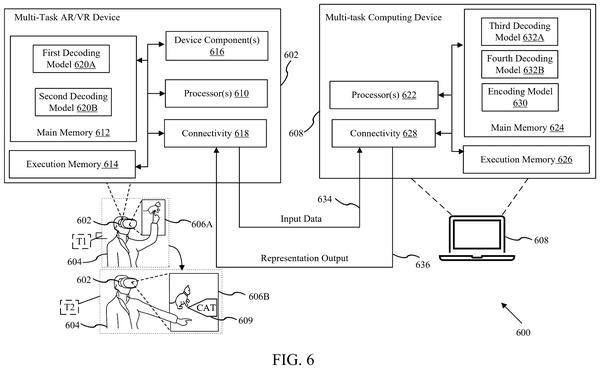
More in AI assistant & agent
All 413 AI assistant & agent patents →
Microsoft
Microsoft Files Patent for Rounding AI Numbers More Carefully to Speed Up Chatbots
Nvidia
Nvidia Patents a Way to Run Two AI Networks at Once to Speed Up Text Generation
Samsung
Samsung Files Patent for Keeping AI Chatbots Quick When Many People Ask at Once
Nvidia
No comments yet