
IBM Patents a Context-Aware Query Rewriting System for RAG
RAG systems are only as good as the question you ask them — and most questions are underspecified. IBM's new patent tackles that problem by automatically rewriting your query before it ever hits the retrieval layer.
How IBM's query rewriting fixes bad RAG results
Imagine asking a colleague a half-formed question — something like "what's the status on that thing from last month?" Without context, they'd have no idea what you mean. AI search tools that use Retrieval-Augmented Generation (RAG) — where the model pulls in relevant documents before answering — face the same problem constantly. Vague or poorly worded queries return irrelevant chunks, and the final answer suffers.
IBM's patent describes a system that acts like a very patient assistant who asks clarifying questions for you — automatically. Before your query hits the retrieval engine, the system figures out what you probably mean, pulls in relevant background context, and extracts the most important keywords.
It then rewrites your original query into a cleaner, more specific version — and that refined query is what actually gets run against the RAG system. The idea is that better inputs lead to better retrieved documents, which leads to better final answers. It's a pre-processing layer sitting in front of your AI search.
How contextualization and keyword extraction reshape the query
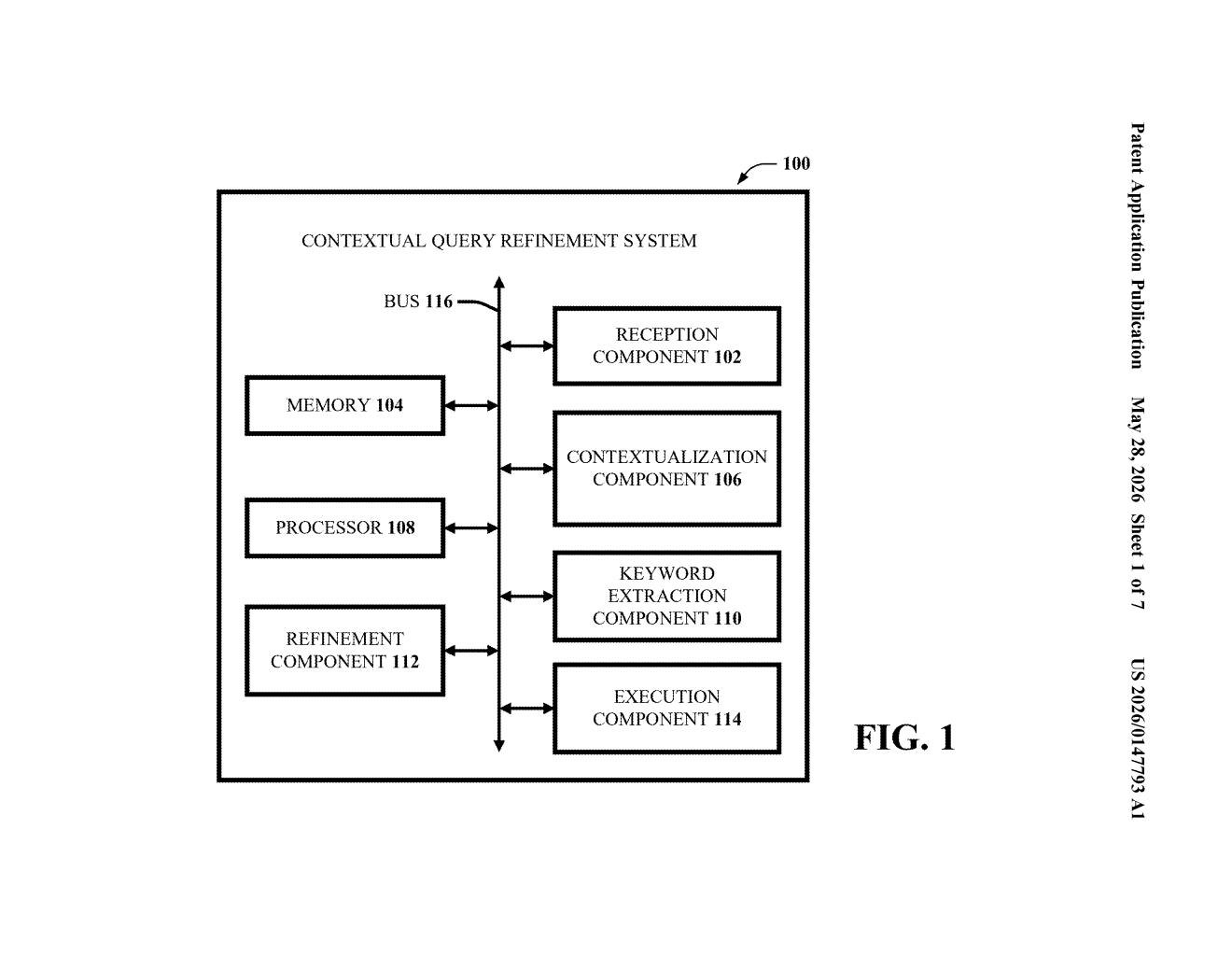
The patent describes a pipeline of five modular components that work together to improve RAG query quality:
- Reception component: accepts the raw incoming query from the user.
- Contextualization component: analyzes the query to identify its broader context — what topic area it belongs to, what background knowledge is relevant — then summarizes that background information.
- Keyword extraction component: uses a natural language processor (NLP) — software that understands human language structure — to pull out the most semantically important terms from the now-contextualized query.
- Refinement component: combines the summarized background and the extracted keywords to generate a new, improved query. This is the core transformation step.
- Execution component: takes the refined query and runs it through the actual RAG system (Retrieval-Augmented Generation — a technique where an LLM retrieves relevant documents from a knowledge base before generating an answer).
The key insight is that the original user query never directly hits the retrieval layer. It's always preprocessed first. The claim is broad enough to cover the general architecture without specifying exactly how the contextualization or keyword extraction are implemented, which gives IBM flexibility in how the system gets built.
What this means for enterprise AI search quality
For enterprise AI deployments — think internal knowledge bases, customer support bots, or document search tools — RAG is already the dominant pattern for grounding LLM answers in real company data. But poor retrieval remains the most common failure mode. If the retrieved chunks are wrong, the answer is wrong, no matter how capable the underlying model is.
A query rewriting layer like this could meaningfully improve retrieval precision without requiring users to learn how to prompt better. You'd just ask your question naturally and the system would handle the rest. That's a real usability win for non-technical enterprise users who aren't going to learn prompt engineering.
This is a practical, incremental improvement to an already well-understood problem in the RAG ecosystem — query rewriting isn't a new idea, and several open-source tools already do variants of it. What IBM is doing here is packaging it into a claimable system architecture. It's not flashy research; it's defensive IP positioning in a space IBM's Watson and watsonx teams clearly care about. Worth noting if you're building enterprise RAG systems, but not a technical leap.
There are more where this came from
We read every patent application Big Tech publishes and send you the ones worth knowing. Plain English, free, every week.
Want this weekly breakdown for a company we don't cover? Patentlyze Pro →