
Google Patents an AI That Learns to Draw Your Specific Subject, Not Just Any One
Most AI image generators can draw 'a dog' — but they can't draw *your* dog. Google's patent describes a training method that lets a diffusion model learn the difference, and reproduce the same specific subject every time you ask.
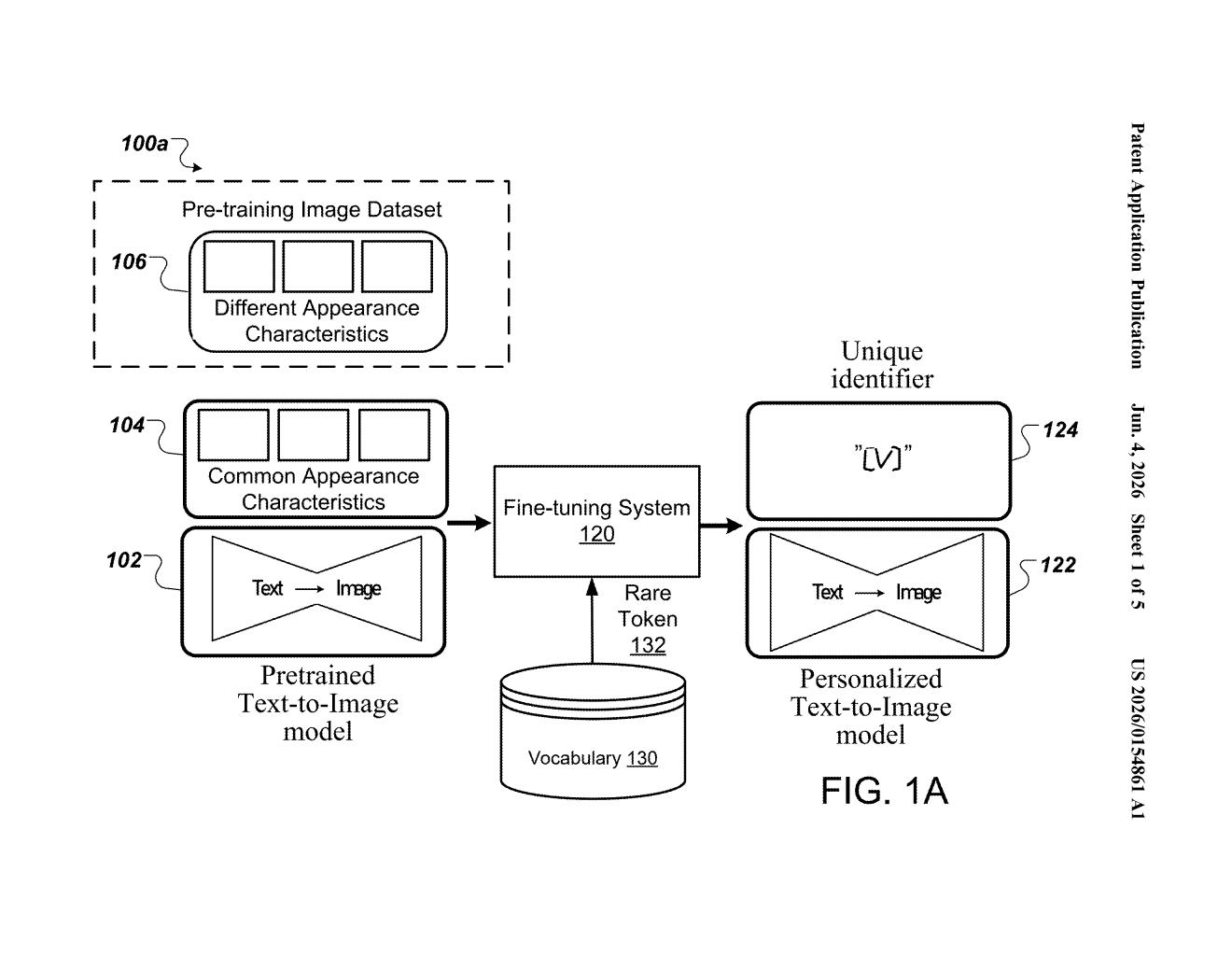
What Google's personalized image generator actually does
Imagine you want an AI to generate a photo of your pet corgi wearing a astronaut suit. Today's tools will give you some corgi — not yours. Google's patent tackles exactly that frustration.
The idea is to train an image model with a special unique identifier — a kind of secret keyword tied to a specific subject (your actual dog, your couch, a particular sneaker). When you use the regular word like 'dog,' the model draws a generic one. When you include the unique identifier, it reproduces that exact subject in whatever new scene you describe.
This creates two modes in the same model: a general creative mode and a locked-in personal mode. You get the flexibility of a full image generator and the ability to anchor it to something real and specific that matters to you.
How the unique identifier locks onto one specific subject
The patent describes a training methodology for text-to-image diffusion models (the class of AI behind tools like Stable Diffusion and Imagen) that gives the model a dual capability.
During training, the model is exposed to a small set of images depicting one specific subject instance — say, a particular chair or a specific person's face. A unique identifier (a rare token or special string) is paired with that subject. The model learns two behaviors simultaneously:
- When given the general class name (e.g., 'chair'), generate varied, generic images of that class.
- When given the unique identifier + class name, reproduce that same specific subject in new contexts, poses, or styles.
The core challenge the patent addresses is language drift — the risk that fine-tuning on a subject corrupts the model's broader understanding of the object class. By tying the subject to a unique token rather than the class name itself, the model preserves general knowledge while adding the personalized capability on top.
This approach is closely related to the published research technique known as DreamBooth, which several of these same inventors co-authored, suggesting this patent is the formal IP claim around that line of work.
What this means for AI-generated personal content
For consumers, this is the difference between 'generate an image of a birthday cake' and 'generate an image of my birthday cake in a tropical setting.' The practical applications range from personalized greeting cards and product visualization to recreating a pet, a piece of furniture, or a person's likeness in generated scenes — the kind of use case that would fit naturally into Google Photos or a future creative suite.
For the broader AI image industry, Google staking a formal patent claim here is notable. The DreamBooth technique is already widely implemented in open-source tools. A granted patent on the training methodology could give Google leverage over how personalized fine-tuning is commercialized across the ecosystem.
This is Google formally planting a flag on DreamBooth-style personalization, which has been one of the most practically useful AI image techniques since it was published. The first independent claim being canceled is a procedural footnote — the publication still signals that Google intends to own this space. Given how directly this maps to consumer products like Google Photos and Pixel's AI editing features, it's worth tracking.
There are more where this came from
We read every patent application Big Tech publishes and send you the ones worth knowing. Plain English, free, every week.
Want this weekly breakdown for a company we don't cover? Patentlyze Pro →