
Amazon Patents a System That Adjusts Alexa's Tone and Style Mid-Conversation
Imagine Alexa sensing that you're frustrated and automatically switching to shorter, calmer responses — no settings menu required. That's roughly what Amazon is patenting here.
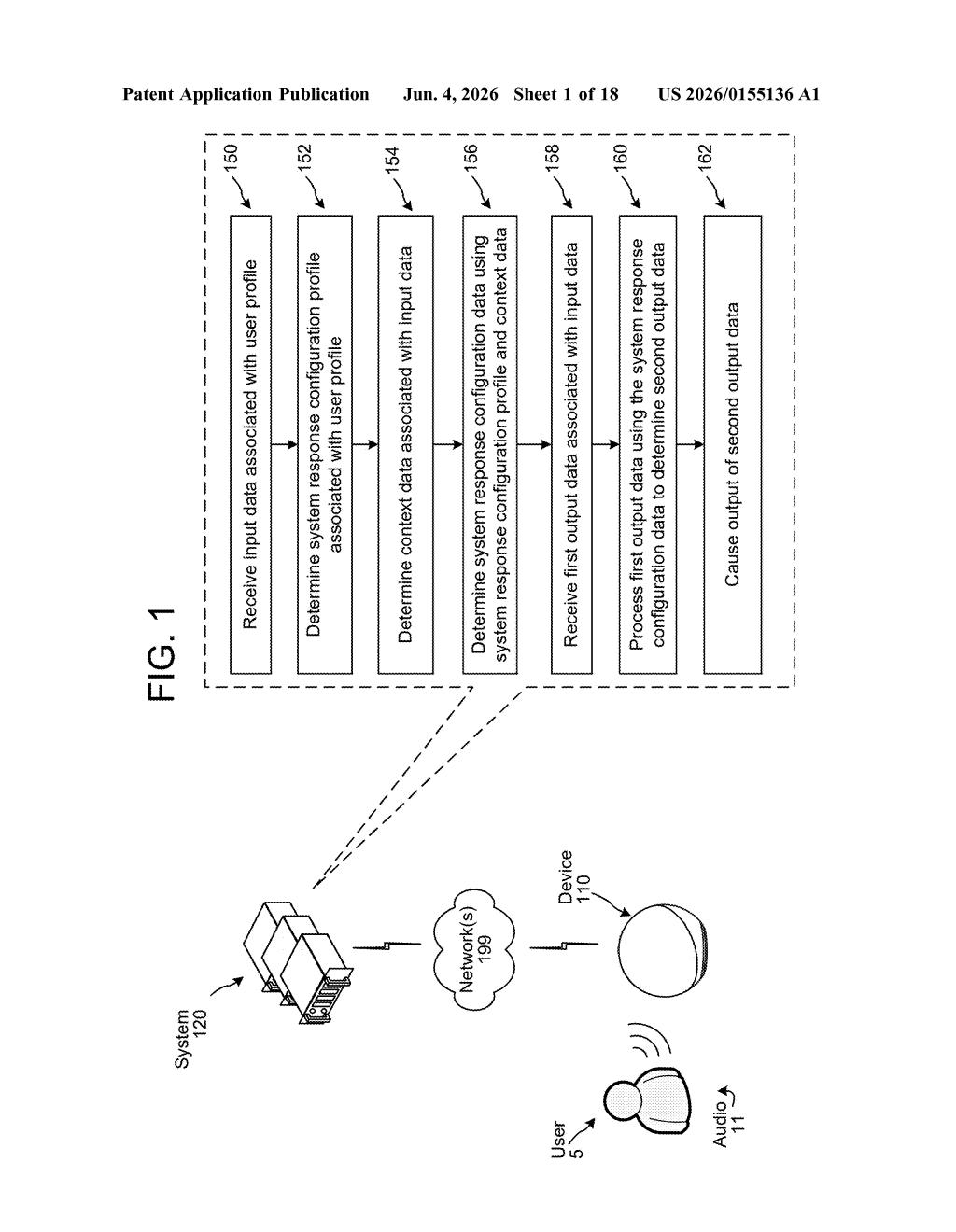
What Amazon's adaptive voice response system actually does
Right now, voice assistants like Alexa respond pretty much the same way every time: same pacing, same verbosity, same general tone. Amazon's new patent describes a system that would change that by reading the context of your conversation and adjusting how it responds on the fly.
Think of it like a skilled customer service rep who gives you a quick one-liner when you're clearly in a hurry, but slows down and walks you through every step when you sound confused. The system would pick from pre-set "profiles" — bundles of settings for things like response length, tone, and speech timing — and swap between them based on what it detects during your conversation.
The key word in the patent is dynamic: this isn't just picking a profile at setup and sticking with it. The system can shift mid-dialog, meaning the same conversation could start casual and get more formal (or vice versa) depending on how things unfold.
How context and sentiment reshape the output pipeline
The patent describes a pipeline that sits between a user's spoken or typed input and the final response the assistant delivers. At each turn in the conversation, the system pulls together context data (what's been said so far, what task is being performed, environmental signals) and sentiment data (an inference about the user's emotional state or urgency level) to select or modify a system response configuration.
That configuration is basically a bundle of output attributes — things like:
- Response verbosity (brief vs. detailed)
- Speech rate and prosody (the rhythm and stress patterns in synthesized voice)
- Formality or register of the generated text
- Timing of when output is delivered
The system maps that configuration to both the natural language generation (NLG) layer — which writes the words — and the text-to-speech (TTS) layer — which speaks them. Both components consume the same configuration object, so the written content and how it's read aloud stay in sync.
Crucially, the patent frames this as a "first quality" determination, implying the system can recalibrate on subsequent turns. This makes it a real-time feedback loop rather than a one-time personalization step.
What this means for Alexa and conversational AI products
For everyday Alexa users, the immediate implication is a more contextually aware assistant — one that doesn't read out a five-sentence answer when you're clearly rushing out the door, or respond curtly when you're confused and need hand-holding. Personalization without configuration is a meaningful UX goal, and this patent is a concrete engineering description of how to get there.
Strategically, this kind of system matters as Amazon tries to position Alexa against increasingly capable LLM-based assistants. A dynamically tuned response layer could become a differentiator in emotionally sensitive use cases — accessibility tools, elderly care devices, or customer service deployments — where a one-size-fits-all tone is a real liability.
This is a well-scoped, practical patent — not flashy AI research, but the kind of infrastructure work that actually makes assistants feel less robotic. The fact that it unifies configuration across both NLG and TTS is the interesting detail: most response-tuning work treats them as separate problems. Whether Amazon ships this as a discrete Alexa feature or folds it into a broader model update, it's a real problem being solved in a sensible way.
There are more where this came from
We read every patent application Big Tech publishes and send you the ones worth knowing. Plain English, free, every week.
Want this weekly breakdown for a company we don't cover? Patentlyze Pro →