Latest AI patents, Page 194
How the biggest tech companies are building AI: language models, assistants and agents, vision, voice, and the systems that train them. The artificial intelligence and machine learning patent applications we have broken down from the companies we track, newest first.
- in the Nov 12 release
- 96
- in November so far
- 188
- filings tracked
- 2,637
- sub-topics
- 10
Recent filings
Newest first · 2,637 total-
Nvidia · Published May 28
Nvidia Patents a Method for Mining Richer Embeddings from Decoder Hidden Layers
Most AI systems treat the encoder's output as the only useful representation of data — Nvidia's new patent says the decoder's internal hidden states are actually a goldmine worth tapping.
-
Nvidia · Published May 28
Nvidia Patents a Foundation Model for Zero-Shot Stereo Depth Estimation
Nvidia is patenting a depth-estimation model that can figure out how far away objects are from a pair of cameras — without being trained specifically for that camera setup or scene. That's the "zero-shot" part, and it's a meaningful engineering goal for robotics and autonomous systems.
-
Nvidia · Published May 28
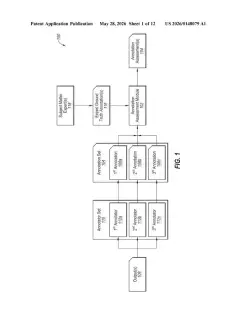
Nvidia Patents a System for Grading Its Own AI Output Annotators
If you're training an AI model, the quality of its training data is only as good as the people — or AI tools — labeling it. Nvidia is patenting a system that watches the watchers, automatically grading the annotators who grade AI outputs.
-
Nvidia · Published May 28
Nvidia Patents a Parallel Attention-SSM Fusion Architecture for Faster Language Models
Nvidia is patenting an architecture that runs two fundamentally different AI memory mechanisms — attention heads and state space models — side by side in parallel, then fuses their outputs. The goal: get the best of both worlds without doubling the cost.
-
Nvidia · Published May 28
Nvidia Patents a Scaling System to Fix Float16 Overflow in Neural Network Training
Training a neural network in reduced precision is a constant balancing act — go too low and your numbers either explode or vanish. Nvidia's new patent describes a systematic way to catch and correct that before it happens.
-
Nvidia · Published May 28
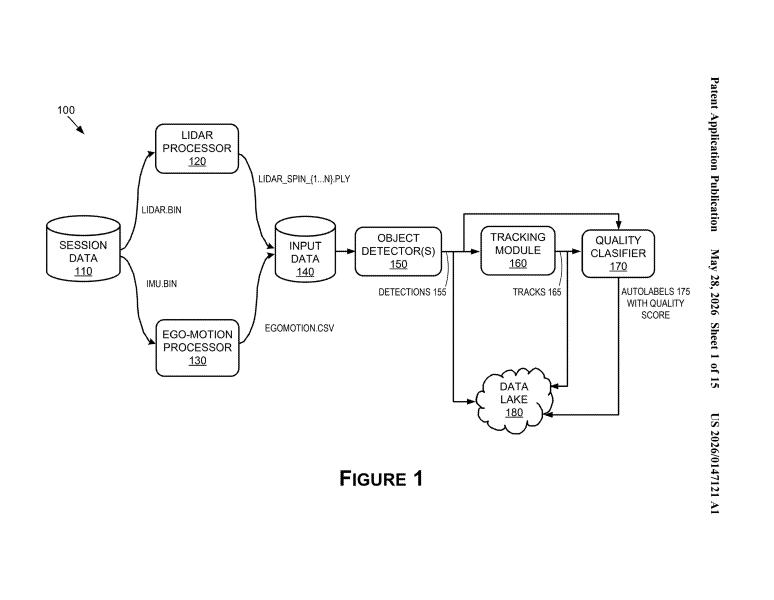
Nvidia Patents an AI Pipeline That Labels Its Own Self-Driving Training Data
Training a self-driving AI requires millions of labeled sensor frames — and labeling them by hand is slow and expensive. Nvidia's new patent describes a system where the AI essentially grades its own homework, flagging only the tricky cases for human reviewers.
-
Nvidia · Published May 28
Nvidia Patents a User-Configurable Compiler System for Agentic AI Pipelines
Most AI infrastructure tools give you a black box — you plug in your agent pipeline and hope for the best. Nvidia's new patent describes a system where you can actually dial in performance trade-offs and have the compiler reshape your AI agent's execution graph accordingly.
-
Nvidia · Published May 28
Nvidia Patents a Unified Training Framework That Merges Two Types of AI Learning
Most AI models are trained to either generate content or classify it — rarely both at once. Nvidia's new patent describes a training framework that unifies those two goals into a single learning loop.
-
Nvidia · Published May 28
Nvidia Patents a Progressive Difficulty Training Loop for Robot Control AI
Training a robot AI on tasks that are too hard from the start is a recipe for failure — so Nvidia's latest patent borrows a trick from human education: start easy, raise the bar only when the student is ready.
-
Nvidia · Published May 28
Nvidia Patents a Neural Network That Reconstructs Missing Medical Scans
What if a hospital only has a patient's MRI but needs a CT scan to make a treatment decision? Nvidia is patenting an AI system that can synthesize the missing scan from the ones that already exist.
-
Nvidia · Published May 28
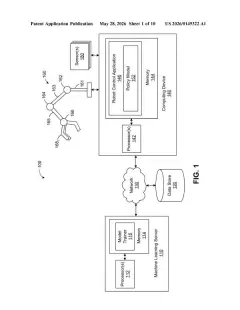
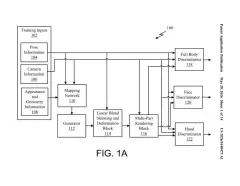
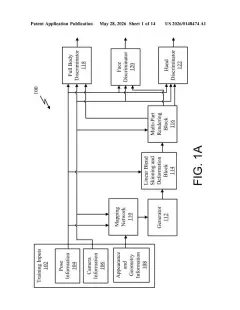
Nvidia Patents a Foundation Model for Generating Full-Body 3D Digital Humans
Nvidia is working on a single AI model that can generate a complete, photorealistic 3D human — face, hands, full body — trained almost entirely on ordinary 2D photos scraped from the internet, no 3D studio required.
-
Nvidia · Published May 28
Nvidia Patents a 3D Digital Human Foundation Model Built From 2D Photos
Nvidia is working on a system that can take ordinary, uncontrolled 2D photos — the kind scraped from the internet — and use them to train a generative model capable of producing detailed, poseable 3D digital humans, complete with face and hand detail.