
Apple
Apple · Software · Filed Apr 13, 2026 · USPTO published Nov 19, 2026 · This week's release
Apple Files Patent for Browser Tabs That Sort Themselves Into Named Groups
Apple filed a patent application for a tool that sorts your open tabs into named groups, and it pays attention to which page you opened from which. It also tries hard not to move a tab once you've learned where it lives.
- Publication number
- US 2026/0367761 A1(US20260367761A1)
- Applicant
- Apple Inc.
- Filed · Published
- Apr 13, 2026 · Nov 19, 2026
- Inventors
- Conrad A. SHULTZ, Mahrusuddin KAZI, Yongjun ZHANG, Rachel R. GINSBERG, Kevin W. TURNER, Remy M. DEMAREST, Ansh SHUKLA, Kristin MCLAUGHLIN, Matthew R. GILLIGAN, Sanjana K. AITHAL, Xianda ZHOU, Berkay BARLAS, Charles H. YING, Craig M. FEDERIGHI, Jonathan R. DASCOLA, Luming YIN, Samantha LIU, Stephen O. LEMAY, Steven J. FALKENBURG, Tanmoy PANIGRAHI, Trevor STEVENSON, Waynar BOCANGEL CALDERON
- Status when we published
- Waiting for an examiner
- Document
- 13 claims
- US classification
- 715/765
- Parent application
- Claims priority from a provisional application 63805646 (filed May 14, 2025)
What Apple's self-sorting browser tabs do
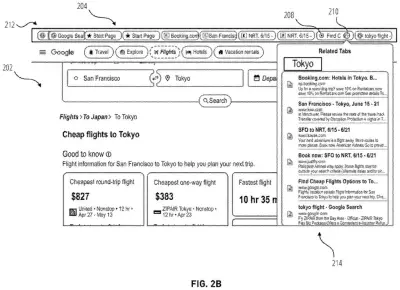
You're planning a trip to Tokyo, and your tab bar is a mess: flights, hotels, restaurant lists, a half-read blog post, plus the tabs from your actual work. Finding the one page with the flight details means clicking through them one by one.
Apple's patent application describes a tool that looks at what each open page is about and gathers related ones into a named group, sitting right in your tab bar. It also notices which page you opened from which, so the flight list and the specific flight page stay together. An AI model then writes a short title for the group.
The same idea works when you save a page: it suggests which bookmark folder fits, so you can save in one tap. Apple says the work happens on your device, so what you read stays there.
display a grouping of interface elements in a user interface panel, wherein the interface elements are visual representations for respective content items, wherein the grouping of interface elements is based on a semantic similarity among the respective content items …
Translation: The software automatically sorts open web tabs by how closely their topics match each other.
How Apple decides which tabs belong together
Apple's filing describes an organization service built into the operating system that watches what's open in a browser (or any app with tabs and windows). For each page, it creates an embedding (a string of numbers that captures what the page is about) and places it on a kind of map where pages with similar meaning land close together.
A clustering algorithm (a method for finding natural clumps in data) picks a center point for each clump, and pages within a set distance of it join the group. The twist is the source relationship: when a link on one page opens another page, that connection gets its own embedding too. This keeps flight, hotel and restaurant pages for one trip from splitting into three groups. A group only forms once it has enough tabs.
The filing also describes:
- An on-device AI language model that reads text from the grouped pages and returns a short title.
- Groups that collapse to just their title, with only one expanded at a time.
- Tabs that stay in their group until too many pile up ungrouped, you ask, or time passes. You are asked first, and the move is animated.
- Folder suggestions when you save a page, favoring bookmark folders, then reading list, then favorites.
… groups tabs and windows into collections based on content similarity, and assigns contextual names generated by AI.
Translation: Artificial intelligence will automatically organize your open tabs and give each group a smart title.
What this means for your tab bar and bookmarks
If you keep a dozen projects alive in one browser window, this is aimed squarely at you. A tab bar that organizes itself could make finding a page faster, and one-tap folder suggestions could end the habit of dumping everything into a general bookmarks folder you never open again.
The filing also says the service could be offered to other apps through a developer interface, including third-party ones, and that groups could span tabs, documents and PDFs across apps. Pieces of a group can also show up on your other devices, using only limited details like page titles and links. That points to a feature built into the system itself, not one browser.
That makes this Apple's 731st filing in our Apple coverage since May, adding to a run that includes draggable handwritten notes and polls from group chat questions.
Source: US 2026/0367761 A1 at the USPTO (PDF). Full patent text and figures are in the official publication.
Get our take in your Top Stories
Liked this breakdown? Add Patentlyze as a preferred source on Google, and our plain-English take shows up more often in your Top Stories the next time Apple patent news breaks.
Add Patentlyze on Google
One click.
There are more where this came from
We read every patent application Big Tech publishes and send you the ones worth knowing. Plain English, free, every week.
The drawings · 21 sheets
21 drawing sheets from US 2026/0367761 A1 · click any drawing to enlarge


Show the other 13 sheets


More from Apple
All 748 Apple patents →
More in Software
All 814 Software patents →
Adobe
Adobe Patents a Browser-Based Screen Recorder That Captures Only What You Choose
Microsoft
Microsoft Patents a Browser That Suggests Your Next Tab While You Browse
Samsung
Samsung Files Patent for a Browser That Spots Ads by Their Behavior
Samsung
No comments yet