
Apple Files Patent for Camera Effects That Jump From One Person to Another
Apple describes a camera effect that follows your hands and body, then leaps to another person when you point, throw, or pull. It treats a visual effect like a ball you can toss to a friend, even if that friend is in another room.
What Apple's pass-along camera effects do
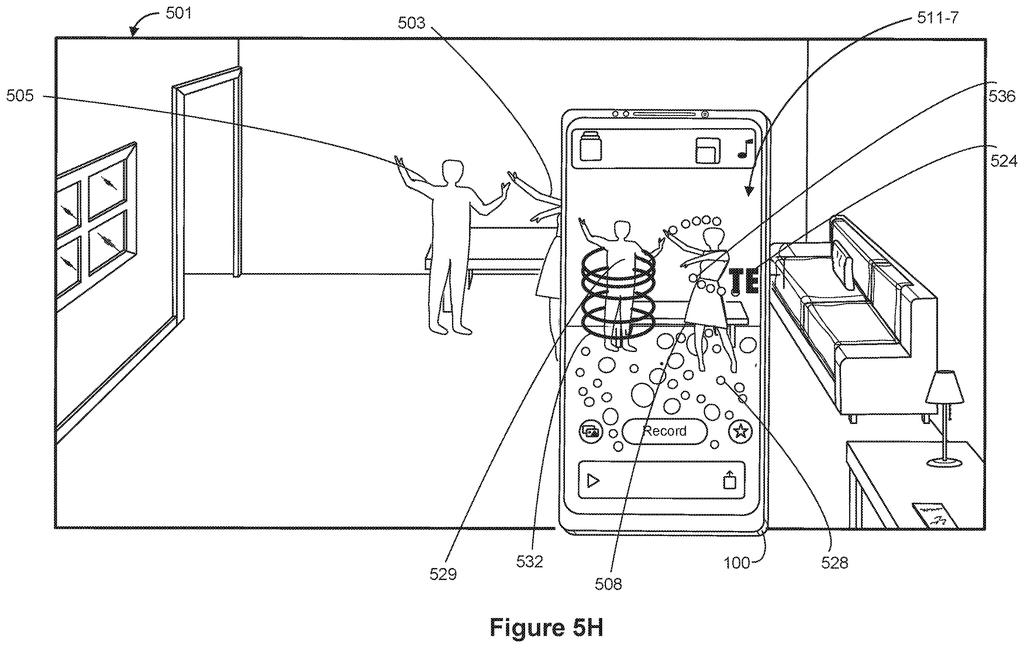
Imagine you and a friend are dancing in front of your phone's camera. Glowing rings circle around you, and bubbles trail from your hands as you wave. Then you point at your friend, and the rings slide off you and start circling them instead.
That is the scene Apple describes in this patent application. The device watches the camera view, spots a person, and tracks how their hands, arms or whole body move. An effect appears near that person and is shaped by their movement. When a certain moment happens, like a pointing or throwing gesture, the effect jumps to a second person and starts following their motion.
The second person can be standing next to you, or on the other end of a live call.
… applies a first virtual effect to a first portion of a view of a three-dimensional environment with a first set of values for a first set of characteristics of the first virtual effect selected in accordance with tracking of movement of one or more portions of the first physical object …
Translation: The system adds a digital effect to a specific area and tracks how a person moves.
How the effect follows hands, then switches
The filing covers a method (a repeatable series of steps) for a device with a display and one or more cameras. It shows a live view of a three-dimensional environment that includes a moving person or object.
When a first event happens, the device places a virtual effect near that person. The effect's look is controlled by a set of characteristics (things like position, size or motion), and the values come from motion tracking. That means the camera follows individual body parts such as hands, arms or feet. The description contrasts this with segmentation (cutting a person's outline out of the background), which cannot tell how a hand moves inside that outline.
When a second event meets certain criteria, the effect moves:
- It appears near a second person or object, with new values based on that person's tracked movement.
- The description lists pointing, a throwing gesture, holding a pose, leaving the camera view, or the other person pulling toward themselves as example triggers.
- After the handoff, the first person's movements stop changing the effect, and it can later be passed back.
The two people can share a room or be in different places. The claims also cover showing this in a real-time communication session and visually highlighting whoever currently holds the effect.
What this means for Apple's Clips-style videos
If this became a feature, you would notice it most in video calls and short clips. Effects would stop being a fixed layer on top of your face and start acting like something you can throw, share or take turns with. Because the filing covers people in different places, a group call could pass one effect around the way you would pass a ball.
The description uses an app labeled Clips for its examples, with music playing, lyrics appearing near the dancers, and a record button. It also lists head-mounted displays among possible screens, so the same idea could reach headsets. It is a patent application, so none of this promises a product.
Apple's 573rd filing we've tracked since May adds to a run of headset comfort work that includes a motion sickness resize patent and one on skipping eye scans.
If you have ever filmed a dance clip or a silly video call with a friend, you know effects usually stick to one face or float over everyone the same way. A filter that hands itself to whoever you point at turns the effect into a prop in the game you are playing. You would notice it right away, because the effect reacts to the moment as it happens.
This filing continues an earlier application, and its claims are broad and focus on the order of steps. The text says nothing about how fast it would run or how many people it could follow at once.
Still, as a camera feature for parties and calls, the pass-along idea is easy to picture and fun to use. Few people would need a manual to figure it out.
Get our take in your Top Stories
Liked this breakdown? Add Patentlyze as a preferred source on Google, and our plain-English take shows up more often in your Top Stories the next time Apple patent news breaks.
There are more where this came from
We read every patent application Big Tech publishes and send you the ones worth knowing. Plain English, free, every week.
The drawings
30 drawing sheets from US 2026/0330782 A1 · click any drawing to enlarge


Show the other 22 sheets


Want this weekly breakdown for a company we don't cover? Patentlyze Pro →
Be the first to weigh in