
Apple
Apple · Security · Filed May 18, 2026 · USPTO published Nov 19, 2026 · This week's release
Apple Files Patent for Letting Airline Staff Make Your Luggage Tag Beep
Your lost suitcase is in an airline's hands, but the tag inside it only answers to you. Apple's filing describes a way to lend a worker just enough access to make it beep, while keeping that borrowed access useless whenever the tag is near your own devices.
- Publication number
- US 2026/0371036 A1(US20260371036A1)
- Applicant
- Apple Inc.
- Filed · Published
- May 18, 2026 · Nov 19, 2026
- Inventors
- Siva Ganesh Movva, John T. Perry
- Status when we published
- Waiting for an examiner
- Document
- 20 claims
- US classification
- 455/456.2
- Parent application
- Claims priority from a provisional application 63808458 (filed May 19, 2025)
What Apple's borrowed-link tag finding does
Today, the location tag in your suitcase answers to you and your own devices, and almost nobody else. That is by design, since a tag anyone could track would be a privacy problem. It also creates a snag: when an airline loses your bag, the person searching the baggage hall can't make the tag beep.
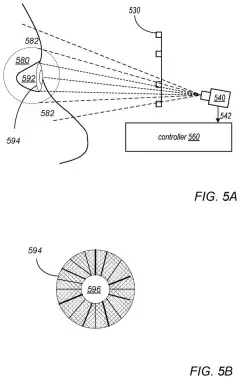
Apple's filing describes a workaround. At check-in you hand over a link, and the airline worker's phone uses it to look up part of the tag's identity. The phone then listens for the tag's Bluetooth broadcasts, recognizes it, connects, and can tell it to beep or show roughly how far away it is and in which direction.
The twist is a safety catch. The tag shares different pieces of its identity depending on whether it is near your own devices, so the borrowed information only works when the tag is away from you.
… initiating, by the electronic user device, a local finding operation with the portable device by: identifying, by the electronic user device, the portable device by matching at least a portion of the tracking identifier to an advertising message that is received at the electronic user device from the portable device …
Translation: The phone starts searching for the tag by matching its tracking code to nearby wireless signals.
How a helper's phone matches your tag
The claims start with a pointer rather than a password. The owner's device sends a network location identifier (in the example, a web link; the filing also lists a phone number or an internet address) to the helper's phone. The helper's phone uses it to ask a server for a tracking identifier, which is a piece of the tag's public key (its shareable cryptographic ID). One claim names the last six digits.
From there the phone runs a local finding operation:
- Match: it listens for the tag's Bluetooth advertising messages (short "I'm here" broadcasts) and looks for one containing that piece of the key.
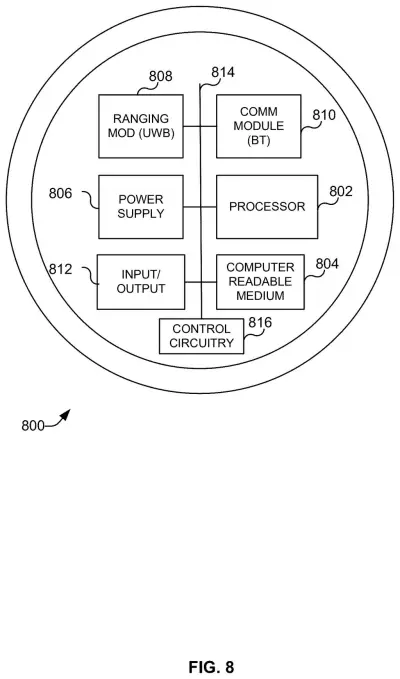
- Connect: it opens a Bluetooth link, using connection details in the broadcast such as a listening schedule and a signed token (digital proof of permission).
- Find: it can tell the tag to beep, vibrate or light up, measure distance and direction from signal timing and strength, and show an arrow or map position.
The safety catch comes from how the tag broadcasts. Near your own devices it sends only a partial key and rotates its ID about every 15 minutes. When it is away, it sends the full key or a different portion and changes ID about daily. A helper's borrowed piece of the key therefore matches only when the tag is away. One claim has the phone seeing the same identical message over more than fifteen minutes.
The local finding operation may include establishing a communication link with the portable device. The local finding operation may include communicating with the portable device to perform the local finding operation via the communication link.
Translation: Once the device is recognized, a direct connection is made to interact with it.
Why airlines and daycares are the use cases
For you, the practical gain is a lost item that other people can help search for without you handing over full control of it. The filing's examples are an airline employee hunting for a checked bag and a dog daycare worker trying to make a collar tag beep when a dog hides in a play area. In both cases the helper's phone can show distance and direction, not just a spot on a map.
The same filing also covers repairs. You could approve, from your own device, a technician's request to move a device's activation lock (the anti-theft lock tied to your account) to a replacement, so location features stay on while the device is out of your hands. It is a patent application, so none of this is a confirmed product.
This is the 677th Apple filing in our Apple coverage since May, adding to work like the screen-share identity check and the dual-SIM signal split.
Source: US 2026/0371036 A1 at the USPTO (PDF). Full patent text and figures are in the official publication.
Get our take in your Top Stories
Liked this breakdown? Add Patentlyze as a preferred source on Google, and our plain-English take shows up more often in your Top Stories the next time Apple patent news breaks.
Add Patentlyze on Google
One click.
There are more where this came from
We read every patent application Big Tech publishes and send you the ones worth knowing. Plain English, free, every week.
The drawings · 10 sheets
10 drawing sheets from US 2026/0371036 A1 · click any drawing to enlarge


Show the other 2 sheets


More from Apple
All 748 Apple patents →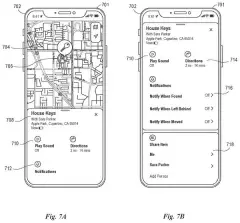
More in Security
All 353 Security patents →
Microsoft
Microsoft Files Patent for Telling a Gunshot From Its Echo in a City
Microsoft
Microsoft Patents a Method Giving Each Server Memory Section Its Own Encryption Key
Samsung
Samsung Files Patent for Fingerprint Unlocking That Still Works on Dry or Scarred Fingers
Nvidia
No comments yet