
Apple
Apple · Networking · Filed Jul 2, 2025 · USPTO published Nov 19, 2026 · This week's release
Apple Files Patent for Dual-SIM Phones That Split the Work of Hunting for a Signal
If your phone has two SIMs, it may be doing the same signal search twice and draining your battery for nothing. A new Apple patent application has one SIM do the looking and pass the results to the other.
- Publication number
- US 2026/0371228 A1(US20260371228A1)
- Applicant
- Apple Inc.
- Filed · Published
- Jul 2, 2025 · Nov 19, 2026
- Inventors
- Nirlesh KOSHTA, Pradeep PANGI, Karthik RAMAMURTHY, Shrinidhi RAMACHANDRA, Madhusudhan CHERIPALLY
- Status when we published
- Waiting for an examiner
- Document
- 20 claims
- US classification
- 370/329
- Parent application
- National Stage Entry of PCT/US2023/085892 (filed Dec 26, 2023)(PCTUS2023085892)
What Apple's shared signal search actually does
Ever land in a new country, check your phone, and watch the battery sink while it hunts for a signal? If you carry two SIMs or eSIMs (say, one for home and one for travel), your phone may be running two separate hunts for the same towers.
Apple's filing describes a simple division of labor. One SIM's modem (the part of the phone's software that talks to a carrier) does the search and tells the other one what it finds, as it finds it. The second SIM can skip its own search, or grab a better network the moment it's spotted.
The filing also covers a quieter chore. When the phone has no normal service, only one SIM needs to stay tuned for emergency alerts, such as earthquake and tsunami warnings. The other can stay asleep.
… prioritizing, by the second modem, a second PLMN search based on the PLMN search results, wherein the second modem delays or forgoes the second PLMN search until: the PLMN search by the first modem completes, or a highest priority PLMN for the second modem is reported by the first modem …
Translation: One modem waits to search for a network until the other modem finishes or finds a top choice.
How one SIM's search results feed the other
The patent covers phones where two SIMs or eSIMs are active at once, each tied to its own carrier and its own modem (a software stack that handles that subscription's connection). Today, each modem can run its own search for available networks, known as a PLMN search (a PLMN is just one carrier's network in one country). That duplicates work, especially when roaming or recovering from lost service.
In the main claim, the first modem tells the second modem when its search begins. It then scans the available radio technologies (5G, 4G, 3G, 2G) and frequency bands, and reports each network it finds along the way. The second modem delays or skips its own search until the first finishes, or until the first reports the highest-priority network for the second SIM. Then it can connect right away.
The description adds details:
- The first modem also reports which technologies and bands it covered, so the second modem only searches the gaps.
- If the first search is cut short, for example by a phone call, the second modem decides whether to run its own.
- Each SIM keeps its own priority list, so a network that suits one SIM may not suit the other.
Two other independent claims cover emergency alerts. When one modem is camped on a network, the second ignores the broadcast system messages (SIB-1) that announce alerts, and relies on the first to watch for them.
When a first modem of the wireless device is in a limited or normal service mode, the second modem ignores system information block (SIB) messages for emergency alerts and relies on the first modem for monitoring SIB messages and providing access to emergency services.
Translation: One modem handles all the emergency alerts so the other one can save power.
Why dual-SIM battery life gets a boost here
The payoff is battery life. Dual-SIM and eSIM phones are common for travelers and people who keep separate work and personal lines. The filing itself says battery performance matters a lot to those users, and searching for networks is a known drain when you are roaming or out of coverage. Sharing results could also get the second SIM onto a better network sooner.
The patent text names the iPhone, iPad, and Apple Watch as example devices. It does not announce a feature. It describes how the phone's cellular software could behave, and nothing in it tells you whether or when it might ship.
That makes this Apple's 675th filing in our Apple coverage since May, a corpus that spans ideas like radio-powered phones and smarter item trackers.
Source: US 2026/0371228 A1 at the USPTO (PDF). Full patent text and figures are in the official publication.
Get our take in your Top Stories
Liked this breakdown? Add Patentlyze as a preferred source on Google, and our plain-English take shows up more often in your Top Stories the next time Apple patent news breaks.
Add Patentlyze on Google
One click.
There are more where this came from
We read every patent application Big Tech publishes and send you the ones worth knowing. Plain English, free, every week.
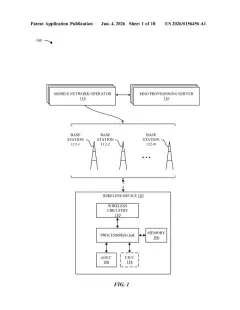
The drawings · 15 sheets
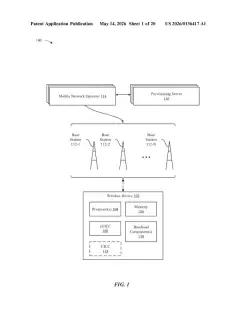
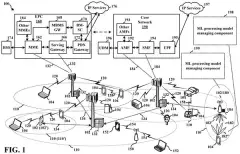
15 drawing sheets from US 2026/0371228 A1 · click any drawing to enlarge


Show the other 7 sheets


More from Apple
All 748 Apple patents →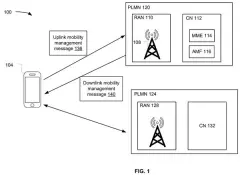
More in Networking
All 516 Networking patents →
Nvidia
Nvidia Files Patent for AI That Counts Phones Trying to Connect at Once
Qualcomm
Qualcomm Files Patent for Phones That Change How They Locate You by Area
Qualcomm
Qualcomm Patents a Phone That Predicts Whether Its Upload Will Get Through
Qualcomm
No comments yet