
Apple
Apple · Security · Filed Apr 17, 2026 · USPTO published Nov 19, 2026 · This week's release
Apple Files Patent to Confirm Screen-Share Requests on a Call Come From the Real Person
Adding a screen share to a phone call sounds simple, until you ask how your phone knows the request isn't from a faker. Apple's patent has a trusted identity server vouch for both sides first.
- Publication number
- US 2026/0371038 A1(US20260371038A1)
- Applicant
- APPLE INC.
- Filed · Published
- Apr 17, 2026 · Nov 19, 2026
- Inventors
- Preethi KONDURI, Justin R ETZINE, Adam Y SYED, Daniel B POLLACK, Pierre J DE FILIPPIS, Yi XU, Abigail Catriona SHILTS, Sean D HEFFERNAN
- Status when we published
- Waiting for an examiner
- Document
- 33 claims
- US classification
- 455/415
- Parent application
- Claims priority from a provisional application 63807781 (filed May 18, 2025)
What Apple's mid-call screen-share check does
Today, if you're on a phone call and want to show the other person something on your screen, your phone has to open a second connection alongside the call. That is where things get risky: caller ID can be faked, so how would the other phone know a sudden share request really comes from the person on the line?
Apple's patent hands the job to a trusted middleman. When you tap share, your phone passes the other person's phone number or email address to an identity service (the same kind of system that supports FaceTime and iMessage). That service sends the request to the other phone, which shows a prompt naming who is asking.
Only if they accept does the screen share begin, and you can keep switching between apps while they watch.
… referring a handle of a second device to the first communication session to an identity service, responsive to an indication that the second device has accepted a request from the identity service of a second communication session between the first and second device, transmitting content from the first device to the second device via the second communication session.
Translation: The system asks an identity service to verify the other device before any screen sharing is allowed to begin.
How the identity server vouches for your caller
The patent describes a way to add a second connection (a "share" session) on top of a call that is already running between two devices. The filing's claims cover the process from three angles: the phone that wants to share, the phone that receives the request, and the identity server in the middle.
The steps go roughly like this:
- During the call, the sharing phone gets a command to share its content.
- It sends the other phone's handle (an identifier such as a phone number or email address, which the call already gave it) to an identity service, a server that can confirm who devices are.
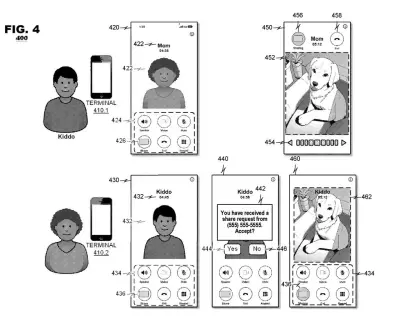
- The server sends a request to the other phone, including the sender's identifier. That phone shows a prompt with the name or number of whoever is asking.
- If the person accepts, the server helps both phones set up the new session.
The server's setup role can include swapping encryption settings (the scrambling that keeps the data private), swapping image encoding settings (how the screen is compressed for sending), and picking a relay server that passes the data along.
Once live, the sharing phone captures what is on its screen, compresses it, and sends it. The shared content can be one app window or the whole display, and a control on screen ends the share.
The identity service may communicate a request to the second device to establish the second communication session, which may include an identifier of the first device. If the request is accepted by the second device, the second communication session may be established between the devices.
Translation: A security check is sent to the receiving device so the user can explicitly approve the screen share request.
Why this matters for sharing screens on calls
If you've ever helped a parent fix their phone over a call, you know screen sharing is useful. The filing also points out the risk: a request that shows up mid-call needs to be trusted, and caller ID alone can be manipulated. Having a server both phones already rely on confirm who is asking could make you more comfortable saying yes.
The filing mentions that Apple's own identity service already supports FaceTime and iMessage, so the pieces for this kind of check exist in Apple's world. A patent application is not a product, though, and nothing here says when or whether it would show up on your phone.
That makes this Apple's 676th filing we've tracked in our Apple coverage since May, adding to work on radio-powered devices and split-signal dual-SIM phones.
Source: US 2026/0371038 A1 at the USPTO (PDF). Full patent text and figures are in the official publication.
Get our take in your Top Stories
Liked this breakdown? Add Patentlyze as a preferred source on Google, and our plain-English take shows up more often in your Top Stories the next time Apple patent news breaks.
Add Patentlyze on Google
One click.
There are more where this came from
We read every patent application Big Tech publishes and send you the ones worth knowing. Plain English, free, every week.
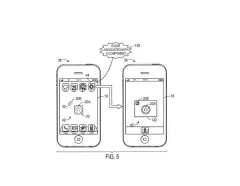
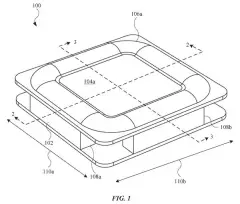
The drawings · 4 sheets
4 drawing sheets from US 2026/0371038 A1 · click any drawing to enlarge


More from Apple
All 748 Apple patents →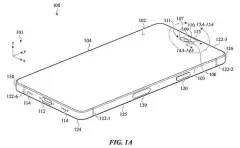
More in Security
All 353 Security patents →
Samsung
Samsung Files Patent for Fingerprint Unlocking That Still Works on Dry or Scarred Fingers
Nvidia
A New Nvidia Patent Lets Chip Buyers Claim Control of What Software Runs
IBM
IBM Files Patent for Turning Plain-English Requests Into Security Alert Rules
IBM
No comments yet