
Apple
Apple · Camera · Filed May 12, 2025 · USPTO published Nov 12, 2026 · This week's release
Apple Files Patent for a Flat, Zoned Lens That Wastes Less Light From Two Lasers
Two light sources sitting side by side never quite aim at the same spot, and the light that misses is thrown away. Apple's filing describes a single flat lens with three zones, each tuned to claw some of that light back.
- Publication number
- US 2026/0358689 A1(US20260358689A1)
- Applicant
- Apple Inc.
- Filed · Published
- May 12, 2025 · Nov 12, 2026
- Inventors
- Roei Remez, Assaf Avraham, Maoz Ovadia, Shay Keren-Zur, Refael Della Pergola
- Status when we published
- Waiting for an examiner
- Document
- 20 claims
- US classification
- 353/122
- Examiner
- CRUZ, MAGDA (Art Unit 2882)
What Apple's three-zone flat lens actually does
Today, a phone that wants to both map a room in 3D and light up a scene with an even glow usually needs two separate light sources. They sit side by side, so their beams point at slightly different areas. Only the overlap lands where the phone is actually looking, and the rest of the light is wasted.
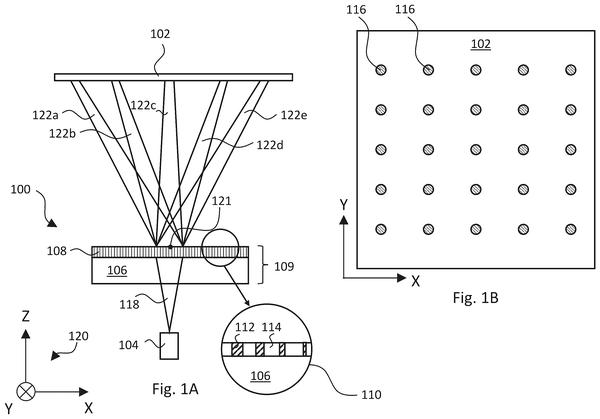
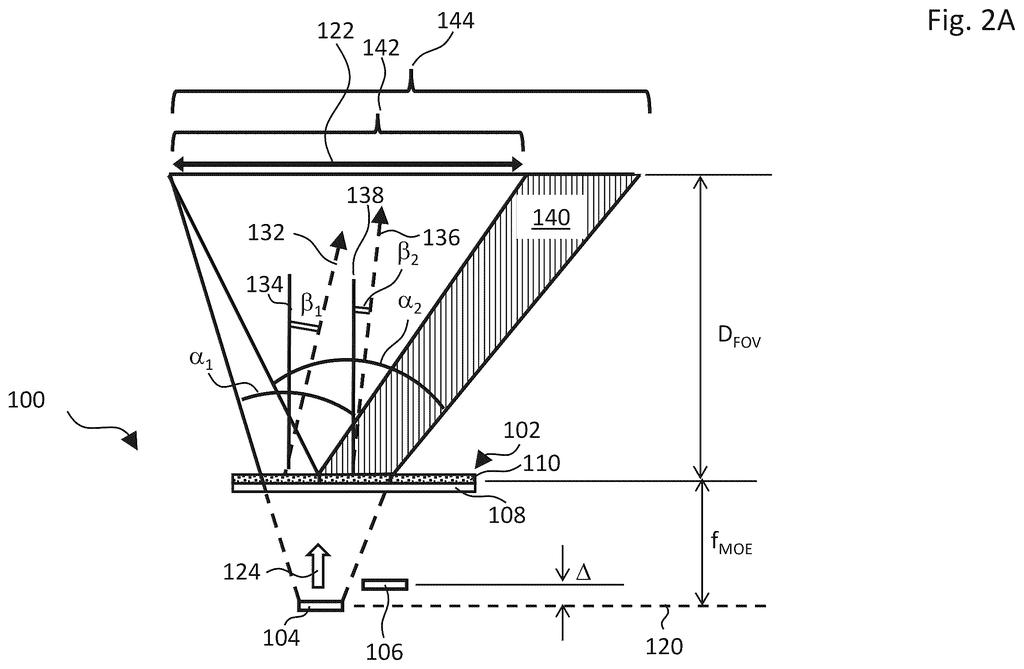
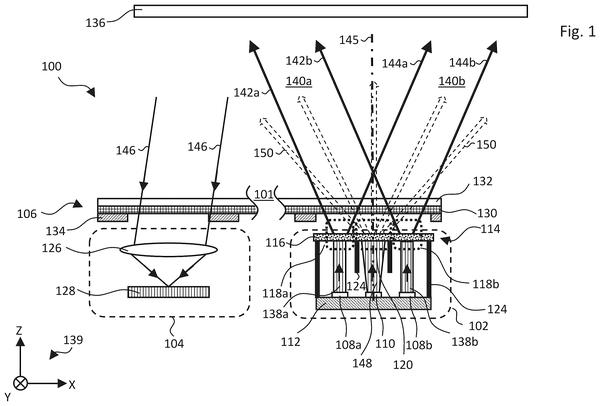
Apple's filing describes one thin, flat lens with three zones. The middle zone handles light from both sources. Each outer zone serves just one source and bends its light so it lands in the same field of view as the other's.
Only the middle zone still spills some light outside the target area. The payoff is one compact part instead of two separate lenses, and less wasted energy than a lens that treats every spot the same way.
… an optical metasurface disposed on the transparent substrate and comprising a central zone, which has a central angular response and coincides at least partially with the overlap region, and first and second peripheral zones, which have respective first and second angular responses, different from the central angular response …
Translation: A flat engineered surface handles light differently in the middle versus the edges to manage overlapping laser beams.
How the lens steers light from two lasers
The patent covers an illumination projector: two laser light sources mounted next to each other under one transparent plate. Each source sends its light through its own area of the plate, and those two areas partly overlap.
The plate carries a metasurface, a flat layer covered in microscopic pillars of different widths. The description says these are made by photolithography (the same printing-style process used for computer chips). The pillar sizes shape how light bends as it passes through, which is called the angular response (the range of directions the light gets sent into).
The metasurface has three zones:
- Central zone: sits over the overlap and handles light from both sources.
- Two peripheral zones: sit on either side, each mostly serving one source.
Each zone points its light at a different angle, and the central zone spreads its light wider. The angles and spreads are chosen so the light from the outer zones overlaps across the same field of view at a chosen distance.
In the main example, one laser array projects a dot pattern for 3D mapping and the other produces flood illumination (broad, even light). Only one mode runs at a time. The filing also says the zones can be designed so rays from different zones meet at the same point cleanly, which keeps the dot pattern sharp.
Why wasted light matters in a phone sensor
If you use a phone or headset that scans your face or maps the room around you, there is a small light projector inside doing the work. Wasted light there means wasted energy in a very tight space. The filing's pitch is a single compact part that does two jobs while throwing away less light than a uniform lens would.
The description names smartphones, AR and VR devices, smart watches and smart glasses as the kinds of gadgets that carry these projectors. It gives no performance numbers, so the size of the savings is unknown. The idea is aimed at packing more capability into less space, which matters most in wearables.
Apple's 71st filing we've tracked since May in the AR glasses race follows work on one fixing virtual hand jumps and virtual TVs casting colored light.
Source: US 2026/0358689 A1 at the USPTO (PDF). Full patent text and figures are in the official publication.
Get our take in your Top Stories
Liked this breakdown? Add Patentlyze as a preferred source on Google, and our plain-English take shows up more often in your Top Stories the next time Apple patent news breaks.
Add Patentlyze on Google
One click.
There are more where this came from
We read every patent application Big Tech publishes and send you the ones worth knowing. Plain English, free, every week.
The drawings · 6 sheets
6 drawing sheets from US 2026/0358689 A1 · click any drawing to enlarge


More from Apple
All 672 Apple patents →
More in Camera
All 268 Camera patents →
Samsung
Samsung Patents a Detachable Lens Cap That Keeps Unwanted Light Out of VR Headsets
Sony
Sony Files Patent to Track Your Body Between Camera Frames
Sony
Sony Patents a Way to Control a Camera Using Gestures From a Headset
Qualcomm
No comments yet