
Apple
Apple · Networking · Filed Feb 7, 2025 · USPTO published Nov 19, 2026 · This week's release
Apple Files Patent for Cellular Devices That Power Themselves From Radio Signals
Apple has filed a patent for a cellular device that can run on energy pulled out of radio signals, with no battery doing the work. The tricky part is getting the cell tower to talk to something with almost no power to spare.
- Publication number
- US 2026/0371257 A1(US20260371257A1)
- Applicant
- APPLE INC.
- Filed · Published
- Feb 7, 2025 · Nov 19, 2026
- Inventors
- Haitong Sun, Dawei Zhang, Alexander Sirotkin, Wei Zeng, Zhibin Wu, Haijing Hu, Mona Agnel, Sudeep Manithara Vamanan, Naveen Kumar R Palle Venkata
- Status when we published
- Waiting for an examiner
- Document
- 20 claims
- US classification
- 455/41.1
- Examiner
- WENDELL, ANDREW (Art Unit 2648)
- Parent application
- National Stage Entry of PCT/US2023/071889 (filed Aug 9, 2023)(PCTUS2023071889)
How Apple's radio-powered devices would work
Almost every wireless gadget you own has the same weak spot: a battery that has to be charged or replaced. For tiny sensors and tags spread around a building or warehouse, that chore adds up fast.
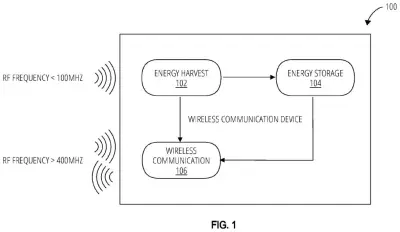
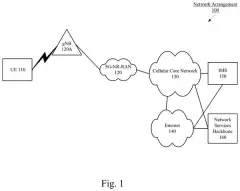
This Apple filing describes a device that powers itself from radio signals in the air. One part of the device collects energy from a low-frequency signal, which works best when the transmitter is nearby. A second part uses that energy to send and receive on a higher-frequency channel. An optional small battery can store some power for later.
The catch is that such a device has very little power to spend. So the filing has it tell the cell tower what type of device it is and how much energy it has left, and the tower then dials back things like speed and bandwidth to match.
determining, at the base station, that a user equipment (UE) is configured with a power class corresponding to an uplink (UL) transmit power for wireless communication using energy harvesting at the UE; …
Translation: The network checks if a device is set up to run on harvested energy.
How the device splits harvesting and talking
The main device claim has three parts. An energy harvest module collects power from incoming radio signals at a low frequency (at most 100 MHz), where the long wavelength suits catching energy from a nearby transmitter. A wireless communications module then uses that power to decode signals at a higher frequency (at least 400 MHz), which suits longer-distance communication. Keeping the two frequencies apart avoids interference. An optional energy storage unit, such as a battery, can hold some of the harvested power.
While running on harvested power, the device tells the network it is a low-power type, either by sending a device ID or a capability report (a message listing what the device can do). It is also limited to a single component carrier, meaning one channel at a time instead of several combined. One version caps total transmit power under 100 microwatts.
A second claim covers the tower side. The tower works out that a device is in this low-power class, then adjusts settings such as:
- How many parallel data streams (MIMO layers) the device handles
- Maximum bandwidth and data rate
- How often the device may transmit (its duty cycle)
- The modulation and coding scheme (how tightly data is packed into the signal)
The filing also adds two reports. A power headroom report says how much transmit power the device has to spare. An energy status report shares the device's stored energy level and the harvest frequency, signal strength and duration it would like.
… an energy harvest module coupled to the antenna and configured to receive the plurality of RF signals and to harvest energy from individual ones of the plurality of RF signals having near-field effect compatible carrier frequency.
Translation: An internal module captures power directly from nearby radio waves to run the device.
Why Apple's battery-free tags matter
The practical payoff would be gadgets that never need a battery swap or a charging cable. The description points to passive IoT devices (small connected sensors and tags) and names RFID tags as the technology to beat. Think of a sensor sealed inside a wall or a tag on a shipping crate, where changing a battery is a real chore.
The filing is written in the language of cellular standards, with power classes, device categories and reports that a tower and a device both have to understand. That suggests it is aimed at the rulebook that all phone networks follow, not at one Apple gadget. It also admits a limit: communication range may be restricted by how much energy a device can harvest.
That makes this Apple's 674th filing in our Apple coverage since May, adding to a run that includes the item tracker sleep idea and the folding hinge patent.
Source: US 2026/0371257 A1 at the USPTO (PDF). Full patent text and figures are in the official publication.
Get our take in your Top Stories
Liked this breakdown? Add Patentlyze as a preferred source on Google, and our plain-English take shows up more often in your Top Stories the next time Apple patent news breaks.
Add Patentlyze on Google
One click.
There are more where this came from
We read every patent application Big Tech publishes and send you the ones worth knowing. Plain English, free, every week.
The drawings · 9 sheets
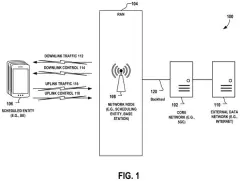
9 drawing sheets from US 2026/0371257 A1 · click any drawing to enlarge


Show the other 1 sheets

More from Apple
All 748 Apple patents →
More in Networking
All 516 Networking patents →
Google
Google Patents a Cellular Radio That Uses Sensor Data to Optimize Its Own Signals
Qualcomm
Qualcomm Patents Phones That Use Radio Signals as Radar and Report Back in Plain Words
Qualcomm
Qualcomm Files Patent for Radio Signals That Send Data and Detect Objects at Once
Qualcomm
No comments yet