
Apple
Apple · AI / ML · Filed Jul 22, 2026 · USPTO published Nov 19, 2026 · This week's release
Apple Patents a Voice Assistant That Waits Until You Finish Your Sentence
Ever noticed how a voice assistant answers the instant you take a breath? Apple's filing describes an assistant that reads the meaning of your words to decide whether you're really finished.
- Publication number
- US 2026/0369271 A1(US20260369271A1)
- Applicant
- Apple Inc.
- Filed · Published
- Jul 22, 2026 · Nov 19, 2026
- Inventors
- Angela H. LEE, Tien Dung T. TRAN, Nicholas L. TZOU, Garrett L. WEINBERG
- Status when we published
- Waiting for an examiner
- Document
- 20 claims
- US classification
- 704/275
- Parent application
- Continuation of 18/597,758 (filed Mar 6, 2024)(18597758)
What Apple's wait-for-you-to-finish assistant does
Ever had a voice assistant jump in the moment you paused to remember something? You say, 'Text Dana that I'll be there at...' and stop to check the time, and the assistant answers a half-finished thought.
This Apple filing goes after that problem. Instead of just listening for silence, the device reads the meaning of what you've said so far. If your request sounds complete, it answers. If it sounds unfinished, it stays quiet for a set stretch of time and keeps listening.
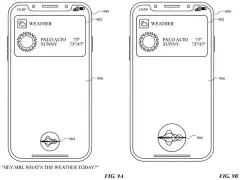
The filing also covers talking over the assistant. While it's answering, you can add a follow-up, and it combines your new words with the original request, with no wake word needed. It can also show a small on-screen element before you finish, so you can see whether it understood you.
in accordance with a determination, based on a semantic analysis of at least a portion of the audio stream, that a user request in the at least a portion of the audio stream is complete, provide a first response to the user request …
Translation: If the assistant understands that you finished your sentence, it will answer you right away.
How the assistant decides your request is done
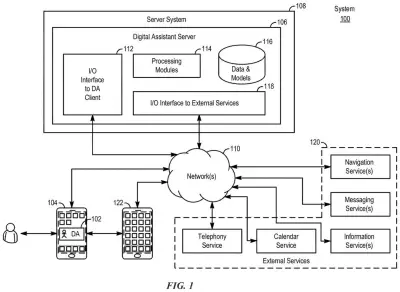
The claims cover a device with a microphone that takes in a continuous audio stream. While it is still listening, it runs a semantic analysis (a check on the meaning of the words, not just the gaps between them) on a chunk of that stream.
There are two branches. If the analysis says the request is complete, the device gives a response. If it says the request is incomplete, the device holds back any spoken reply for a predetermined duration. If the next chunk of audio still sounds unfinished, it waits again for another set stretch. The claims describe this as finding the request's endpoint, the spot where you stop asking.
The dependent claims add several extras:
- Talking over it: if you speak while the assistant is answering, within a set time and in the same voice, it builds a new response from your original request plus your new words. It can stop its first answer, and it does not need a wake word.
- Early on-screen feedback: for certain kinds of requests, it shows an on-screen element before you finish speaking.
- Manual endpoints: for some task types, it waits for you to signal the end yourself.
- Pause and resume: you can ask it to pause an answer and pick it up again later.
Why fewer interruptions matter for Apple's assistant
The practical win is fewer botched requests. If your assistant stops jumping in when you pause, you stop repeating yourself, and a longer, messier request (a message with a name, a time and a place) has a better chance of landing in one go. The filing itself ties the idea to fewer repeated requests and shorter back-and-forth exchanges.
The follow-up and early-display parts point to a more conversational assistant. You could correct it mid-answer, or glance at the screen to see whether it understood you before you finish speaking. The filing lists iPhone, Apple Watch, iPad, speakers and TVs as example devices, so the idea is not tied to one gadget.
This is the seventh Apple filing in voice and speech AI we've tracked since June, a group that includes work like knowing when you speak to it and voicemail AI that books appointments.
Source: US 2026/0369271 A1 at the USPTO (PDF). Full patent text and figures are in the official publication.
Get our take in your Top Stories
Liked this breakdown? Add Patentlyze as a preferred source on Google, and our plain-English take shows up more often in your Top Stories the next time Apple patent news breaks.
Add Patentlyze on Google
One click.
There are more where this came from
We read every patent application Big Tech publishes and send you the ones worth knowing. Plain English, free, every week.
The drawings · 20 sheets
20 drawing sheets from US 2026/0369271 A1 · click any drawing to enlarge


Show the other 12 sheets


More from Apple
All 748 Apple patents →
More in AI / ML
All 2,738 AI / ML patents →
Samsung
Samsung Patents a Voice Assistant That Responds Before You Finish Your Sentence
Samsung
Samsung Patents a Phone Assistant That Waits on Hold and Gets Firm in Your Voice
Samsung
Samsung Patents a Voice Assistant That Catches and Corrects Its Own Mistakes
Meta
No comments yet